
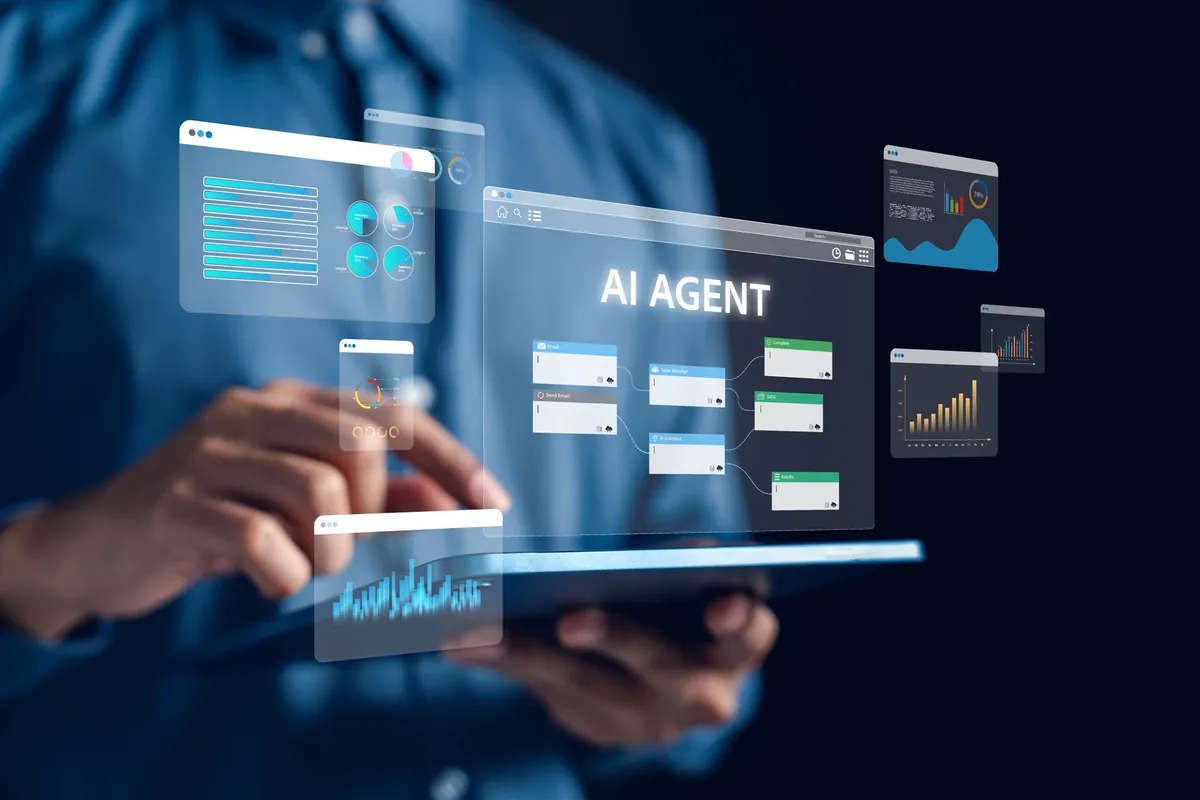
Agentic AI is a type of artificial intelligence that can independently plan, make decisions, use tools, and execute actions to achieve a specific goal with minimal human intervention.
Unlike traditional AI systems that wait for user instructions, Agentic AI can proactively determine the steps required to complete a task and execute those steps automatically.
Example
Traditional AI:
“Summarize this sales report.”
Agentic AI:
“Analyze sales data, identify growth opportunities, create a presentation, notify stakeholders, and schedule a review meeting.”
Instead of performing one task, Agentic AI manages an entire workflow.
Why Agentic AI Matters in 2026
Businesses today operate across dozens of software systems:
- CRM platforms
- ERP solutions
- Accounting software
- Marketing tools
- Customer support systems
- Project management applications
Employees often spend hours moving information between these systems manually.
Agentic AI acts as an intelligent coordinator that can connect multiple business tools, automate processes, and make workflow decisions in real time.
As businesses continue pursuing digital transformation, Agentic AI is becoming a competitive advantage rather than an experimental technology.
Agentic AI vs Traditional AI
| Feature | Traditional AI | Agentic AI |
| Purpose | Execute Commands | Achieve Goals |
| Planning | No | Yes |
| Multi-Step Tasks | Limited | Advanced |
| Decision Making | Rule-Based | Context-Aware |
| Tool Integration | Basic | Extensive |
| Adaptability | Low | High |
| Autonomy | Minimal | Significant |
| Workflow Management | No | Yes |
The key difference is that traditional AI performs tasks, while Agentic AI manages outcomes.
How Agentic AI Works
Most Agentic AI systems follow a four-step process:
1. Goal Understanding
The AI receives a business objective.
Example:
Increase qualified sales leads by 20%.
2. Planning
The AI develops a strategy and determines required actions.
3. Execution
The system interacts with tools, databases, APIs, and software applications.
4. Optimization
The AI evaluates outcomes and continuously improves future performance.
This ability to operate across multiple systems makes Agentic AI significantly more powerful than conventional automation tools.
Real-World Business Applications of Agentic AI
Customer Support Automation
AI agents can:
- Resolve common support requests
- Access customer records
- Create tickets automatically
- Escalate complex issues
- Follow up after resolution
Business Benefits
- Faster response times
- Lower support costs
- Improved customer satisfaction
Sales and Lead Generation
Agentic AI can:
- Identify potential customers
- Research companies
- Qualify leads
- Personalize outreach
- Schedule meetings
Sales teams spend less time on administrative work and more time closing deals.
Marketing Automation
Marketing departments use Agentic AI to:
- Generate content
- Create advertising campaigns
- Analyze customer behavior
- Optimize budgets
- Personalize customer journeys
This results in higher engagement and improved marketing ROI.
Human Resources
HR teams can leverage Agentic AI for:
- Resume screening
- Candidate evaluation
- Interview scheduling
- Employee onboarding
- Internal support services
This reduces administrative workload and accelerates hiring processes.
Finance and Accounting
Agentic AI can automate:
- Invoice processing
- Expense management
- Fraud detection
- Financial forecasting
- Budget analysis
Organizations gain greater financial visibility while reducing manual errors.
Software Development
Development teams use AI agents to:
- Generate code
- Review pull requests
- Create documentation
- Identify bugs
- Monitor deployments
This accelerates software delivery and improves development efficiency.
Key Benefits of Agentic AI for Businesses
Increased Productivity
Employees spend more time on strategic initiatives and less time on repetitive tasks.
Reduced Costs
Automation decreases operational expenses and improves resource allocation.
Faster Decision-Making
AI agents analyze large amounts of data in seconds.
Better Customer Experiences
Customers receive personalized support and faster service.
Continuous Operations
AI systems can operate 24/7 without interruption.
Improved Scalability
Businesses can grow without proportionally increasing staffing requirements.
Agentic AI Statistics for 2026
Organizations worldwide are increasing investments in AI-powered automation.
Industry research indicates:
- Enterprise AI adoption continues to grow rapidly across all major sectors.
- Businesses increasingly prioritize workflow automation and intelligent decision-making systems.
- AI-assisted operations are becoming a strategic priority for digital transformation initiatives.
- Customer service, sales, and software development remain among the fastest-growing AI adoption areas.
These trends suggest Agentic AI will become a standard feature in enterprise software over the next few years.
Potential Risks and Challenges
While Agentic AI offers significant advantages, organizations must address potential challenges.
Data Security
AI agents often access sensitive business information.
Businesses should implement:
- Strong authentication
- Encryption
- Access controls
- Security monitoring
Governance and Compliance
Organizations need clear policies regarding:
- AI permissions
- Human approval requirements
- Regulatory compliance
- Decision auditing
Accuracy and Reliability
AI systems may occasionally generate inaccurate recommendations.
Human oversight remains essential for high-impact decisions.
Integration Complexity
Older software systems may require modernization before Agentic AI can be fully deployed.
Expert Perspective
Many technology leaders view Agentic AI as the next major shift in enterprise software.
The evolution follows a clear progression:
- Manual Processes
- Business Automation
- Generative AI Assistants
- Agentic AI Systems
The future of business software is moving from tools that support employees to systems that actively collaborate with them.
Organizations that begin adopting Agentic AI today will likely gain significant competitive advantages in efficiency, innovation, and customer experience.
How Businesses Can Prepare for Agentic AI
Modernize Technology Infrastructure
Cloud-native and API-enabled systems provide the best foundation for AI adoption.
Improve Data Quality
AI systems depend on accurate and structured business data.
Identify Repetitive Workflows
Start by automating high-volume, repetitive processes.
Train Employees
Successful adoption requires employees to understand how to work alongside AI agents.
Start with Pilot Projects
Begin with small implementations before expanding organization-wide.
The Future of Business Software
By 2030, many business applications will include autonomous AI agents capable of managing entire workflows.
Future systems may:
- Automatically handle customer support requests
- Manage sales pipelines
- Optimize marketing campaigns
- Monitor business performance
- Generate strategic recommendations
Instead of employees operating software, software will increasingly operate itself under human supervision.
Frequently Asked Questions (FAQ)
What is Agentic AI?
Agentic AI is an artificial intelligence system capable of independently planning, reasoning, and executing tasks to achieve defined goals.
How is Agentic AI different from Generative AI?
Generative AI creates content such as text, images, and code. Agentic AI goes further by making decisions and executing actions across systems.
What industries can benefit from Agentic AI?
Healthcare, finance, retail, manufacturing, logistics, education, software development, marketing, and customer service can all benefit from Agentic AI.
Is Agentic AI safe for businesses?
Yes, when deployed with appropriate governance, security controls, monitoring systems, and human oversight.
Will Agentic AI replace employees?
Most experts believe Agentic AI will augment employees rather than replace them entirely. It automates repetitive tasks and enables workers to focus on higher-value activities.
What is the biggest advantage of Agentic AI?
Its ability to independently manage multi-step workflows and achieve business objectives with minimal human intervention.
Conclusion
Agentic AI represents one of the most important advancements in business software since the rise of cloud computing and automation platforms.
Unlike traditional AI systems that simply respond to commands, Agentic AI can understand objectives, create plans, make decisions, and execute complex workflows across multiple applications.
For businesses seeking greater efficiency, scalability, and innovation, Agentic AI is rapidly becoming a strategic necessity rather than a future possibility.
Organizations that invest in AI-ready infrastructure, high-quality data, and intelligent automation today will be best positioned to lead the next generation of digital transformation.