
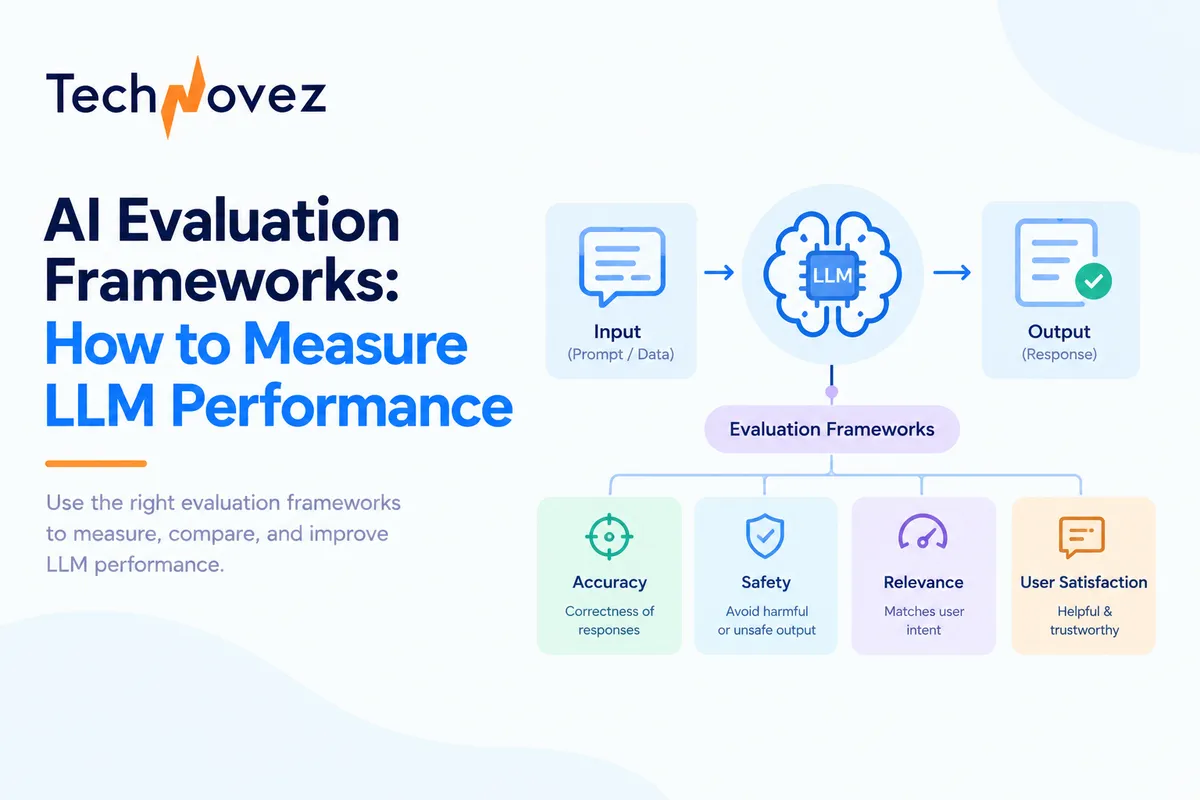
By the Technovez AI Engineering Team · Updated September 2026 · 9-minute read
Shipping a feature built on a large language model is easy. Knowing whether it actually works, and keeps working after the next prompt change or model upgrade, is much harder. That is the job of LLM evaluation. At Technovez, we build and test AI systems for companies across the United States and Europe, and the teams that succeed all have one thing in common: a repeatable LLM evaluation framework in place before launch, not after the first incident.
This guide explains how to measure LLM performance, which metrics and benchmarks matter, how the best AI evaluation frameworks compare, and how to run automated, continuous evaluation in production. If you would rather have experts set this up for you, explore our AI development and LLM engineering services.
| Quick answer: How do you measure LLM performance? | You measure LLM performance by defining task-specific success criteria, building a "golden" test dataset of real examples, scoring outputs with a mix of automated metrics, LLM-as-a-judge and human review, and then running those tests automatically in your CI/CD pipeline and continuously on live production traffic. Public benchmarks help you shortlist models, but only evaluation on your own data tells you whether your application is ready. |
Key takeaways
- LLM evaluation has three layers: model benchmarks, application-level testing, and production monitoring.
- The right LLM evaluation metrics combine quality (accuracy, faithfulness, relevance), safety (toxicity, PII leakage, jailbreak resistance) and operations (latency, cost).
- Open-source tools such as DeepEval, RAGAS and Promptfoo make automated LLM evaluation accessible to any team.
- For enterprises in the US and EU, documented evaluation is increasingly a governance requirement, not just good engineering.
What Is LLM Evaluation and Why Does It Matter?
LLM evaluation (also called AI model evaluation or generative AI evaluation) is the systematic process of measuring how well a large language model, or an application built on one, performs against defined criteria such as accuracy, relevance, safety, latency and cost.
It is important to separate two things. Model evaluation asks, "How capable is GPT, Claude, Gemini or Llama in general?" Application evaluation asks, "Does my customer-support bot answer my customers' questions correctly, safely and affordably?" Most business risk lives in the second question.
Evaluation matters for four reasons. LLMs are non-deterministic, so the same input can produce different outputs. They hallucinate confident but false answers. Small changes to prompts, retrieval or model versions can silently break behaviour. And regulators increasingly expect proof of testing: the EU AI Act sets testing, documentation and risk-management duties for high-risk AI systems, while the NIST AI Risk Management Framework in the US dedicates an entire "Measure" function to evaluation.
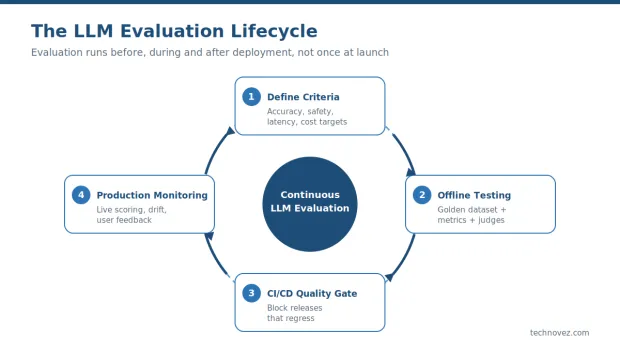
Figure 1: The LLM evaluation lifecycle: evaluation runs before, during and after deployment.
File: llm-evaluation-lifecycle.webp · Alt text: LLM evaluation lifecycle diagram showing define, test, deploy and monitor stages
The Three Layers of AI Model Evaluation
1. LLM benchmarks (model level)
LLM benchmarks are standardised public tests used to compare models. Common examples include MMLU for broad knowledge, GPQA for expert-level reasoning, SWE-bench for real-world coding, and Stanford's HELM for holistic comparison across many scenarios. Benchmarks are useful for shortlisting models, but they have limits: many are saturated at the top, some test data has leaked into training sets, and none of them reflect your specific users or documents.
2. Application-level evaluation (task level)
This is where you evaluate generative AI applications against your own use case, using a curated golden dataset of realistic inputs and expected outputs. It is the most important layer for product quality.
3. Production evaluation (live level)
Once deployed, you sample real traffic, score it automatically, collect user feedback and watch for drift. This is where continuous LLM evaluation lives.
LLM Evaluation Metrics That Actually Matter
There is no single number that captures AI model performance. Choose a small set of LLM evaluation metrics that map directly to business outcomes:
| Metric category | What it measures | Example metrics | Best for |
| Correctness | Is the answer right? | Exact match, F1, factual correctness, pass@k (code) | Q&A, extraction, coding |
| Faithfulness | Is the answer grounded in the source? | Hallucination rate, groundedness score | RAG, summarisation |
| Retrieval quality | Did the system fetch the right context? | Context precision, context recall, MRR | RAG pipelines |
| Relevance & helpfulness | Does it address the user's intent? | Answer relevance, rubric scores, CSAT | Chatbots, assistants |
| Safety & compliance | Is it harmful, biased or leaking data? | Toxicity, bias, PII leakage, jailbreak success rate | All customer-facing apps |
| Operational | Is it fast and affordable? | p95 latency, cost per request, token usage | All production systems |
If your product uses retrieval-augmented generation (RAG), always measure retrieval and generation separately, so you know whether a bad answer came from the wrong documents or from the model itself.
How to measure LLM accuracy
There are three practical approaches to measuring LLM accuracy and overall LLM quality evaluation:
- Reference-based scoring: compare output to a known correct answer using exact match, similarity or structured checks. Fast and cheap, but brittle for open-ended text.
- LLM-as-a-judge: a strong model grades outputs against a written rubric. It scales well, but you must calibrate it against human labels (aim for high agreement) and watch for bias toward longer or self-generated answers.
- Human evaluation: domain experts review a sample. It is the gold standard for nuance, and it should be used to validate your automated scores rather than replace them.
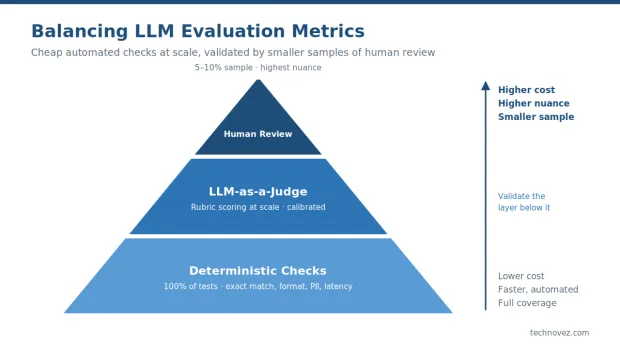
Figure 2: Balance cheap automated metrics at scale with smaller samples of expert human review.
File: llm-evaluation-metrics-pyramid.webp · Alt text: Pyramid of LLM evaluation metrics from automated checks to human review
Best LLM Evaluation Frameworks in 2026
The best AI evaluation frameworks fall into three groups: open-source testing libraries, observability and tracing platforms, and benchmark harnesses. Here is how the leading options compare:
| Framework | Type | Key strength | Best for |
| DeepEval | Open-source library | Pytest-style unit tests for LLMs, many built-in metrics | Developers adding tests to CI |
| RAGAS | Open-source library | Specialised RAG metrics (faithfulness, context recall) | RAG and knowledge assistants |
| Promptfoo | Open-source CLI | Prompt/model comparison and red-teaming | Prompt iteration, security testing |
| LangSmith | Commercial platform | Tracing, datasets and evaluation in one place | LangChain/LangGraph teams |
| Arize Phoenix | Open-source observability | Tracing plus evals built on OpenTelemetry | Production monitoring |
| Braintrust | Commercial platform | Experiment tracking and team review workflows | Product and AI teams at scale |
| lm-evaluation-harness / HELM | Benchmark harnesses | Standardised academic benchmarks | Model selection and research |
How to choose: start with an open-source library for offline testing, add an observability tool once you are in production, and use benchmark harnesses only when selecting or fine-tuning models. Our team regularly implements these tools as part of our LLM engineering services.
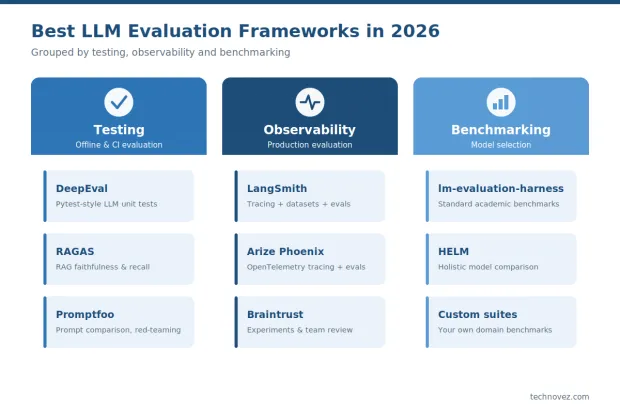
Figure 3: Leading LLM evaluation frameworks grouped by testing, observability and benchmarking.
File: best-llm-evaluation-frameworks-comparison.webp · Alt text: Comparison infographic of the best LLM evaluation frameworks including DeepEval, RAGAS and Promptfoo
How to Test LLM Applications: A 7-Step Framework
Whether you are evaluating a chatbot, a document-processing pipeline or an AI agent, this process shows how to evaluate LLM performance in a way that is repeatable and auditable:
- Define success criteria. Write down what "good" means for each use case: accuracy targets, tone, forbidden behaviours, latency and cost budgets.
- Build a golden dataset. Collect 100–500 real, representative inputs, including edge cases and past failures, with expected outputs or grading rubrics.
- Pick a metric mix. Combine deterministic checks, LLM-as-a-judge scores and a human-review sample.
- Calibrate your judges. Compare automated scores with expert labels and refine rubrics until they agree.
- Automate in CI/CD. Run automated LLM evaluation on every prompt, model or retrieval change, and block releases that regress.
- Red-team for safety. Test prompt injection, jailbreaks, PII leakage and bias before launch.
- Monitor continuously. Score sampled production traffic, track user feedback and feed new failures back into the golden dataset.
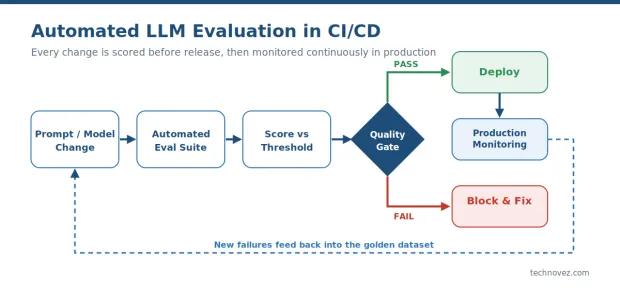
Figure 4: Automated evaluation acts as a quality gate before every release.
File: automated-llm-evaluation-ci-cd-pipeline.webp · Alt text: Automated LLM evaluation pipeline integrated into CI/CD with a quality gate
Production and Enterprise LLM Evaluation
Production LLM evaluation differs from offline testing because real users are unpredictable. Continuous LLM evaluation means sampling live conversations, scoring them with the same metrics used offline, alerting on drops in quality, and tracking latency and cost per request alongside quality. Model providers update their models regularly, so a system that passed last month can quietly degrade this month.
Enterprise LLM evaluation adds governance. Teams need versioned datasets, audit trails for every evaluation run, role-based access to sensitive test data and clear sign-off before release. For organisations in the EU, evaluation data must be handled in line with GDPR, and high-risk use cases fall under the EU AI Act's requirements for testing and technical documentation. In the US, aligning with the NIST AI RMF is a practical way to show customers and auditors that risk is being measured and managed. Technovez helps companies build this layer through our production AI and MLOps services.
LLM Evaluation Best Practices
- Evaluate the whole system, not just the model: prompts, retrieval, tools and guardrails all affect results.
- Start small with 50–100 high-quality test cases, then grow the dataset from real production failures.
- Version everything: prompts, datasets, model versions and evaluation results.
- Track quality, safety and cost together so one is not improved at the expense of the others.
- Re-run your full evaluation suite whenever the underlying model changes.
- Keep humans in the loop for high-stakes domains such as finance, healthcare and legal.
Common LLM Evaluation Mistakes to Avoid
The most common mistakes we see are relying only on public benchmarks, testing with a handful of hand-picked "happy path" prompts, trusting an uncalibrated LLM judge, and treating evaluation as a one-time launch task instead of an ongoing process. If any of these sound familiar, talk to our AI engineers for a second opinion.
Frequently Asked Questions
What is an LLM evaluation framework?
An LLM evaluation framework is a structured combination of test datasets, metrics, scoring methods and tooling used to measure how well a large language model or LLM application performs on accuracy, safety, relevance, latency and cost.
How do you evaluate generative AI applications?
Define success criteria, build a golden dataset from real use cases, score outputs with automated metrics, LLM-as-a-judge and human review, automate tests in CI/CD, and continuously monitor production traffic.
What are the most important LLM evaluation metrics?
Core metrics are correctness, faithfulness (hallucination rate), answer relevance, retrieval precision and recall for RAG, safety metrics such as toxicity and PII leakage, and operational metrics such as latency and cost per request.
Are LLM benchmarks enough to choose a model?
No. Benchmarks such as MMLU or SWE-bench help shortlist models, but only testing on your own data shows how a model will perform in your application.
What are the best LLM evaluation frameworks?
Popular options include DeepEval, RAGAS and Promptfoo for open-source testing, LangSmith, Arize Phoenix and Braintrust for tracing and production evaluation, and lm-evaluation-harness or HELM for benchmarking.
How often should LLMs be evaluated in production?
Continuously. Run automated evaluation on every change before release and score a sample of live traffic daily or weekly, with alerts when quality, safety or cost moves outside agreed thresholds.
Conclusion
Reliable AI is measured AI. By combining the right LLM evaluation metrics, a well-built golden dataset, proven open-source frameworks and continuous monitoring, you can ship generative AI with confidence and prove its quality to customers and regulators in both the US and EU.
| Ready to Measure and Improve Your LLM Performance? | Technovez designs, builds and evaluates production-grade AI for businesses across the USA and Europe. Get a free LLM evaluation audit and a clear roadmap to more accurate, safer and cheaper AI. | ▶ Book a Free LLM Evaluation Audit | Explore Our AI Services | Contact Our Team |
Add a named human author with credentials and link to a Technovez team or About page.