
TECHNOVEZ // AI SAFETY ENGINEERING
AI Guardrails: Preventing Hallucinations in Production
How to build layered guardrails that catch LLM hallucinations before they reach a user — grounding, validation, detection, and graceful fallback for enterprise AI systems.
An LLM stating a wrong fact with total confidence is not a bug in the traditional sense — it's the expected behavior of a system that generates the most statistically plausible next token, not the most true one. AI hallucinations are not rare edge cases; they are a structural property of how language models work, which means preventing them isn't about finding a smarter model. It's about building AI guardrails around the model so production systems stay reliable even when the model itself is occasionally wrong.
This guide covers how to prevent LLM hallucinations in production: what causes them, how to build AI guardrails for production applications, the techniques that actually reduce hallucination rates, and how to validate LLM responses before they reach a user or a downstream system.
What Are AI Hallucinations?
AI hallucinations are outputs that are fluent, confident, and wrong — a fabricated citation, an invented API parameter, a policy that doesn't exist, a statistic pulled from nowhere. LLM hallucinations differ from simple errors because the model presents them with the same fluency and confidence as correct answers, which is exactly what makes them dangerous in production.
- Intrinsic hallucinations — the output contradicts information that was actually provided in the prompt or context.
- Extrinsic hallucinations — the output can't be verified against the provided context at all; the model is generating from its training data or from nothing verifiable.
Both matter for production AI systems, but they call for different guardrails.
Why LLM Hallucinations Happen
Understanding the cause is what makes preventing AI hallucinations tractable rather than a guessing game. LLMs hallucinate for a few structural reasons:
- Next-token prediction has no built-in truth check — the model optimizes for plausible continuations, not verified ones.
- Training data has gaps and contradictions — when a model hasn't seen enough reliable signal, it still has to produce an answer.
- Context windows dilute relevance — as more information is packed into a prompt, attention to the most relevant facts weakens.
- Ambiguous or underspecified prompts invite the model to fill gaps with plausible-sounding invention.
None of this means hallucinations are unmanageable — it means they need to be treated as an expected failure mode with engineered mitigations, the same way distributed systems are engineered around network failures.
What Are AI Guardrails?
AI guardrails are the layer of checks, constraints, and fallbacks wrapped around a model to keep its outputs safe, accurate, and within bounds — before a response ever reaches a user or triggers a downstream action. LLM guardrails aren't a single tool; they're a pipeline of independent checks, each catching a different failure mode.
A production AI guardrails pipeline typically includes:
- Input validation — sanitizing and scoping what the model is asked, including prompt injection checks.
- Grounding and retrieval — supplying the model with verified, relevant context rather than relying on parametric memory alone.
- Output validation — checking the response against rules, schemas, or the source context before it's used.
- Fallback and escalation — a defined path for what happens when a check fails.
Enterprise AI safety programs treat this pipeline as infrastructure, not an afterthought bolted onto a working demo.
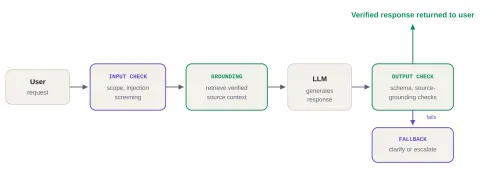
Fig. 1 — AI guardrails pipeline: input validation, grounding, generation, output validation, with fallback for anything that fails a check.
How to Build AI Guardrails for Production Applications
Knowing how to build AI guardrails means designing checks at each stage of the request lifecycle, not adding one generic filter at the end.
- Constrain the input — validate and scope user input before it reaches the model; screen for prompt injection attempts.
- Ground the model in verified data — retrieval-augmented generation (RAG) is the single most effective structural guardrail.
- Constrain the output format — structured output makes responses easier to validate and harder to wander outside expected bounds.
- Validate before use — rule-based checks, schema validation, and a second model pass where stakes are high.
- Define a fallback path — degrade gracefully rather than surfacing an unverified answer.
- Log and monitor everything — track validation failures, not just successes.
Techniques to Reduce LLM Hallucinations
- Retrieval-augmented generation (RAG) — ground responses in retrieved, source-checkable documents.
- Lower temperature for factual tasks — reduces sampling randomness and creative invention.
- Explicit “I don't know” permission — measurably reduces confident fabrication.
- Chain-of-verification — have the model, or a second model, check its own claims against source material.
- Citation requirements — claims without a traceable source are easier to flag automatically.
- Constrained decoding and structured outputs — restricting the output space reduces the surface area for fabrication.
AI Hallucination Detection Techniques
Prevention isn't perfect, so AI hallucination detection techniques matter as a second line of defense — catching what slips through before it reaches a user.
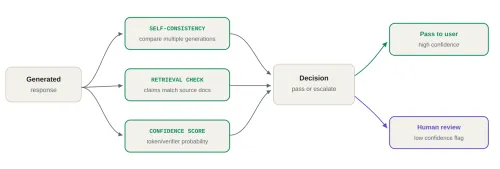
Fig. 2 — Hallucination detection workflow: parallel self-consistency, retrieval verification, and confidence scoring feed a decision to pass or escalate to human review.
- Self-consistency checks — generate multiple responses and flag disagreement between them.
- Retrieval verification — automatically check whether claims are actually supported by retrieved source documents.
- Confidence and uncertainty scoring — use token-level probability or a verifier model to flag low-confidence spans.
- Human-in-the-loop review — route high-stakes or low-confidence outputs to human reviewers.
- Factual consistency models — specialized smaller models scoring whether a claim is entailed by a source document.
How to Validate LLM Responses
- Schema validation for structured outputs — reject responses that don't conform.
- Source-grounding checks — verify factual claims trace back to retrieved context.
- Business rule validation — domain-specific checks like valid price ranges or existing product references.
- Toxicity and policy filters for outputs shown to end users.
- Regression testing against known cases — a fixed test set run on every model or prompt change.
AI output validation should happen as a distinct pipeline stage, logged and measurable, not as an implicit hope that a good prompt will keep the model in line.
Enterprise LLM Safety Best Practices
- Treat guardrails as versioned infrastructure, tested and deployed with the same rigor as the model itself.
- Separate high-stakes from low-stakes flows and apply proportionally stronger validation.
- Maintain an audit trail of inputs, outputs, and which guardrail checks passed or failed.
- Red-team regularly — actively probe for hallucination and prompt injection failure modes.
- Keep humans in the loop for irreversible actions.
Building Reliable Production AI Systems
AI reliability isn't a property of the model alone — it's a property of the system built around it. How to make AI applications more reliable comes down to treating hallucinations as a known, measurable failure mode: instrument for it, build layered guardrails against it, and design graceful fallbacks for when those guardrails catch something.
Frequently Asked Questions
What causes AI hallucinations in LLMs?
LLMs generate the most statistically plausible next token rather than a verified fact, so gaps in training data, diluted context, and underspecified prompts all lead to fluent but incorrect output.
How do you prevent LLM hallucinations in production?
Ground responses in retrieval-augmented generation, constrain output formats, validate responses against source material, and define a graceful fallback for when validation fails.
What are AI guardrails?
AI guardrails are the pipeline of input validation, grounding, output validation, and fallback logic wrapped around a model to keep its responses accurate and within bounds.
Can AI hallucinations be completely eliminated?
No. Hallucinations are a structural property of how language models generate text, so the realistic goal is measurable reduction and reliable detection, not full elimination.
Build Production-Ready AI Guardrails with Technovez
Technovez designs and implements AI guardrails, retrieval architecture, and production LLM safety systems for teams across the USA and EU.
Explore our AI development services: technovez.com/services
Contact our team: technovez.com/contact