
TECHNOVEZ
Enterprise AI Automation & Digital Transformation
How Growing Businesses Can Scale AI Successfully in 2026
By the Technovez Editorial Team | Enterprise AI & Infrastructure Insights | 2026
Executive Summary
Most enterprises adopting generative AI, AI agents, and Agentic AI in 2026 are discovering the same constraint: the tools work, but the infrastructure underneath them often doesn't scale, secure, or govern that usage properly. This guide lays out a practical AI infrastructure blueprint — the compute, data, model, and orchestration layers that determine whether AI initiatives scale reliably or stall after the pilot stage. It covers core architecture components, cloud deployment models, agent-specific infrastructure requirements, the Microsoft AI ecosystem, security and governance, a step-by-step roadmap, and the infrastructure trends shaping 2026–2030.
Key Takeaways
- AI infrastructure is a distinct discipline from traditional IT infrastructure, built around model serving, data retrieval, and non-deterministic workloads.
- A modern AI stack requires a cloud platform, data lake, vector database, API gateway, identity management, and orchestration layer working together.
- Retrieval-Augmented Generation (RAG) and vector databases are foundational for grounding LLM outputs in enterprise data.
- AI agents and multi-agent systems introduce additional infrastructure requirements: memory, tool calling, and orchestration through protocols like MCP.
- Security and governance — identity, encryption, Zero Trust, and audit logging — must be built into the infrastructure layer, not bolted on afterward.
- A phased roadmap, starting with an infrastructure audit and a scoped pilot, reduces risk compared to enterprise-wide AI rollouts.
1. Introduction: Why Infrastructure Determines AI Success
| Quick Answer | Businesses can no longer treat AI as a standalone tool because generative AI, RAG, and AI agents depend on underlying infrastructure — compute, data pipelines, security, and orchestration — that determines whether AI initiatives scale or stall. |
Early AI adoption inside most organizations looked like this: a team subscribes to a chatbot tool, connects it to a few documents, and calls it done. That approach works for individual productivity, but it breaks down the moment AI needs to operate across enterprise data, take action inside business systems, or support more than a handful of users reliably.
What separates organizations that scale AI successfully from those that stall after a promising pilot is rarely the choice of model. It's the infrastructure underneath: how data is stored and retrieved, how identity and access are managed, how AI agents call tools and take action, and how all of it is monitored and governed.
AI-ready infrastructure means having the compute, data, security, and orchestration layers in place to run generative AI and AI agents reliably — not as one-off experiments, but as production systems that a growing business can depend on. This guide is a practical blueprint for building that foundation.
2. What Is AI Infrastructure?
| Quick Answer | AI infrastructure is the combined set of compute, storage, networking, data pipelines, models, and APIs required to build, run, and scale AI applications. It differs from traditional IT infrastructure in that it must support non-deterministic, GPU-intensive, and data-retrieval-heavy workloads. |
Traditional IT infrastructure is built around deterministic applications: a database query returns the same result every time, and capacity planning is based on predictable transaction volumes. AI infrastructure has to support something different — workloads where outputs vary, where GPU compute is often the bottleneck, and where a single user request might trigger a chain of model calls, data retrievals, and tool actions.
Core Elements
- Compute: GPU and CPU resources for model inference, fine-tuning, and orchestration workloads.
- Storage: Object storage, data lakes, and databases holding structured and unstructured enterprise data.
- Networking: Low-latency connectivity between applications, models, and data sources, often spanning cloud and on-premises environments.
- AI Services: Managed platforms providing model hosting, fine-tuning, and inference endpoints.
- Data Pipelines: Ingestion, transformation, and indexing processes that prepare enterprise data for AI consumption.
- AI Models: The LLMs and specialized models that power reasoning, generation, and classification tasks.
- APIs: The integration layer connecting applications, agents, and enterprise systems to AI services.
3. Why Growing Businesses Need an AI Infrastructure Blueprint
| Quick Answer | Growing businesses need an AI infrastructure blueprint to keep pace with rapid AI adoption while maintaining scalability, security, and operational efficiency — without accumulating technical debt that becomes expensive to unwind later. |
- Rapid AI Adoption: Teams are adopting AI tools faster than infrastructure planning typically happens, creating fragmentation.
- Scalability: A blueprint ensures infrastructure can support growth from a single pilot to organization-wide usage.
- Security: Planning infrastructure deliberately reduces the risk of ungoverned data access and shadow AI usage.
- Operational Efficiency: Shared infrastructure components reduce duplicated effort across AI projects.
- Future-Proofing: A well-architected foundation adapts more easily to new models and capabilities as they emerge.
- Competitive Advantage: Businesses with reliable AI infrastructure can ship AI-powered capabilities faster and more safely than competitors improvising as they go.
4. Core Components of an AI Infrastructure
| Quick Answer | A complete AI infrastructure includes a cloud platform, AI models, data lake, vector database, knowledge base, API gateway, identity management, workflow engine, MCP support, AI agents, RAG pipeline, MLOps tooling, and monitoring and cost management layers. |
| Component | Role |
| Cloud Platform | The foundational compute and services layer — Azure, AWS, or Google Cloud — hosting AI workloads. |
| AI Models | LLMs and specialized models used for reasoning, generation, classification, and embeddings. |
| Data Lake | Centralized storage for structured and unstructured enterprise data feeding AI systems. |
| Vector Database | A database optimized for storing and querying vector embeddings, enabling semantic search for RAG. |
| Knowledge Base | Curated, indexed enterprise content that AI systems retrieve from to ground their responses. |
| API Gateway | A managed entry point that handles routing, authentication, and rate limiting for AI service calls. |
| Identity Management | Systems managing authentication and authorization for both users and AI agents. |
| Workflow Engine | The orchestration layer sequencing multi-step processes across automation and AI systems. |
| MCP (Model Context Protocol) | An open protocol standardizing how AI applications connect to external tools and data sources. |
| AI Agents | Autonomous or semi-autonomous systems that plan, reason, and take action toward a defined goal. |
| RAG (Retrieval-Augmented Generation) | An architecture pattern that retrieves relevant data before generating a response, grounding outputs in real information. |
| MLOps | Practices and tooling for deploying, monitoring, and maintaining models in production. |
| Monitoring | Real-time visibility into system performance, usage, and errors across the AI stack. |
| Logging | Detailed records of AI system activity used for debugging, auditing, and compliance. |
| Observability | The broader capability to understand system behavior through logs, metrics, and traces combined. |
| Cost Management | Tracking and optimizing spend on compute, storage, and API usage across AI workloads. |
Each layer in this flow has a distinct responsibility. The AI gateway centralizes authentication and monitoring so individual applications don't each reinvent security controls. The RAG layer and vector database ensure model outputs are grounded in actual enterprise data rather than relying solely on a model's training data. Enterprise data sources remain the system of record — AI infrastructure retrieves from them, rather than replacing them.
6. Cloud vs Hybrid vs On-Premises AI
| Dimension | Cloud AI | On-Premises AI | Hybrid AI |
| Security | Managed by cloud provider, shared responsibility | Full organizational control | Combines both models |
| Scalability | High — elastic compute on demand | Limited by owned hardware capacity | High, with sensitive workloads isolated |
| Performance | Strong, dependent on region and network | Can be optimized for specific workloads | Balanced based on workload placement |
| Compliance | Strong provider certifications, shared duty | Easiest to fully control and audit | Flexible — sensitive data can stay on-prem |
| Cost | Operational expense, pay-as-you-go | Higher upfront capital investment | Mixed cost model |
| Management | Lower operational burden | Requires dedicated infrastructure team | Requires coordination across environments |
| Deployment Speed | Fastest to stand up | Slowest, hardware-dependent | Moderate — depends on integration complexity |
| Enterprise Suitability | Strong for most growing businesses | Best for highly regulated, data-sensitive cases | Best for enterprises with mixed requirements |
7. AI Infrastructure for Agentic AI
| Quick Answer | Agentic AI requires infrastructure beyond standard LLM hosting: memory storage, tool-calling interfaces, workflow orchestration, and increasingly, MCP servers that standardize how agents connect to enterprise systems. |
- AI Agents: Require a hosting and execution environment that can manage state across multi-step tasks.
- Multi-Agent Systems: Need an orchestration layer to coordinate handoffs and shared context between specialized agents.
- Workflow Orchestration: Sequences agent actions, tool calls, and human checkpoints within a defined process.
- Memory: Infrastructure for retaining relevant context across a session or across multiple interactions.
- Planning: Underlying model and orchestration support for decomposing goals into ordered sub-tasks.
- Reasoning: Compute and context-management infrastructure supporting multi-step, context-aware decision-making.
- Tool Calling: Secure interfaces allowing agents to invoke external APIs, databases, and enterprise applications.
- MCP Servers: Model Context Protocol servers that standardize how AI agents discover and connect to tools and data sources, reducing custom integration work.
Single-Agent vs Multi-Agent Infrastructure
| Dimension | Single-Agent | Multi-Agent |
| Orchestration Complexity | Low — single execution path | Higher — requires coordination between agents |
| Memory Requirements | Session-scoped context | Shared and agent-specific context management |
| Failure Handling | Simpler to trace and debug | Requires tracing across multiple agents |
| Typical Use Case | Well-defined, bounded tasks | Complex workflows spanning multiple domains |
8. Microsoft AI Ecosystem
| Quick Answer | Microsoft's AI ecosystem — spanning Copilot Studio, Azure AI Foundry, Azure OpenAI, Power Platform, Microsoft Fabric, and supporting identity and productivity tools — provides a full AI infrastructure stack for organizations already standardized on Microsoft 365. |
- Microsoft Copilot Studio: Low-code environment for building conversational and autonomous AI agents connected to enterprise data.
- Azure AI Foundry: Platform for building, evaluating, and deploying custom AI models and agents at scale.
- Azure OpenAI: Enterprise-grade hosting for OpenAI models with built-in access controls and content filtering.
- Power Automate: Workflow orchestration connecting AI capabilities to structured business processes.
- Power Platform: The broader low-code layer spanning apps, automation, and data (Dataverse).
- Microsoft Fabric: Unified data platform supporting the data lake and pipeline layer that feeds AI systems.
- SharePoint: A common enterprise knowledge source that RAG pipelines frequently retrieve from.
- Teams: A primary interaction surface for AI agents and Copilot experiences.
- Dynamics 365: CRM and ERP systems that AI agents can query and update as part of automated workflows.
- Microsoft Entra ID: Identity and access management extending to both human users and AI agents.
9. Security & Governance
| Quick Answer | AI infrastructure security requires the same fundamentals as traditional IT — identity management, encryption, and Zero Trust — extended to cover model access, agent permissions, and AI-specific audit logging. |
- Identity Management: Authenticating both human users and AI agents accessing enterprise systems.
- Role-Based Access Control (RBAC): Restricting data and tool access based on defined roles, applied consistently to AI agents.
- Secrets Management: Securely storing and rotating API keys and credentials used by AI services and agents.
- Encryption: Protecting data at rest and in transit across the AI infrastructure stack.
- Zero Trust: Verifying every request regardless of network origin, rather than assuming internal traffic is safe.
- Compliance: Mapping infrastructure controls to relevant regulatory and industry requirements.
- Audit Logging: Recording AI system and agent activity for accountability and incident investigation.
- Responsible AI: Embedding fairness, transparency, and appropriate-use principles into infrastructure design.
- AI Governance: Policy and oversight structures ensuring infrastructure decisions align with organizational risk tolerance.
- Model Security: Protecting against prompt injection, data leakage, and unauthorized model access.
10. Common Infrastructure Mistakes
| Quick Answer | The most common AI infrastructure mistakes include skipping governance, underestimating data quality requirements, weak monitoring, ignoring scalability, and failing to plan for cost or disaster recovery. |
10 Common Mistakes Checklist
☐ No governance: AI infrastructure decisions made without cross-functional oversight
☐ Poor data quality: Feeding AI systems unclean, outdated, or unstructured data without preparation
☐ Weak monitoring: Limited visibility into model performance, errors, or usage patterns
☐ No observability: Missing distributed tracing across multi-step AI and agent workflows
☐ Ignoring scalability: Architecture built for a pilot that can't support production load
☐ Vendor lock-in: Infrastructure tightly coupled to a single provider's proprietary services
☐ No disaster recovery: No tested plan for AI system failure or data loss scenarios
☐ No cost optimization: Unmonitored GPU and API spend leading to budget overruns
☐ Missing identity controls: AI agents granted broad access without least-privilege scoping
☐ No documentation: Architecture, data flows, and access decisions left unrecorded
11. AI Infrastructure Roadmap
| Quick Answer | A practical AI infrastructure roadmap moves through ten stages: business assessment, infrastructure audit, data readiness, cloud strategy, AI platform selection, pilot, security review, production deployment, monitoring, and continuous optimization. |
| Stage | What Happens |
| 1. Business Assessment | Identify the business problems AI infrastructure needs to support, and define success metrics. |
| 2. Infrastructure Audit | Assess current compute, storage, networking, and identity systems against AI workload requirements. |
| 3. Data Readiness | Evaluate data quality, structure, and accessibility across systems that AI will need to retrieve from. |
| 4. Cloud Strategy | Decide on a cloud, hybrid, or on-premises approach based on compliance, cost, and performance needs. |
| 5. AI Platform Selection | Choose model providers and platform services aligned to the organization's technical and governance requirements. |
| 6. Pilot | Deploy a scoped pilot on production-representative infrastructure to validate the architecture. |
| 7. Security Review | Conduct a formal security and governance review before wider rollout. |
| 8. Production Deployment | Roll out to production with monitoring, rollback plans, and defined ownership in place. |
| 9. Monitoring | Track performance, cost, and usage continuously after go-live. |
| 10. Continuous Optimization | Refine architecture, cost allocation, and scaling based on real-world usage data. |
12. Future Trends (2026–2030)
| Quick Answer | Between 2026 and 2030, expect AI-native infrastructure design, agentic cloud platforms, enterprise AI mesh architectures, GPU optimization advances, and growing adoption of edge AI and hybrid AI platforms. |
- AI-Native Infrastructure: Systems designed from the ground up around AI workloads rather than retrofitted from traditional IT architecture.
- Agentic Cloud Platforms: Cloud services purpose-built to host, orchestrate, and govern AI agents at scale.
- Enterprise AI Mesh: Distributed architecture connecting AI capabilities across business units through standardized interfaces.
- Autonomous Infrastructure: Infrastructure management tasks increasingly handled by AI systems themselves, with human oversight.
- GPU Optimization: Continued advances in efficient model serving, reducing the compute cost of running AI at scale.
- AI Operating Systems: Emerging platforms providing a unified layer for managing models, agents, and data across an organization.
- Edge AI: Increasing deployment of AI inference closer to where data is generated, reducing latency for time-sensitive use cases.
- Hybrid AI Platforms: Continued growth of architectures blending cloud scalability with on-premises control for sensitive workloads.
13. How Technovez Helps
Technovez helps growing businesses design and implement AI infrastructure that's built to scale — grounded in practical architecture patterns rather than one-size-fits-all templates.
- Enterprise AI Infrastructure: Designing the compute, data, and orchestration layers that support production AI workloads
- AI Strategy: Aligning infrastructure investment with business priorities and growth plans
- Microsoft Copilot Studio: Building governed AI agents on top of a well-architected infrastructure foundation
- Azure AI: Implementing Azure AI Foundry and Azure OpenAI solutions tailored to enterprise requirements
- AI Automation: Connecting infrastructure to real business workflows through Power Automate and custom integrations
- AI Governance: Embedding security, identity, and compliance controls into the infrastructure layer from the start
- Digital Transformation: Ensuring AI infrastructure investments support broader enterprise transformation goals
Decision Framework: Is Your Business Ready for Enterprise AI?
Use this maturity scoring model to assess infrastructure readiness. Score each area from 0 (not in place) to 3 (fully implemented and monitored), then total the result.
| Readiness Area | Score |
| Cloud platform and compute strategy defined | 0–3 |
| Data quality and accessibility assessed | 0–3 |
| Vector database or RAG capability in place | 0–3 |
| Identity and access management extended to AI systems | 0–3 |
| API gateway and integration layer established | 0–3 |
| Monitoring, logging, and observability implemented | 0–3 |
| Security and governance review process defined | 0–3 |
| Cost management and optimization practices in place | 0–3 |
- 0–8: Foundational — infrastructure basics are not yet in place; start with a cloud strategy and data readiness assessment
- 9–16: Developing — core components exist but integration and monitoring need work
- 17–20: Scaling — infrastructure supports production AI; focus on agent-specific capabilities and cost optimization
- 21–24: Advanced — infrastructure is mature; focus on AI-native architecture and continuous optimization
AI Infrastructure Glossary
| Term | Definition |
| AI Infrastructure | The combined compute, storage, networking, data, and orchestration systems required to run AI applications. |
| Agentic AI | AI systems that plan, reason, and act with bounded autonomy toward a defined goal. |
| RAG (Retrieval-Augmented Generation) | An architecture pattern that retrieves relevant data before generating a model response. |
| Vector Database | A database optimized for storing and searching vector embeddings used in semantic search. |
| MCP (Model Context Protocol) | An open protocol standardizing how AI applications connect to external tools and data sources. |
| MLOps | Practices and tooling for deploying, monitoring, and maintaining machine learning models in production. |
| Zero Trust | A security model that verifies every request regardless of network origin. |
| LLM (Large Language Model) | A model trained on large text datasets, capable of understanding and generating natural language. |
| API Gateway | A managed entry point handling authentication, routing, and rate limiting for service calls. |
| Observability | The capability to understand system behavior through combined logs, metrics, and traces. |
Frequently Asked Questions
What is AI infrastructure?
AI infrastructure is the combined set of compute, storage, networking, data pipelines, models, and APIs required to build, run, and scale AI applications reliably.
Why do businesses need AI infrastructure?
Because generative AI, RAG, and AI agents depend on underlying compute, data, and orchestration systems that determine whether AI initiatives scale beyond a pilot.
What is an AI stack?
An AI stack is the layered set of technologies — cloud platform, models, data pipelines, vector databases, and orchestration — that together support AI applications.
What is a vector database?
A vector database stores and searches vector embeddings, enabling semantic search that powers Retrieval-Augmented Generation and similar AI capabilities.
What is Retrieval-Augmented Generation (RAG)?
RAG is an architecture pattern where relevant data is retrieved from a knowledge source before a model generates its response, grounding outputs in real information.
What infrastructure do AI agents need?
AI agents need memory management, tool-calling interfaces, workflow orchestration, and often MCP servers to connect securely to enterprise systems.
How much does enterprise AI infrastructure cost?
Cost varies widely based on scale, model usage, and cloud versus on-premises choices; a scoped pilot is the recommended way to establish realistic cost baselines before wider investment.
What is the role of Microsoft Copilot Studio?
Copilot Studio provides a low-code environment for building AI agents that connect to enterprise data and systems with governance controls built in.
What is MLOps?
MLOps refers to the practices and tooling used to deploy, monitor, and maintain machine learning models reliably in production.
What is Zero Trust in the context of AI infrastructure?
Zero Trust means verifying every access request to AI systems and data, regardless of whether it originates inside or outside the network.
Should businesses use cloud, hybrid, or on-premises AI infrastructure?
It depends on compliance requirements, data sensitivity, and existing infrastructure; hybrid approaches are common among enterprises with mixed requirements.
What is the Model Context Protocol (MCP)?
MCP is an open protocol that standardizes how AI applications and agents connect to external tools and data sources, reducing custom integration work.
How is AI infrastructure different from traditional IT infrastructure?
AI infrastructure must support non-deterministic, GPU-intensive workloads and data-retrieval-heavy patterns that differ from the predictable transaction volumes traditional IT is built around.
What is the first step in building an AI infrastructure blueprint?
The first step is typically a business assessment and infrastructure audit to understand current capabilities and the specific AI use cases being planned.
Do small and mid-sized businesses need enterprise-grade AI infrastructure?
Growing businesses benefit from planning infrastructure deliberately even at smaller scale, since retrofitting security and scalability later is typically more costly than designing for it early.
People Also Ask
- What is the difference between AI infrastructure and MLOps?
- Can small businesses build AI infrastructure without a large IT team?
- What cloud provider is best for AI infrastructure?
- How do vector databases relate to large language models?
- What skills does a team need to manage AI infrastructure?
Related Search Queries
- AI infrastructure examples
- enterprise AI architecture diagram
- RAG architecture explained
- AI infrastructure cost breakdown
- AI agent infrastructure requirements
- Azure AI vs AWS AI infrastructure
| Ready to Build AI Infrastructure That Scales With Your Business? | Technovez helps growing businesses design and implement AI infrastructure, AI strategy, Microsoft Copilot Studio agents, Azure AI solutions, AI automation, AI governance, and broader digital transformation initiatives. | Contact Technovez to start with an infrastructure readiness assessment → www.technovez.com/contact |
Publishing & Technical SEO Notes
Recommended Schema Markup
- Article Schema — headline, author, datePublished, dateModified, publisher
- FAQPage Schema — mapped to the 15 FAQ entries above
- Organization Schema — Technovez entity, logo, sameAs profiles
- BreadcrumbList Schema — Home > Blog > AI Infrastructure Blueprint
- HowTo Schema — mapped to the AI Infrastructure Roadmap steps
Internal Linking Suggestions
- Homepage anchor text: “Technovez’s enterprise AI infrastructure and automation services” → https://www.technovez.com/
- Blog anchor text: “more Technovez insights on AI infrastructure and Agentic AI” → https://www.technovez.com/blog
- Services anchor text: “our AI infrastructure and Azure AI services” → https://www.technovez.com/services
- Contact anchor text: “talk to a Technovez AI infrastructure architect” → https://www.technovez.com/contact
Authoritative References to Cite
- Microsoft Learn
- Azure AI Documentation
- Microsoft Copilot Studio Documentation
- Azure AI Foundry Documentation
- AWS Well-Architected Framework
- Google Cloud Architecture Framework
- NIST AI Risk Management Framework
- ISO/IEC 42001
- Kubernetes Documentation
- OpenAI Documentation
- Anthropic Documentation
- Model Context Protocol (MCP) Specification
Note: link directly to the current pages on each of these sites at publication time; do not fabricate specific URLs or citations not verified at time of publishing.
Image SEO
| Element | Detail |
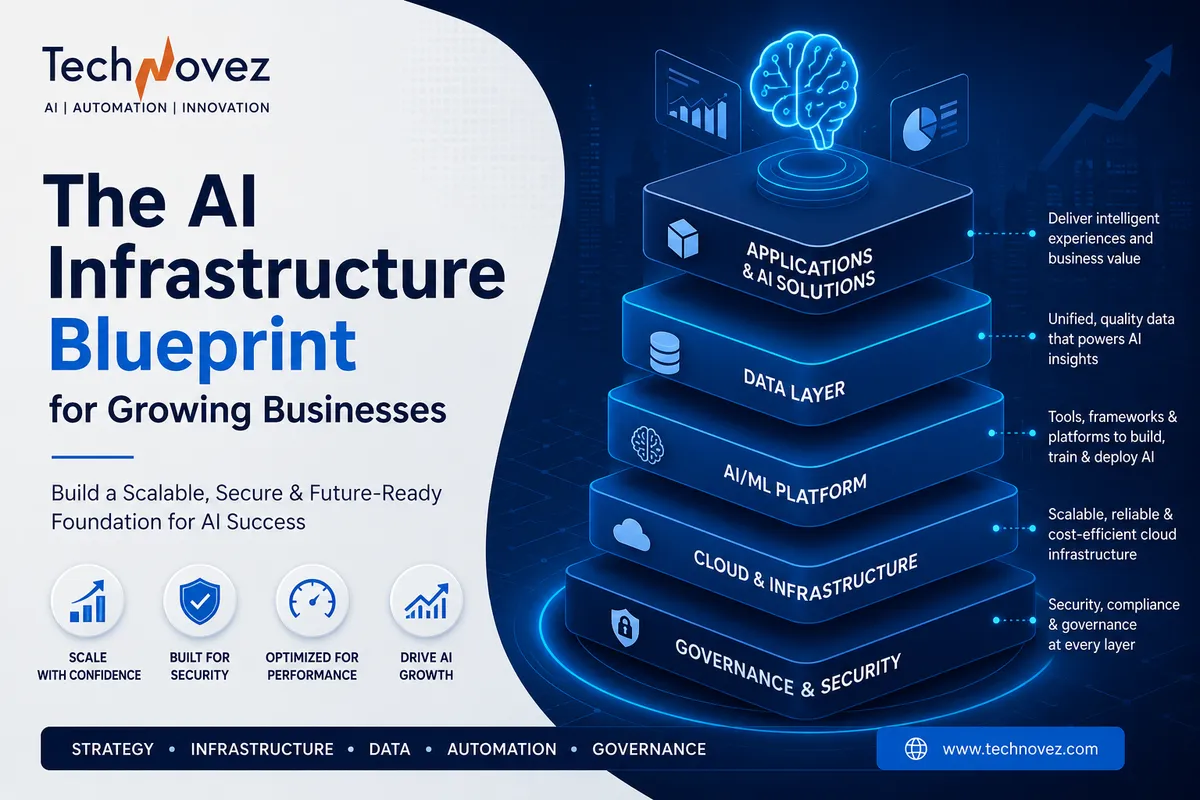
| Hero Image Concept | A layered architecture visual showing stacked infrastructure tiers — cloud, data, models, agents — connected vertically in navy and teal tones. |
| Suggested Featured Image Title | The AI Infrastructure Blueprint: From Cloud to Agents |
| AI Image Generation Prompt | Modern enterprise tech illustration, vertical stacked architecture layers labeled abstractly for cloud, data, models, and agents, connected by glowing teal lines on a navy background; flat corporate style, no text, no logos |
| Alt Text | Layered AI infrastructure architecture illustration showing cloud, data, model, and agent layers connected in an enterprise stack |
| SEO-Friendly Filename | ai-infrastructure-blueprint-2026.jpg |
| Caption | A modern AI infrastructure blueprint connects cloud, data, model, and agent layers into one scalable architecture. |
AI-Generated Infographic Ideas
- The AI Stack, visualized as a 6-layer vertical diagram from cloud platform to end-user application
- Cloud vs Hybrid vs On-Premises AI, visualized as a 3-column comparison graphic
- The 10-Stage AI Infrastructure Roadmap, visualized as a horizontal timeline
- Single-Agent vs Multi-Agent Infrastructure, visualized as two contrasting network diagrams
- The Enterprise AI Infrastructure Readiness Checklist, visualized as a scorecard graphic
NLP Keyword List
AI infrastructure, enterprise AI infrastructure, AI architecture, AI stack, AI platform, Agentic AI, AI agents, large language models, retrieval-augmented generation, RAG architecture, vector database, MLOps, AI security, AI governance, cloud AI, Azure AI, AWS AI, Google Cloud AI, Microsoft Copilot Studio, Power Automate, Power Platform, enterprise automation, AI scalability, AI operations, digital transformation, Model Context Protocol, Zero Trust, multi-agent systems, GPU compute, API gateway.
Featured Snippet Optimization Notes
The Featured Snippet Answer at the top of this document is structured as a 40–60 word direct definition, matching Google's preferred format for definition-style featured snippets. Each major H1 section also opens with a Quick Answer callout to maximize eligibility for AI Overviews and other GEO-optimized citation formats.
Content Gap Analysis vs. Competing AI Infrastructure Articles
- Most competing articles cover cloud platform comparisons but omit agent-specific infrastructure requirements (memory, tool calling, MCP) — this guide addresses that gap directly in Section 7.
- Few competing resources provide a scored maturity/readiness model; this guide includes a practical 0–24 scoring matrix.
- Most articles treat security as a single bullet point rather than a dedicated section; this guide dedicates Section 9 to security and governance specifically.
- This guide includes a text-based architecture diagram and glossary, which many competing long-form articles omit despite targeting technical readers.
- Opportunity: a future companion article with a deeper technical walkthrough of MCP server implementation could extend topical authority further.
Social Media Assets
LinkedIn Post
Most AI rollouts don't fail because of the model. They fail because the infrastructure underneath it was never built to scale.
Compute, data pipelines, vector databases, identity management, orchestration — these are the layers that decide whether your AI initiative makes it past the pilot stage.
Our latest guide lays out a complete AI Infrastructure Blueprint for growing businesses — architecture, security, agent infrastructure, and a step-by-step roadmap.
Full guide → link in comments.
#AIInfrastructure #EnterpriseAI #AgenticAI #AzureAI #MicrosoftCopilotStudio
Facebook Post
Is your AI infrastructure actually ready to scale — or is it held together by one pilot project? Our latest guide breaks down the complete AI Infrastructure Blueprint for growing businesses, including a readiness scoring model. Read it here →
Medium Introduction
Every business exploring generative AI and AI agents eventually runs into the same wall: the tools work in a demo, but scaling them reliably across the organization is a different problem entirely. That problem is almost always infrastructure — compute, data pipelines, vector databases, identity management, and orchestration working together, not just a model API key. This guide lays out a practical AI infrastructure blueprint for growing businesses: what the modern AI stack actually consists of, how cloud, hybrid, and on-premises approaches compare, what agentic AI specifically requires, and a step-by-step roadmap for building infrastructure that scales with the business rather than becoming its bottleneck.