
AI integration with CRM systems connects machine learning, generative AI and AI agents to the customer data inside platforms like Salesforce and HubSpot. The CRM can then score leads, predict which deals will close, draft follow-ups and run workflows automatically. Done right, it raises sales productivity, shortens sales cycles and, for European companies, stays GDPR- and EU AI Act-compliant.
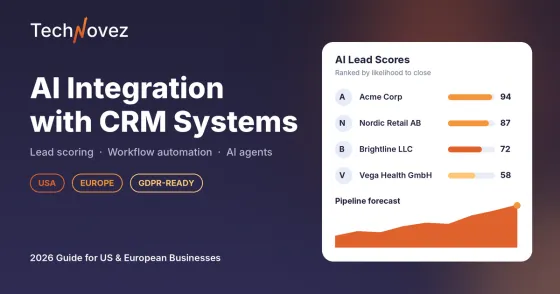
AI integration with CRM systems dashboard showing lead scores and sales forecasts
Your CRM already holds your most valuable asset: every lead, deal, email and support ticket your business has ever logged. Yet in most companies that data sits idle while sales reps spend hours on manual entry and guesswork. AI changes that. Around 45% of sales professionals now use AI at least weekly, most often inside their CRM, according to G2.
This guide explains what AI CRM integration is, the benefits it delivers, how to add AI to your existing CRM in five steps, and what US and European businesses need to know before they start. At Technovez, we build these integrations for startups, SMBs and enterprises on both sides of the Atlantic.
What Is AI Integration with CRM Systems?
AI integration with CRM systems is the process of embedding artificial intelligence into customer relationship management software so it can analyze data, make predictions and take actions without manual input. Instead of a passive database, the CRM becomes an active assistant for sales, marketing and service teams.
A typical AI-powered CRM solution combines five layers:
- Predictive models that score leads, forecast revenue and flag churn risk.
- Generative AI that writes emails, call summaries and deal notes.
- AI agents that complete multi-step tasks, such as qualifying a lead and booking a meeting.
- Natural language processing that analyzes calls, chats and emails for intent and sentiment.
- An integration layer (APIs, webhooks, middleware) that moves data securely between the CRM, your AI models and other tools.
Some of this ships natively with major platforms. Most businesses, however, need custom AI CRM development to connect their own data, workflows and compliance rules. That is where AI integration services for businesses come in.
Benefits of AI Integration with CRM Software
The main benefits are more selling time, better-qualified pipeline and more accurate forecasts. Here is how they break down:
- AI lead scoring and customer insights. Models rank every lead by likelihood to buy, using behavior, firmographics and past wins, so reps call the right people first.
- AI-powered CRM workflow automation for sales teams. Data entry, follow-up reminders, task routing and deal-stage updates run automatically.
- Automated customer data analysis. AI spots patterns across thousands of records, such as which segments churn or which offers convert, in minutes instead of weeks.
- Accurate forecasting. Predictive pipelines replace gut-feel forecasts with probability-weighted numbers.
- Faster, personalized service. AI chat and email assistants answer routine questions and hand complex cases to humans with full context.
How AI CRM Integration Improves Sales Productivity
AI improves sales productivity by removing low-value admin work and pointing reps at the deals most likely to close. The data backs this up:
- Salesforce’s State of Sales research reports that AI-powered CRM tools raise rep productivity by 41%.
- HubSpot data shows companies using AI deal insights saw sales cycles about 20% faster than peers.
- Businesses using generative AI in their CRM are 83% more likely to exceed sales goals.
- McKinsey estimates generative AI could lift sales productivity by roughly 3–5% of global sales spend.
The lesson from these numbers: AI works best when it guides reps, not when it replaces their judgment.
How to Integrate AI into Existing CRM Systems: 5 Steps
You do not need to replace your CRM to add AI. Follow these five steps to integrate AI into the system you already use.
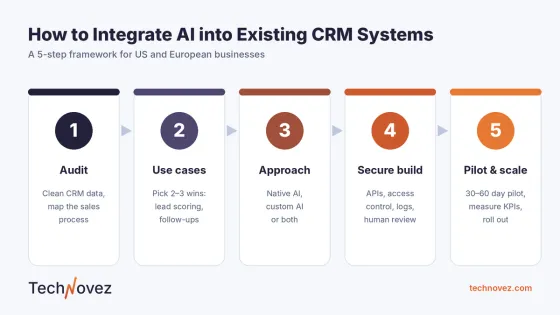
5-step process to integrate AI into existing CRM systems
Step 1: Audit your CRM data and processes
AI is only as good as its data. Remove duplicates, fill missing fields and map how leads move from first touch to closed deal.
Step 2: Pick two or three high-value use cases
Start where the payoff is clear, such as lead scoring, automated follow-ups or call summaries. Define a KPI for each, like conversion rate or hours saved per rep.
Step 3: Choose native AI, custom AI or both
Native tools are quick to switch on. Custom models and agents fit your exact workflows, data sources and industry rules.
Step 4: Build a secure integration
Connect through official APIs, apply role-based access, encrypt data in transit and at rest, log every AI action, and keep a human approval step for high-impact decisions.
Step 5: Pilot, measure and scale
Run the pilot with one team for 30–60 days, compare KPIs against a control group, then roll out what works.
Custom AI Integration for Salesforce and HubSpot
Salesforce and HubSpot both offer built-in AI, but custom integration connects that AI to the rest of your business. Salesforce provides AI features such as Einstein and Agentforce; HubSpot offers its Breeze AI tools. Custom work extends them with your own data, models and processes.
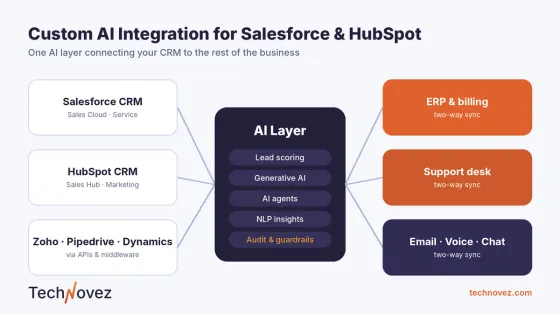
Custom AI integration for Salesforce and HubSpot
Common projects we deliver include:
- Salesforce AI integration: custom lead-scoring models, AI agents that update opportunities, and connections between Sales Cloud, ERP and support data.
- HubSpot AI integration: AI-written sequences tuned to your tone, chatbot-to-CRM qualification flows, and predictive deal scoring.
- Other CRMs: Zoho, Pipedrive and Microsoft Dynamics 365, connected through APIs and middleware.
Whether you need Salesforce AI integration services in the USA or HubSpot AI integration in Europe, the approach is the same: start with your workflow, then fit the AI around it. See examples in our projects portfolio.
AI CRM Integration Services in the USA
US businesses usually prioritize speed to revenue: faster lead response, more meetings booked and leaner sales operations. As an AI CRM integration company in the USA, headquartered in St. Petersburg, Florida, Technovez focuses on three areas for American clients:
- CRM automation services that cut manual work for growing sales teams.
- AI sales automation software that qualifies inbound leads and books meetings 24/7, including AI voice agents.
- AI integration for small businesses in the USA, with fixed-scope packages that avoid enterprise-level costs.
US teams should also respect state privacy laws such as California’s CCPA/CPRA when AI processes customer data. Our custom CRM integration services build these controls in from day one.
AI CRM Integration Services in Europe: GDPR-Compliant by Design
For European businesses, compliance shapes the entire project. GDPR-compliant AI CRM solutions need a lawful basis for processing, data minimization, clear retention rules and, under GDPR Article 22, human involvement in significant automated decisions.
The EU AI Act adds another layer. Transparency duties, such as telling customers they are speaking with an AI chatbot, apply from August 2, 2026. A provisional deal reached in May 2026 moved most high-risk obligations to December 2, 2027. Serious violations can bring fines up to €35 million or 7% of global turnover, and a CRM agent that can send emails or change records may face stricter scrutiny than a simple chatbot.
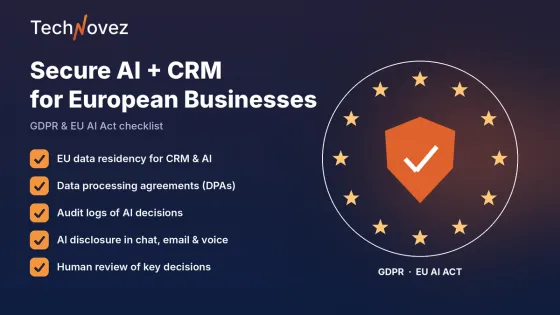
Secure AI integration with CRM systems for European businesses: GDPR and EU AI Act checklist
Secure AI integration with CRM systems for European businesses should include:
- EU data residency for CRM and AI processing where required.
- Data processing agreements with every AI vendor.
- Audit logs of AI decisions and outputs.
- AI disclosure in chat, email and voice interactions.
- Human review for lead or credit decisions with legal effect.
Technovez delivers AI CRM integration services across Europe with these safeguards built into the architecture, not bolted on later.
AI CRM Integration for Small and Medium-Sized Businesses
SMBs gain the most from AI CRM integration because every hour saved matters more on a small team. A phased approach keeps costs predictable: start with one automation, such as AI lead scoring or automated follow-ups, prove the return, then expand. Most SMBs see value from affordable connections to the CRM they already pay for, not a new platform.
How to Choose the Best AI CRM Integration Solution
The best AI CRM integration solution is the one that fits your CRM, your data and your regulations. When comparing partners, check for:
- Proven experience with your CRM (Salesforce, HubSpot or others).
- Ability to build custom models and agents, not just switch on features.
- Compliance expertise for your markets (CCPA in the US, GDPR and the EU AI Act in Europe).
- Clear KPIs and a pilot-first plan.
- Ongoing support and model monitoring after launch.
Learn more about Technovez and our approach, or read answers to common questions on our FAQ page.
Frequently Asked Questions About AI CRM Integration
What is AI CRM integration? AI CRM integration adds machine learning, generative AI and AI agents to a CRM such as Salesforce or HubSpot. The CRM can then score leads, forecast sales, draft messages and automate workflows using your own customer data.
How do I integrate AI into my existing CRM system? Audit and clean your CRM data, choose two or three high-value use cases, decide between native and custom AI, build a secure API integration with logging and human review, then pilot for 30–60 days before scaling.
What are the main benefits of AI integration with CRM software? The biggest benefits are higher sales productivity, more accurate lead scoring, faster sales cycles, automated data entry and better forecasts. Salesforce research links AI-powered CRM tools to a 41% gain in rep productivity.
Can AI be integrated with Salesforce and HubSpot? Yes. Both platforms include native AI features, and both offer APIs for custom AI integration. Custom work connects your own models, agents and external data to Salesforce or HubSpot workflows.
Is AI CRM integration GDPR-compliant? It can be, if designed for it. GDPR-compliant AI CRM solutions use a lawful basis for processing, data minimization, EU data residency where needed, vendor data processing agreements, audit logs and human review of significant automated decisions.
How does the EU AI Act affect AI in CRM systems? AI chatbots and assistants must disclose that users are talking to AI from August 2026. Higher-risk uses, such as AI agents that take consequential actions on customer records, face stricter documentation and oversight duties, most now due from December 2027.
Is AI CRM integration affordable for small businesses? Yes. Small and medium-sized businesses can start with one automation, such as AI lead scoring or automated follow-ups, on the CRM they already use. A phased rollout keeps costs predictable and proves return before expanding.
How long does an AI CRM integration project take? A focused pilot typically takes 4–8 weeks from data audit to launch. Larger multi-system or compliance-heavy projects take longer and are scoped after a discovery call.
Which company offers AI CRM integration services in the USA and Europe? Technovez is an AI automation company based in St. Petersburg, Florida, delivering AI CRM integration, custom AI agents and CRM automation services for businesses in the USA and Europe.
Ready to Make Your CRM Work Smarter?
Turn your CRM into your best-performing sales rep.
Technovez builds custom AI CRM integrations for Salesforce, HubSpot and more, with AI lead scoring, workflow automation and AI agents designed for US speed and European GDPR compliance.
Book a Free AI CRM Consultation → | Explore Our AI Integration Services
Call +1 (727) 276-4724 · Email sales@technovez.com · 7901 4th St N, Ste 300, St. Petersburg, FL 33702