
TECHNOVEZ // AI ENGINEERING
How LLM memory actually works, why AI agents forget without it, and how to architect short-term and long-term memory for production-grade AI products.
Every AI agent that feels “smart” over time is running some form of memory system underneath it. Without memory, an LLM only knows what's inside its current context window ask it about something you told it five minutes ago in a different session, and it's gone. This is the single biggest gap between a chatbot and an actual AI agent, and it's why AI memory has become one of the most important architecture decisions in production AI systems today.
This guide breaks down AI memory systems explained in plain language: what short-term and long-term memory mean in an AI context, how AI agent memory actually works under the hood, and how to build memory for AI agents that scales in production.
What Is AI Memory?
AI memory is the mechanism that lets a model or an AI agent retain, retrieve, and reuse information across a conversation or across sessions. LLM memory is not the same thing as the model's trained parameters an LLM's weights are frozen after training. Memory is the external, contextual layer that feeds relevant information back into the model at inference time, so it behaves as though it “remembers.”
Two forces make AI memory necessary:
- Context windows are finite. Even a 200K-token window fills up fast once you add documents, tool outputs, and a long conversation history.
- Sessions are disconnected by default. Without a memory layer, a new chat session starts from zero, no matter how much history exists elsewhere.
A well-designed AI memory system solves both problems by deciding what to keep, where to store it, and when to bring it back.
AI Memory Architecture: The Core Building Blocks
Most AI memory architecture in production systems is organized in layers rather than a single database. A typical LLM memory architecture includes:
- Working memory the live context window during a single exchange.
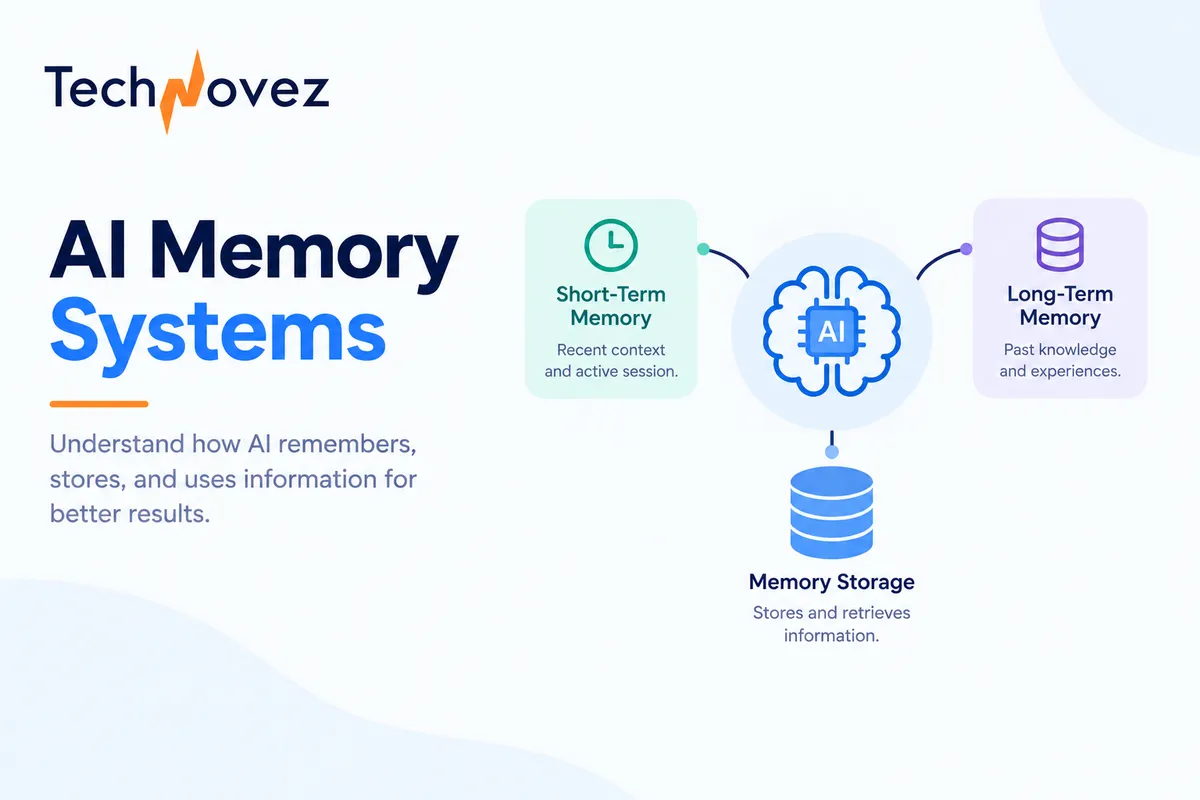
- Short-term memory recent conversation turns, held for the duration of a session.
- Long-term memory durable facts, preferences, and history stored outside the model and retrieved on demand.
- Retrieval layer the logic, often vector search, that decides what long-term memory is relevant right now.
- Consolidation layer the process that decides what short-term memory graduates into long-term storage.
This layered structure mirrors how cognitive science describes human memory, which is why the short-term vs long-term memory framing translates so well to AI systems.
Short-Term Memory in AI (Working Memory)
Short-term memory in AI refers to information the system holds only for the current session or task. In an LLM, this usually means the active context window: the running transcript of the conversation, recent tool calls, and any documents pulled in for the current task.
- Fast and cheap it lives in the prompt itself, with no external lookup required.
- Volatile once the session ends or the context window is trimmed, it's gone unless explicitly saved elsewhere.
- Limited by token budget every added message competes for the same finite space.
Short-term memory is what makes a single conversation feel coherent. It's the equivalent of RAM in a computer: fast, immediate, but wiped clean when the session ends.
Long-Term Memory in AI Agents (Persistent Memory)
Long-term memory in AI is information stored outside the model's context window in a durable system a database, vector store, or knowledge graph and retrieved only when relevant. This is what allows an AI agent to remember a user's name, preferences, past decisions, or project history across weeks or months of use.
Long-term memory for AI agents typically stores:
- User preferences and profile data tone, goals, recurring constraints
- Episodic history what happened in past interactions
- Semantic facts things learned and confirmed as generally true
- Task and project state ongoing work that spans multiple sessions
Persistent memory for AI agents is usually implemented with embeddings and a vector database, or a hybrid of vector search plus structured storage.
Short-Term vs Long-Term Memory in AI: Key Differences
| Dimension | Short-Term Memory | Long-Term Memory |
| Lifespan | Single session or task | Persistent, across sessions |
| Storage location | Context window / prompt | External database (vector store, SQL, graph) |
| Retrieval method | Always present in context | Queried and injected on demand |
| Cost profile | Low latency, competes for token budget | Slightly higher latency, near-unlimited capacity |
| Best for | Conversational flow, in-task reasoning | Personalization, continuity, institutional knowledge |
| Failure mode | Truncated or forgotten as context fills | Retrieval misses relevant memory or surfaces stale data |
Neither layer replaces the other. A production-grade AI agent memory system nearly always combines both: short-term memory for fluency within a session, long-term memory for continuity across sessions.
How AI Agent Memory Works (Under the Hood)
Understanding how AI agent memory works means following a request through the pipeline:
- Input arrives a user sends a message or the agent receives a trigger.
- Retrieval the system queries long-term memory, usually via semantic or vector search.
- Context assembly retrieved memories are merged with short-term history and the current input.
- Inference the model generates a response using this assembled context.
- Write-back new information worth keeping is extracted and written to long-term storage.
- Consolidation raw session logs are periodically summarized or pruned.
This retrieval → assembly → inference → write-back loop is the backbone of nearly every modern AI agent memory system.
Conversational Memory in AI Products
Conversational memory in AI is the user-facing expression of this architecture it's what lets a support assistant remember a customer's order history, or a productivity agent remember a user's working style. The difference between good and bad conversational memory almost always comes down to retrieval quality, not how much is stored.
How to Build Memory for AI Agents: An Implementation Guide
- Define what's worth remembering separate transient chatter from durable facts, decisions, and preferences.
- Choose your storage layers combine a vector database, a structured store, and a summarization layer.
- Build the retrieval logic decide how many memories to pull and how to rank them by recency, relevance, and importance.
- Handle consolidation and decay prune and summarize long-term memory so it doesn't become stale or unwieldy.
- Add feedback loops let the system or the user correct bad memories.
Best Memory Systems for AI Agents: Best Practices
- Separate memory types explicitly treat preferences, facts, and episodic history differently.
- Make retrieval relevance-first, not recency-first.
- Cap what gets injected per request more context isn't always better.
- Version and audit memory writes.
- Give memory an expiration policy design decay rules per memory type.
- Test retrieval like you'd test search precision and recall both matter.
There is no single “best” memory system for every AI agent the right approach depends on your latency budget, data sensitivity, and how personalized the product needs to be.
Frequently Asked Questions
What is the difference between short-term and long-term memory in AI?
Short-term memory lives inside the model's active context window and lasts only for the current session. Long-term memory is stored externally, often in a vector database, and persists across sessions.
Does an LLM have memory by default?
No. An LLM's weights are static after training. Memory behavior comes from an external system, not from the model learning during the conversation.
What is the best way to implement AI agent memory?
Most production systems combine a vector store, a structured database, and a summarization or consolidation process.
Why does AI agent memory matter for businesses?
Persistent memory turns a generic chatbot into a personalized AI agent, which directly improves retention, efficiency, and trust in the product.
Build Production-Ready AI Memory Systems with Technovez
Technovez designs and builds custom AI agent memory systems, LLM integrations, and full-stack AI products for teams across the USA and EU.
Explore our AI development services: technovez.com/services
Contact our team: technovez.com/contact