
AI Security Best Practices 2026: The Complete Framework for Enterprises
Meta Title: AI Security Best Practices 2026 | Enterprise AI Security Framework
Meta Description: A complete guide to AI security best practices, risks, and governance frameworks for enterprises. Learn how to secure AI systems with Technovez.
Artificial intelligence is no longer an experimental technology sitting in a lab — it is running inside customer support systems, financial models, healthcare diagnostics, and core enterprise infrastructure across the United States and the European Union. With that shift, AI security has moved from a "nice to have" to a board-level priority. Attackers now target the AI layer itself — model weights, training data, prompts, and inference pipelines — not just the traditional network perimeter.
This guide breaks down the full landscape of AI cybersecurity and artificial intelligence security, covering the risks organizations face in 2026, the frameworks that govern AI systems in the US and EU, and the practical AI security best practices 2026 that enterprises need to adopt now. Whether you are a CISO, a product leader, or a founder evaluating enterprise AI security, this article gives you a working playbook.
If you need hands-on help implementing any of the practices below, Technovez's security and AI engineering services team can assess your environment and build a roadmap tailored to your stack.
What Is AI Security? A Working Definition
AI security refers to the practices, controls, and governance structures used to protect AI systems — models, data pipelines, APIs, and the infrastructure around them — from misuse, manipulation, and compromise. It sits at the intersection of traditional cybersecurity and a newer discipline sometimes called AI application security, which focuses specifically on vulnerabilities unique to machine learning and generative AI systems.
Unlike conventional software, AI systems introduce attack surfaces that didn't exist before:
- Training data that can be poisoned or leaked
- Model weights that can be stolen or reverse-engineered
- Prompts and inputs that can be manipulated to bypass safeguards (prompt injection)
- Outputs that can leak sensitive information or be weaponized for fraud
Because of this, secure AI systems require a security model that extends well beyond firewalls and endpoint protection.
Why AI Security Matters More in 2026 — Especially for US and EU Businesses
Regulatory pressure has caught up with adoption. In the EU, the AI Act is now in active enforcement phases, requiring risk classification, documentation, and human oversight for high-risk AI systems. In the US, a patchwork of federal guidance (including NIST's AI Risk Management Framework) and state-level laws (California, Colorado, and others) is pushing companies toward formal AI governance programs.
For organizations operating across both regions, this means:
- Documented AI risk management processes are becoming a compliance requirement, not just best practice
- Data residency and AI privacy and security obligations differ between GDPR (EU) and sector-specific US laws (HIPAA, CCPA, GLBA)
- Auditability of AI decision-making is increasingly mandatory for high-risk use cases (credit, hiring, healthcare)
Ignoring this isn't just a security gap — it's a legal and reputational one.
Common AI Security Risks and Threats in 2026
Understanding AI security risks is the first step toward mitigating them. The most pressing AI security threats enterprises face today include:
1. Prompt Injection and Jailbreaking
Attackers craft inputs designed to override a model's instructions, extract hidden system prompts, or manipulate outputs — a top concern for any business deploying customer-facing generative AI.
2. Data Poisoning
Malicious or low-quality data introduced into training or fine-tuning pipelines can silently corrupt model behavior, creating backdoors or biased outcomes that are hard to detect after deployment.
3. Model Theft and Extraction
Competitors or bad actors can query a deployed model repeatedly to reconstruct its logic or weights — a real risk for companies with proprietary models representing significant R&D investment.
4. Sensitive Data Leakage
Large language models trained or fine-tuned on internal data can inadvertently expose confidential information in outputs, creating serious AI data security and privacy violations.
5. Supply Chain Vulnerabilities
Pre-trained models, open-source libraries, and third-party APIs used in AI pipelines can introduce vulnerabilities inherited from upstream sources.
6. Shadow AI
Employees adopting unsanctioned AI tools without IT or security oversight creates blind spots that undermine even well-designed AI security strategy efforts.
The Core Pillars of an AI Security Framework
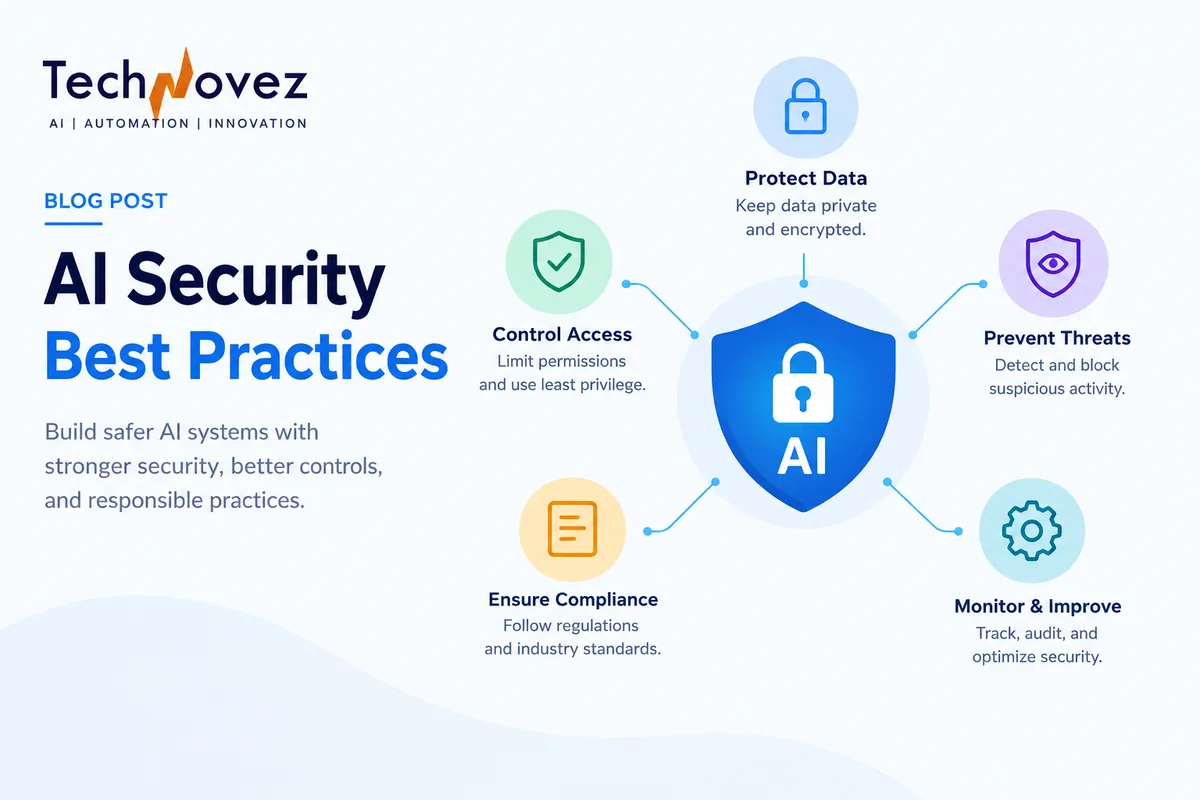
AI security framework is typically built on five interconnected pillars:
- Governance and Accountability — clear ownership, policies, and documented risk classifications (aligned with NIST AI RMF and the EU AI Act)
- Data Security — encryption, access control, and lineage tracking across training and inference data
- Model Security — protecting weights, monitoring for extraction attempts, and validating model integrity
- Application-Layer Security — input validation, output filtering, and rate limiting for AI-powered applications
- Continuous Monitoring — logging, anomaly detection, and red-teaming to catch emerging threats before they cause damage
This structure gives security and product teams a shared vocabulary — and it's the same framework Technovez uses when auditing client AI deployments through our enterprise services.
AI Security Best Practices for 2026
Here are the practical, implementable AI security best practices every organization should adopt this year.
Strengthen AI Application Security
- Validate and sanitize all user inputs before they reach the model
- Apply output filtering to catch data leakage or harmful content before it reaches end users
- Rate-limit and monitor API access to prevent automated extraction attempts
- Run regular adversarial testing (red-teaming) against production models
Prioritize AI Data Security and Privacy
- Encrypt training and inference data both at rest and in transit
- Apply data minimization — only feed models the data they genuinely need
- Maintain clear data lineage so you can trace what a model was trained on
- Implement differential privacy or anonymization techniques where regulations demand it
Build Real AI Governance, Not Just Policy Documents
- Classify AI use cases by risk level (aligned with EU AI Act categories: unacceptable, high, limited, minimal)
- Assign clear accountability — a named owner for every production AI system
- Maintain audit trails for model decisions, especially in regulated industries
- Establish an internal AI review board for new deployments
Operationalize AI Risk Management
- Conduct AI-specific risk assessments before deployment, not after
- Maintain a model inventory (what's deployed, where, and by whom)
- Set up continuous monitoring for model drift, bias, and anomalous behavior
- Build incident response playbooks specific to AI failures — not just generic breach response
Secure the Supply Chain
- Vet third-party models and datasets before integration
- Maintain a software bill of materials (SBOM) equivalent for AI components
- Patch and update dependencies used in AI pipelines as rigorously as any other software
Building an Enterprise AI Security Strategy
A strong AI security strategy isn't a one-time project — it's a continuous program that evolves alongside your AI adoption. The most effective enterprises we work with follow this sequence:
- Assess current AI usage across the organization, including shadow AI
- Classify systems by risk and regulatory exposure (US and EU requirements differ)
- Implement the technical controls outlined above
- Govern with clear policy, ownership, and audit trails
- Monitor continuously and iterate as threats evolve
If your team needs support building or auditing this strategy, Technovez's engineers work directly with businesses to design secure, compliant AI systems from the ground up — explore our services page or get in touch with our team to discuss your environment.
Frequently Asked Questions
What is the difference between AI security and traditional cybersecurity?
Traditional cybersecurity protects networks, endpoints, and applications. AI security adds protection for model weights, training data, prompts, and AI-specific attack vectors like prompt injection and data poisoning that don't exist in conventional software.
Is AI security regulated ?
Yes. The EU AI Act imposes binding requirements on high-risk AI systems, while the US relies on a mix of federal guidance (NIST AI RMF) and state-level laws. Businesses operating in both regions need a governance approach that satisfies the stricter of the two.
What are the biggest AI security risks in 2026?
The most common risks are prompt injection, data poisoning, model theft, sensitive data leakage, supply chain vulnerabilities, and unsanctioned "shadow AI" tools used without security oversight.
How often should AI systems be audited for security?
High-risk AI systems should be reviewed continuously through monitoring, with formal audits at least quarterly or whenever a model, dataset, or major dependency changes.
Do small and mid-sized businesses need an AI security framework?
Yes. AI security risk isn't limited to large enterprises — any business using third-party AI tools or deploying custom models handles sensitive data and inherits real risk, regardless of company size.
Final Thoughts
AI security in 2026 is no longer optional infrastructure — it's a core requirement for any organization deploying AI. The businesses that treat AI governance, AI risk management, and AI data security as foundational — not an afterthought — will be the ones that scale AI adoption safely and stay ahead of regulatory requirements on both sides of the Atlantic.
Ready to Secure Your AI Systems?
Technovez helps enterprises design, audit, and implement enterprise AI security frameworks — from data protection to governance and compliance.