
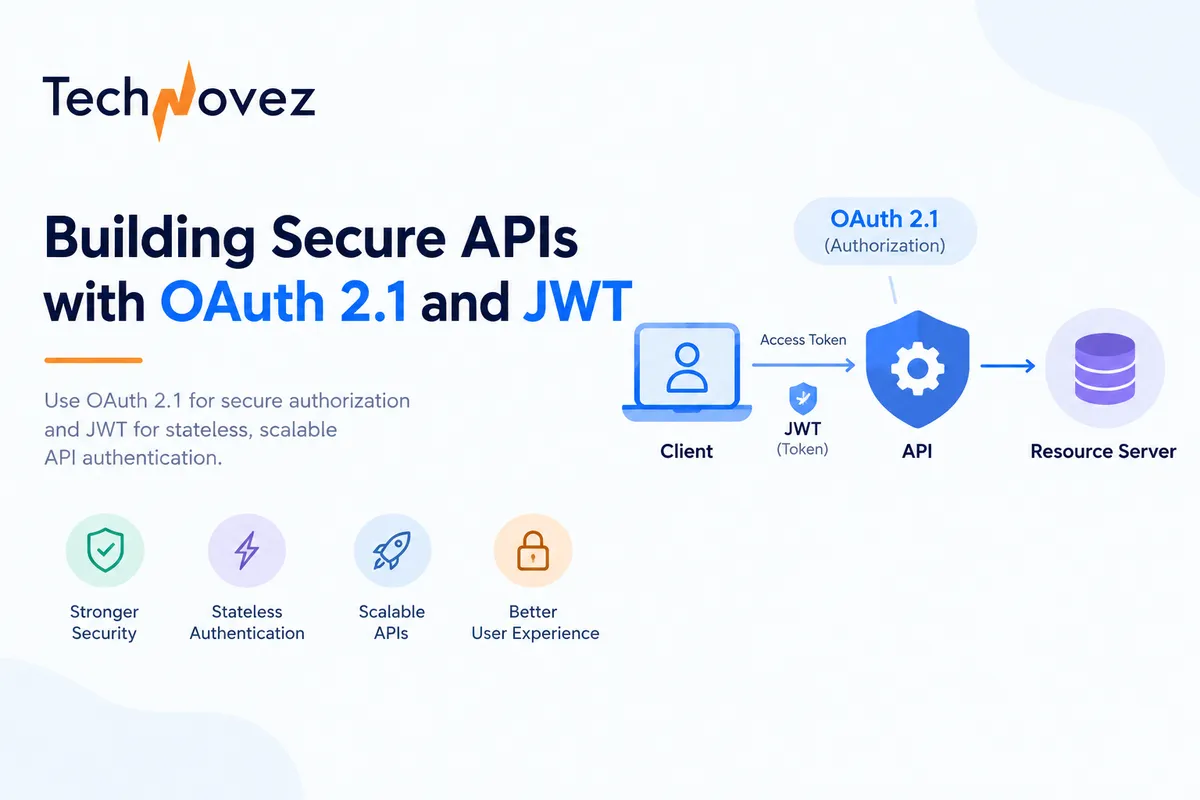
If your API is reachable from the internet, authentication and authorization aren't optional line items they're the front door to your business. This guide walks through building secure API authentication and API authorization using OAuth 2.1 and JWT authentication, the combination that has become the de facto standard for secure REST API design across the US and EU in 2026.
Whether you're securing a single REST API or a fleet of microservices, you'll get a clear picture of the OAuth 2.1 authentication flow, how JWT works with OAuth 2.1, and the API authentication best practices that separate resilient systems from breach headlines.
OAuth vs JWT: Clearing Up the Most Common Confusion
Before going further, it's worth resolving the question almost everyone searches first: OAuth vs JWT — are they the same thing? No. This is the single most misunderstood pairing in API security.
| Factor | OAuth 2.1 | JWT |
| What it is | Authorization framework/protocol | Token format (a way to encode claims) |
| Job | Defines how a client gets access (flows, consent, PKCE) | Defines how the access token itself is structured & verified |
| Analogy | The process of issuing a badge | The badge itself |
| Used alone? | Yes — can issue opaque tokens instead of JWTs | Yes — JWTs can carry auth data outside OAuth too |
| Together | OAuth 2.1 issues a JWT as the access token | JWT is validated by the resource server on every request |
In short: OAuth 2.1 is the process; JWT is the artifact that process produces. Most modern secure REST API with JWT implementations use OAuth 2.1 to issue and manage JWT access tokens which is exactly why the two are almost always discussed together.
What Is OAuth 2.1?
OAuth 2.1 is the consolidated authorization framework that folds a decade of OAuth 2.0 security lessons PKCE, strict redirect matching, removal of risky grants into a single, safer specification. It replaces the original OAuth 2.0 core (RFC 6749) and Bearer Token Usage (RFC 6750) with one hardened profile.
The headline changes that matter for OAuth 2.1 authentication:
- PKCE is mandatory for every authorization code flow, not just public clients
- The Implicit grant is removed tokens must never be returned directly in a URL fragment
- The Resource Owner Password Credentials (ROPC) grant is removed apps should never collect and forward raw user passwords
- Redirect URIs must match exactly (no wildcard or partial matching), closing a major open-redirect attack surface
- Refresh tokens for public clients must be sender-constrained or rotated on use
As of 2026, OAuth 2.1 is still an IETF Internet-Draft rather than a published RFC, but it already defines the practical security baseline that major identity providers (Okta, Auth0, Microsoft Entra, AWS Cognito) are converging toward so implementing it now future-proofs your API authentication.
The OAuth 2.1 Authorization Code Flow, Step by Step
The authorization code flow (with PKCE) is the OAuth 2.1 authorization code flow every web, mobile, and single-page application should use. Here's how to secure APIs with OAuth 2.1 using this flow:
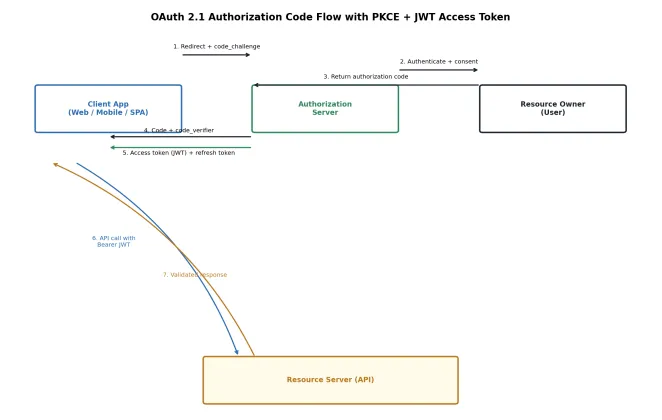
Figure 1: OAuth 2.1 authorization code flow with PKCE, issuing a JWT access token
- 1. Authorization request the client redirects the user to the authorization server with a code challenge (derived from a locally generated code verifier)
- 2–3. User authentication & consent the resource owner logs in and approves the requested scopes; the server returns a short-lived authorization code
- 4. Token exchange the client exchanges the code plus the original code verifier for tokens; the server verifies the PKCE proof
- 5. Token issuance the authorization server returns a JWT access token and a refresh token
- 6–7. API access the client calls the resource server with the JWT as a Bearer token; the API validates the signature, claims, and scope before responding
How JWT Works with OAuth 2.1
A JSON Web Token is a compact, URL-safe, digitally signed token made of three Base64URL-encoded parts, separated by dots: header, payload, and signature.
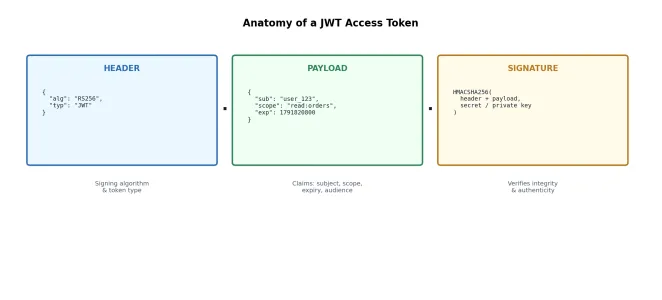
Figure 2: Anatomy of a JWT access token used in secure API authentication
- Header declares the signing algorithm (e.g., RS256) and token type
- Payload carries claims: subject (sub), scope, audience (aud), issuer (iss), and expiry (exp)
- Signature cryptographically proves the token wasn't tampered with, using either a shared secret (HMAC) or a private/public key pair (RSA/ECDSA)
In OAuth 2.1 JWT authentication, the authorization server signs the JWT, and every downstream resource server can validate it independently using the issuer's public key without a network round trip back to the authorization server. This is what makes JWT-based OAuth 2.1 for microservices so effective: each service validates the token locally and stays stateless.
JWT Access Token Best Practices
- Keep access tokens short-lived (5–15 minutes) and rely on refresh tokens for longevity
- Always set and validate exp, aud, and iss claims never trust a token whose audience doesn't match your API
- Use asymmetric signing (RS256/ES256) for anything validated by multiple services, so no resource server ever holds a signing secret
- Never store JWTs in localStorage for browser apps use HttpOnly, Secure, SameSite cookies to reduce XSS token theft
- Keep payloads minimal JWTs are visible to anyone who has them (they're signed, not encrypted); never put secrets or excessive PII in the payload
- Support token revocation via short expiries plus a refresh-token blocklist, since JWTs can't be individually invalidated once issued
OAuth 2.1 Security Best Practices for 2026
These API authentication best practices 2026 apply whether you're protecting a single REST API or a distributed platform:
- Enforce PKCE on every authorization code flow, including confidential clients
- Validate redirect URIs with exact string matching no wildcards
- Rotate refresh tokens on every use and detect reuse as a signal of token theft
- Scope tokens narrowly request and grant only the permissions a client actually needs
- Terminate TLS everywhere; never transmit tokens over unencrypted connections
- Log and monitor token issuance and API authorization failures for anomaly detection
Together, these form the backbone of modern API security and they're the same baseline auditors in both the US (SOC 2, HIPAA) and EU (GDPR, NIS2) increasingly expect to see documented.
OAuth 2.1 for Microservices and Enterprise APIs
In a distributed system, OAuth 2.1 for enterprise APIs typically centers on a dedicated identity provider issuing JWTs that every internal service can verify independently:
- Centralized issuance, decentralized validation one authorization server issues tokens; every microservice validates signatures locally using cached public keys (JWKS)
- API gateway enforcement — a gateway can validate tokens and enforce coarse-grained authorization before requests ever reach internal services
- Service-to-service auth use the client credentials grant with short-lived JWTs for machine-to-machine calls between services
- Token propagation pass the original (or an exchanged, narrower) token downstream so every hop can enforce authorization consistently
If your organization is also weighing how to structure those services in the first place, this pairs directly with modular monolith and microservices architecture decisions the identity layer should be designed before, not after, you commit to a service topology.
A Simple Implementation Example
A minimal OAuth 2.1 implementation example for validating an incoming JWT on a Node.js resource server looks like this:
const { auth } = require("express-oauth2-jwt-bearer");
app.use(
auth({
issuerBaseURL: "https://auth.technovez.com",
audience: "https://api.technovez.com",
})
);
app.get("/orders", (req, res) => {
// req.auth.payload contains verified JWT claims
res.json({ orders: [] });
});
The library fetches the issuer's public signing keys (via the JWKS endpoint), verifies the signature, and checks exp, aud, and iss automatically so your API code never has to touch cryptography directly.
How Technovez Secures APIs for Growing Teams
At Technovez, we design and implement secure API authentication and authorization for startups and enterprises across the US and EU from a single OAuth 2.1 authorization server to full identity architecture across a microservices fleet. Our team builds systems that pass security audits the first time, not the third.
Explore our API security and backend engineering services to see how we implement OAuth 2.1 and JWT authentication in production, or contact our team for a free API security review.
Frequently Asked Questions
Is OAuth 2.1 the same as JWT?
No. OAuth 2.1 is an authorization framework that defines how a client obtains access; JWT is a token format that can be used to represent that access. OAuth 2.1 commonly issues JWTs as access tokens, but the two solve different problems.
Do I need OAuth 2.1 if I'm already using JWT?
Using JWTs alone only solves token format and verification it doesn't define how tokens are safely issued, consented to, or refreshed. OAuth 2.1 provides that missing authorization layer, especially for third-party or user-facing API access.
What replaced the OAuth 2.0 implicit flow in OAuth 2.1?
The authorization code flow with PKCE. It avoids exposing tokens in the browser's URL fragment and protects against authorization code interception, making it suitable for public clients like SPAs and mobile apps.
How long should a JWT access token last?
Most production systems use 5–15 minute access token lifetimes paired with longer-lived, rotated refresh tokens. Short expiries limit the damage window if a token is ever leaked.
Can JWTs be used without OAuth?
Yes, JWTs can be issued by a custom authentication system without full OAuth 2.1 flows. However, for third-party integrations, delegated access, or multi-service authorization, OAuth 2.1 provides a standardized, interoperable, and better-audited approach.
Ready to Lock Down Your API?
OAuth 2.1 and JWT authentication done right is the difference between an API that scales safely and one that becomes a headline. Technovez's engineering team has implemented secure API authentication and authorization for products across the US and EU let's make sure yours is built right from day one.