
TECHNOVEZ
Enterprise AI Automation & Digital Transformation
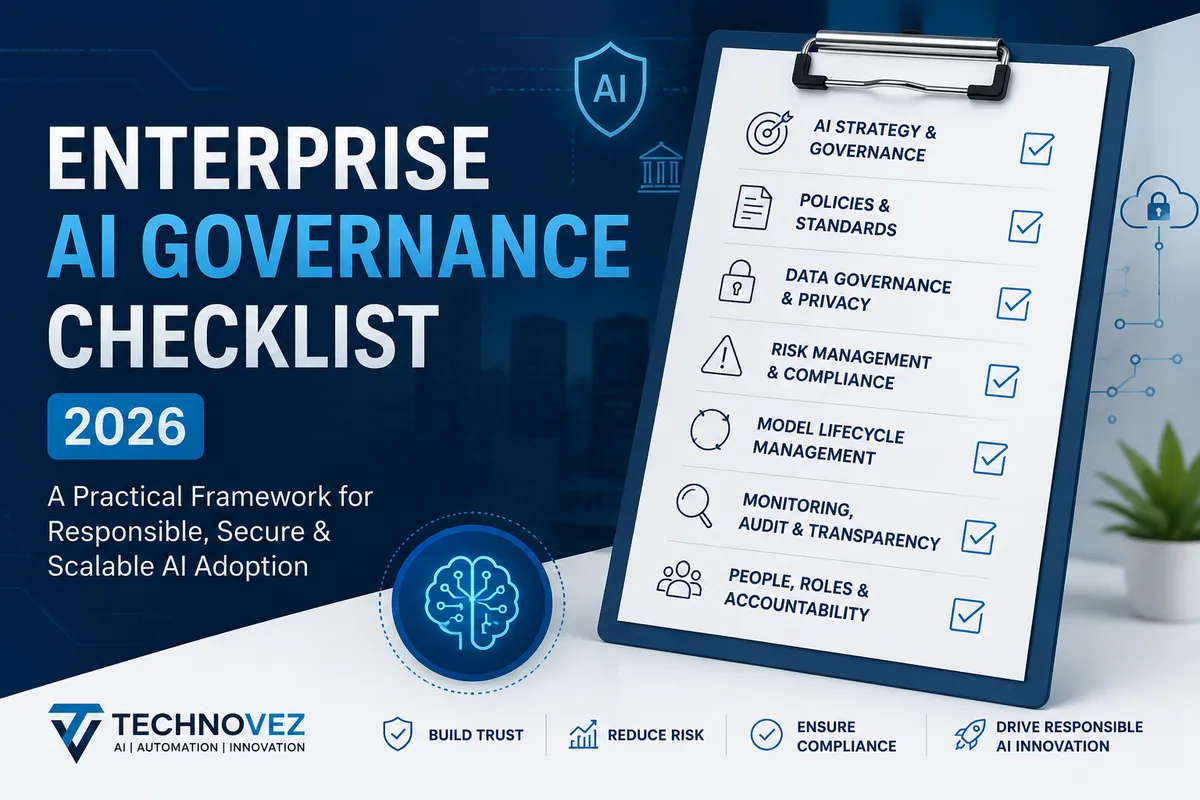
Enterprise AI Governance Checklist: A Complete Guide to Secure, Responsible, and Scalable AI Adoption in 2026
Best Practices for Secure AI Implementation
By the Technovez Editorial Team | Enterprise AI & Governance Insights | 2026
1. Introduction: AI Governance Is Now a Board-Level Priority
| Quick Answer | AI governance has moved from an IT concern to a board-level priority because enterprises are deploying generative AI and AI agents faster than their risk, security, and compliance functions can keep pace — and regulators are catching up quickly. |
Generative AI and AI agents have moved from pilot projects to production systems inside enterprise environments at a pace few other technologies have matched. Employees are using AI tools with or without formal approval, business units are standing up Copilot Studio agents, and IT teams are integrating large language models (LLMs) into customer-facing and internal workflows.
That speed creates exposure. AI systems can access sensitive data, take autonomous action, and make decisions that affect customers, employees, and regulatory standing — often without the same controls applied to traditional software. Regulatory frameworks such as the EU AI Act, along with voluntary standards like the NIST AI Risk Management Framework and ISO/IEC 42001, are raising the baseline expectation for how organizations manage AI risk.
This is why AI governance now sits on board and audit committee agendas, not just IT roadmaps. Boards want assurance that AI deployment won't create legal liability, security incidents, or reputational damage. This guide lays out what enterprise AI governance actually means, why it matters, and a complete, practical checklist your organization can use to build a governance program — covering everything from executive sponsorship to agent-specific oversight.
2. What Is AI Governance?
| Quick Answer | AI governance is the framework of policies, roles, processes, and controls an organization uses to ensure AI systems are developed, deployed, and monitored responsibly, securely, and in compliance with legal and ethical standards. |
AI governance sits above individual tools and models. It defines who is accountable for AI decisions, what risk an AI system is allowed to take on, how that risk is monitored, and what happens when something goes wrong. It is the connective layer between AI strategy, security, legal, and operations.
Core Components
- Responsible AI: Principles and practices ensuring AI systems are fair, transparent, and used within intended boundaries.
- AI Lifecycle Management: Governance applied consistently from planning through retirement of an AI system, not just at launch.
- AI Policies: Documented rules defining acceptable use, approved tools, and data-handling requirements for AI systems.
- Risk Management: Structured identification, assessment, and mitigation of risks specific to AI — including bias, hallucination, and unauthorized action.
- Security: Controls protecting AI systems, data, and infrastructure from misuse, manipulation, or compromise.
- Transparency: Clear documentation of how an AI system works, what data it uses, and how its outputs should be interpreted.
- Human Oversight: Defined checkpoints where a person reviews, approves, or can override an AI system's output or action.
3. Why Every Enterprise Needs AI Governance
| Quick Answer | Enterprises need AI governance to manage business risk, meet compliance obligations, maintain customer trust, and prevent security incidents — without governance, AI adoption tends to outpace the organization's ability to control it. |
- Business Risk: Ungoverned AI can make decisions or take actions outside the organization's risk tolerance.
- Compliance: Regulations increasingly require documented AI risk management, especially for high-risk use cases.
- Customer Trust: Customers and partners expect AI systems handling their data to be secure and accountable.
- Operational Resilience: Governance ensures AI failures are detected and contained before they cascade into larger outages.
- Security: AI systems introduce new attack surfaces — prompt injection, data leakage, tool misuse — that require dedicated controls.
- Brand Reputation: Public AI failures, from biased outputs to data exposure, carry outsized reputational cost.
- Financial Impact: Poorly governed AI can create direct financial loss through errors, fines, or remediation costs.
- Regulatory Readiness: Early governance investment reduces the cost and disruption of adapting to new AI regulation later.
4. Enterprise AI Governance Checklist
| Quick Answer | A complete enterprise AI governance checklist spans strategy, risk, data and model governance, identity and access management, monitoring, compliance, and organizational readiness — organized here into nine practical categories. |
Strategy & Sponsorship
☐ Executive sponsor assigned for AI governance
☐ AI strategy documented and aligned to business objectives
☐ Governance committee established with cross-functional representation
☐ Clear ownership defined for each AI system in production
Risk & Data Governance
☐ AI risk assessment completed for each use case
☐ Data governance policy defines what data AI systems can access
☐ Data classification applied before granting AI access
☐ Third-party and vendor AI risk assessed before adoption
Model & Prompt Governance
☐ Model selection criteria documented, including approved providers
☐ Prompt governance policy defines acceptable prompt patterns and restrictions
☐ Model evaluation process in place before production deployment
☐ Hallucination and bias testing conducted prior to launch
Agent Governance & Human Oversight
☐ Agent permissions scoped to least privilege required for the task
☐ Human-in-the-loop checkpoints defined for high-risk agent actions
☐ Escalation path defined for agent actions above a risk threshold
☐ Agent activity logged with full audit trail
Identity, Access & Security
☐ Role-based access control (RBAC) applied to all AI systems
☐ Multi-factor authentication enforced for AI administration
☐ Encryption applied to data at rest and in transit
☐ Secrets management used for API keys and credentials
Monitoring & Incident Response
☐ Centralized logging in place for AI system activity
☐ Real-time monitoring configured for anomalous AI behavior
☐ Incident response plan includes AI-specific scenarios
☐ Regular audit trail review scheduled
Compliance & Responsible AI
☐ AI usage policy published and communicated organization-wide
☐ Compliance mapping completed against relevant regulations
☐ Ethics review process defined for sensitive use cases
☐ Responsible AI principles documented and enforced
Continuity & Documentation
☐ Business continuity plan covers AI system failure scenarios
☐ Disaster recovery plan tested for AI-dependent workflows
☐ AI system documentation maintained and kept current
☐ Model and data lineage documented for auditability
People & Continuous Improvement
☐ Employee AI training program in place
☐ Governance KPIs defined and tracked
☐ Governance program reviewed and updated on a regular cadence
☐ Shadow AI usage actively monitored and addressed
5. Governance Framework Across the AI Lifecycle
| Quick Answer | Effective AI governance applies controls at every stage of the AI lifecycle — planning, development, testing, deployment, monitoring, optimization, and retirement — rather than only at launch. |
| Lifecycle Stage | Governance Activity |
| Planning | Define use case, risk tolerance, data requirements, and success metrics before development begins. |
| Development | Apply secure development practices, document model and data sources, and involve governance stakeholders early. |
| Testing | Conduct bias testing, hallucination testing, security testing, and human evaluation before production release. |
| Deployment | Apply access controls, human oversight checkpoints, and rollback plans as part of go-live. |
| Monitoring | Track accuracy, security events, and business KPIs continuously after deployment. |
| Continuous Optimization | Refine prompts, guardrails, and permissions based on observed performance and incidents. |
| Retirement | Formally decommission AI systems, revoke access and credentials, and archive documentation for audit purposes. |
6. AI Governance Maturity Model
| Quick Answer | AI governance maturity progresses through five levels — from ad hoc, ungoverned use to a fully governed, AI-first enterprise with continuous oversight built into every AI system. |
| Maturity Level | Description |
| Level 1 — Ad Hoc | AI tools used informally across teams with no central policy, visibility, or risk assessment. |
| Level 2 — Managed | Basic AI usage policy exists; some tools are approved, but oversight is inconsistent across the organization. |
| Level 3 — Standardized | Formal governance committee, documented policies, and risk assessments applied consistently to new AI systems. |
| Level 4 — Governed | Governance is embedded in the AI lifecycle with continuous monitoring, audit trails, and defined accountability. |
| Level 5 — AI-First Enterprise | AI governance is integrated into overall enterprise risk management, with mature agent governance and proactive regulatory readiness. |
7. AI Governance vs AI Security
| Quick Answer | AI governance defines the policies and accountability structures for responsible AI use, while AI security focuses specifically on protecting AI systems, data, and infrastructure from technical threats. The two are complementary, not interchangeable. | |
| Dimension | AI Governance | AI Security |
| Primary Focus | Policy, accountability, and responsible use | Protecting systems from technical threats |
| Scope | Organization-wide AI strategy and oversight | Infrastructure, data, and model-level protection |
| Owned By | Governance committee, legal, compliance | Security engineering, CISO |
| Key Concerns | Ethics, compliance, transparency, accountability | Prompt injection, data leakage, access control |
| Example Control | Human-in-the-loop approval policy | Encryption and least-privilege access control |
AI Governance vs IT Governance
| Dimension | AI Governance | Traditional IT Governance |
| Primary Risk Type | Model behavior, bias, autonomous action | System availability, data integrity, access |
| Change Frequency | Model and prompt behavior can shift over time | Infrastructure changes are typically planned and versioned |
| Oversight Focus | Decision quality and appropriateness of AI actions | System uptime, configuration, and change control |
Traditional Governance vs AI Governance
| Dimension | Traditional Governance | AI Governance |
| Predictability | Systems behave deterministically | Outputs can vary even with identical inputs |
| Risk Profile | Well-understood, established control frameworks | Emerging risks — hallucination, bias, autonomous action |
| Audit Approach | Standard change logs and access reviews | Requires model, prompt, and output-level audit trails |
8. Microsoft AI Governance
| Quick Answer | Microsoft's platform provides built-in governance capabilities across Copilot Studio, Power Platform, Azure AI Foundry, and supporting security tools like Microsoft Purview, Entra ID, and Defender — giving enterprises a foundation for governed AI deployment inside their existing tenant. |
- Microsoft Copilot Studio: Provides permission scoping, data loss prevention integration, and monitoring for AI agents built on the platform.
- Power Platform: Includes environment-level governance, data loss prevention policies, and admin controls spanning Power Apps, Power Automate, and Copilot Studio.
- Power Automate: Governed through Power Platform admin center policies, connector restrictions, and approval workflows.
- Azure AI Foundry: Supports model evaluation, content filtering, and responsible-AI tooling for custom AI application development.
- Azure OpenAI: Offers enterprise-grade access controls, content filtering, and data handling commitments for OpenAI models hosted on Azure.
- Microsoft Purview: Provides data governance, classification, and compliance capabilities that extend to AI-generated and AI-accessed content.
- Microsoft Entra ID: Manages identity, authentication, and conditional access for both users and AI agents interacting with enterprise systems.
- Microsoft Defender: Extends threat protection and monitoring to AI workloads and connected data sources.
- Microsoft Fabric: Supports governed data pipelines that feed AI systems, with lineage and access control built in.
For enterprises standardized on Microsoft 365, these tools provide a practical starting point: governance controls can be layered onto AI initiatives without building a separate compliance stack from scratch.
9. Industry-Specific Governance Considerations
| Quick Answer | AI governance requirements vary significantly by industry — healthcare and finance face the strictest regulatory scrutiny, while sectors like retail and education face growing but less prescriptive expectations. |
Healthcare
Governance must address patient data privacy, clinical decision-support accuracy, and regulatory requirements for AI used in care-related decisions.
Finance
Governance focuses on model explainability, fair lending considerations, and audit trails for AI-assisted financial decisions.
Insurance
Governance addresses fairness in underwriting and claims decisions, along with documentation supporting regulatory review.
Retail
Governance covers customer data handling and transparency in AI-driven personalization and pricing.
Manufacturing
Governance emphasizes safety-critical decision oversight where AI supports operational or predictive maintenance systems.
Government
Governance requires heightened transparency, public accountability, and alignment with public-sector AI use policies.
Education
Governance addresses student data privacy and appropriate use boundaries for AI in academic settings.
Legal
Governance requires strict human review of AI-assisted legal analysis and clear documentation of AI involvement in work product.
10. Common AI Governance Mistakes
| Quick Answer | The most common AI governance failures include skipping a governance committee, deploying without a risk assessment, weak access controls, ignoring compliance requirements, and allowing unmonitored shadow AI usage across the organization. |
- No Governance Committee: Decisions about AI risk are made informally, without cross-functional accountability.
- No Risk Assessment: AI systems go into production without a documented understanding of what could go wrong.
- No Documentation: Model, data, and decision logic aren't recorded, making audits and incident investigation difficult.
- Weak Access Controls: AI systems and agents are granted broader data or tool access than the task requires.
- Ignoring Compliance: Regulatory requirements are addressed reactively instead of being built into the deployment process.
- No Human Approval: High-risk AI actions proceed without a defined checkpoint for human review.
- Poor Monitoring: AI system behavior isn't tracked closely enough to catch drift, errors, or misuse early.
- Shadow AI: Employees adopt unsanctioned AI tools that fall entirely outside governance visibility.
- No Incident Response: There is no defined process for responding when an AI system produces a harmful or non-compliant output.
11. Future of AI Governance (2026–2030)
| Quick Answer | Between 2026 and 2030, expect expanding AI regulation, wider ISO/IEC 42001 adoption, dedicated governance for autonomous AI agents, AI-specific auditing practices, and governance processes that are themselves increasingly automated. |
- AI Regulations: Continued expansion of regional AI regulation, building on frameworks like the EU AI Act.
- ISO/IEC 42001 Adoption: Growing enterprise adoption of the ISO/IEC 42001 AI management system standard as a certification benchmark.
- Autonomous AI Governance: Purpose-built governance models for AI agents operating with greater independence and tool access.
- AI Auditing: Maturing practices and tooling for independently auditing AI system behavior and decisions.
- Policy Automation: Governance policies increasingly enforced automatically through platform-level controls rather than manual review.
- Agent Governance: Dedicated frameworks for permissioning, monitoring, and constraining multi-agent systems.
- Enterprise AI Operating Models: Governance becoming a standing function within enterprise operating models, not a project-based initiative.
12. How Technovez Helps
Technovez helps enterprise teams build AI governance programs that are practical, not performative — grounded in recognized frameworks and tailored to how your organization actually deploys AI.
- Enterprise AI Governance: Designing governance committees, policies, and risk assessment processes tailored to your AI portfolio
- AI Strategy: Aligning AI investment with business objectives and governance requirements from the outset
- Microsoft Copilot Studio: Building governed AI agents with appropriate permission scoping and oversight
- Power Platform Governance: Implementing environment-level controls and data loss prevention policies
- AI Security: Assessing and strengthening the security posture of AI systems and their data access
- Agentic AI: Designing agent architectures with governance and human oversight built in from day one
- Enterprise Digital Transformation: Ensuring governance scales alongside broader AI and automation adoption
Decision Framework: Is Your Organization Ready for Enterprise AI?
Use this scoring matrix to assess governance readiness. Score each area from 0 (not in place) to 3 (fully implemented and monitored), then total the result.
| Readiness Area | Score |
| Executive sponsorship and governance committee | 0–3 |
| Documented AI risk assessment process | 0–3 |
| Data governance and classification policy | 0–3 |
| Identity, access, and encryption controls | 0–3 |
| Monitoring, logging, and audit trails | 0–3 |
| Human-in-the-loop checkpoints for high-risk actions | 0–3 |
| Compliance mapping to relevant regulations | 0–3 |
| Employee AI usage policy and training | 0–3 |
- 0–8: Ad hoc — governance foundations are not yet in place; start with a risk assessment and committee formation
- 9–16: Developing — core policies exist but application is inconsistent; focus on standardization
- 17–20: Managed — governance is functioning; focus on monitoring maturity and agent-specific controls
- 21–24: Advanced — governance is well embedded; focus on continuous improvement and regulatory readiness
Frequently Asked Questions
What is AI Governance?
AI governance is the framework of policies, roles, and controls that ensure AI systems are developed, deployed, and monitored responsibly, securely, and in compliance with legal and ethical standards.
Why is AI Governance important?
It manages business, security, and compliance risk while maintaining customer trust as organizations adopt generative AI and AI agents at increasing scale.
What is ISO/IEC 42001?
ISO/IEC 42001 is an international standard specifying requirements for an AI management system, helping organizations govern AI responsibly across its lifecycle.
What is the NIST AI Risk Management Framework?
The NIST AI RMF is a voluntary framework published by the U.S. National Institute of Standards and Technology to help organizations identify, assess, and manage risks associated with AI systems.
How do you govern AI Agents?
Agent governance involves scoping permissions to least privilege, defining human-in-the-loop checkpoints for high-risk actions, and maintaining full audit trails of agent activity.
Does Microsoft Copilot require governance?
Yes. Copilot and Copilot Studio agents access enterprise data and can take action, so they require the same governance controls — access management, monitoring, and policy — as other AI systems.
How can organizations reduce AI risks?
By implementing a documented risk assessment process, least-privilege access controls, human oversight for high-risk decisions, and continuous monitoring.
What is Responsible AI?
Responsible AI refers to principles and practices ensuring AI systems are fair, transparent, secure, and used within their intended purpose and limitations.
What is Shadow AI?
Shadow AI refers to AI tools adopted by employees without formal approval or governance oversight, creating risk that falls outside the organization's visibility.
What is the difference between AI governance and AI security?
AI governance covers policy, accountability, and responsible use, while AI security focuses specifically on protecting AI systems and data from technical threats.
Who should be on an AI governance committee?
Typically representatives from IT, security, legal, compliance, data governance, and relevant business units, sponsored by an executive stakeholder.
What is human-in-the-loop governance?
It's a design pattern where a human reviews or approves AI-generated decisions or actions above a defined risk or confidence threshold before they take effect.
How does the EU AI Act affect enterprise AI governance?
It introduces risk-based obligations for AI systems used in or affecting the EU, requiring documentation, risk assessment, and oversight proportional to the system's risk classification.
What is AI lifecycle management?
It's the practice of applying governance consistently across every stage of an AI system's life — planning, development, testing, deployment, monitoring, and retirement.
How often should an AI governance program be reviewed?
Most organizations review governance policies and controls at least annually, with more frequent review for high-risk AI systems or after significant incidents.
| Ready to Build a Governance Program That Scales with Your AI Adoption? | Technovez helps enterprise teams design and implement AI governance, AI strategy, Microsoft Copilot Studio agents, Power Platform governance, AI security, and broader digital transformation initiatives — grounded in recognized frameworks, not guesswork. | Contact Technovez to start with a governance readiness assessment → www.technovez.com/contact |
Publishing & Technical SEO Notes
Recommended Schema Markup
- Article Schema — headline, author, datePublished, dateModified, publisher
- FAQPage Schema — mapped to the 15 FAQ entries above
- Organization Schema — Technovez entity, logo, sameAs profiles
- BreadcrumbList Schema — Home > Blog > Enterprise AI Governance Checklist
- HowTo Schema — mapped to the Enterprise AI Governance Checklist steps
Internal Linking Suggestions
- Homepage anchor text: “Technovez’s enterprise AI governance and automation services” → https://www.technovez.com/
- Blog anchor text: “more Technovez insights on AI governance and Agentic AI” → https://www.technovez.com/blog
- Services anchor text: “our AI governance and Microsoft Copilot Studio services” → https://www.technovez.com/services
- Contact anchor text: “talk to a Technovez AI governance strategist” → https://www.technovez.com/contact
Authoritative References to Cite
- NIST AI Risk Management Framework (AI RMF 1.0)
- ISO/IEC 42001
- Microsoft Learn
- Microsoft Responsible AI Standard
- Microsoft Copilot Studio Documentation
- Azure AI Documentation
- OWASP Top 10 for LLM Applications
- OECD AI Principles
- European Union AI Act
- OpenAI Safety Documentation
Note: link directly to the current pages on each of these sites at publication time; do not fabricate specific URLs or citations not verified at time of publishing.
Social Media Assets
LinkedIn Post
Most enterprises adopted generative AI faster than they built the governance to manage it.
That gap is where the risk lives — not in the technology itself, but in ungoverned access, missing audit trails, and AI agents operating without clear oversight.
Our latest guide breaks down a complete Enterprise AI Governance Checklist — covering risk, data, identity, monitoring, and agent-specific oversight — plus a maturity model and readiness scoring matrix.
Full framework and checklist → link in comments.
#AIGovernance #EnterpriseAI #ResponsibleAI #MicrosoftCopilotStudio #AICompliance
Facebook Post
Is your organization actually ready for enterprise AI — or just using it? Our latest guide includes a complete AI governance checklist, a maturity model, and a scoring matrix to help you find out. Read it here →
Medium Introduction
Enterprise AI adoption has outpaced enterprise AI governance almost everywhere. It's not that organizations don't care about risk — it's that generative AI and AI agents moved into production faster than most risk, security, and compliance functions could build the controls to match. This guide lays out what AI governance actually means, why it belongs on the board agenda, and a complete, practical checklist — covering strategy, data, identity, agent oversight, and monitoring — that enterprise teams can use to close that gap.