
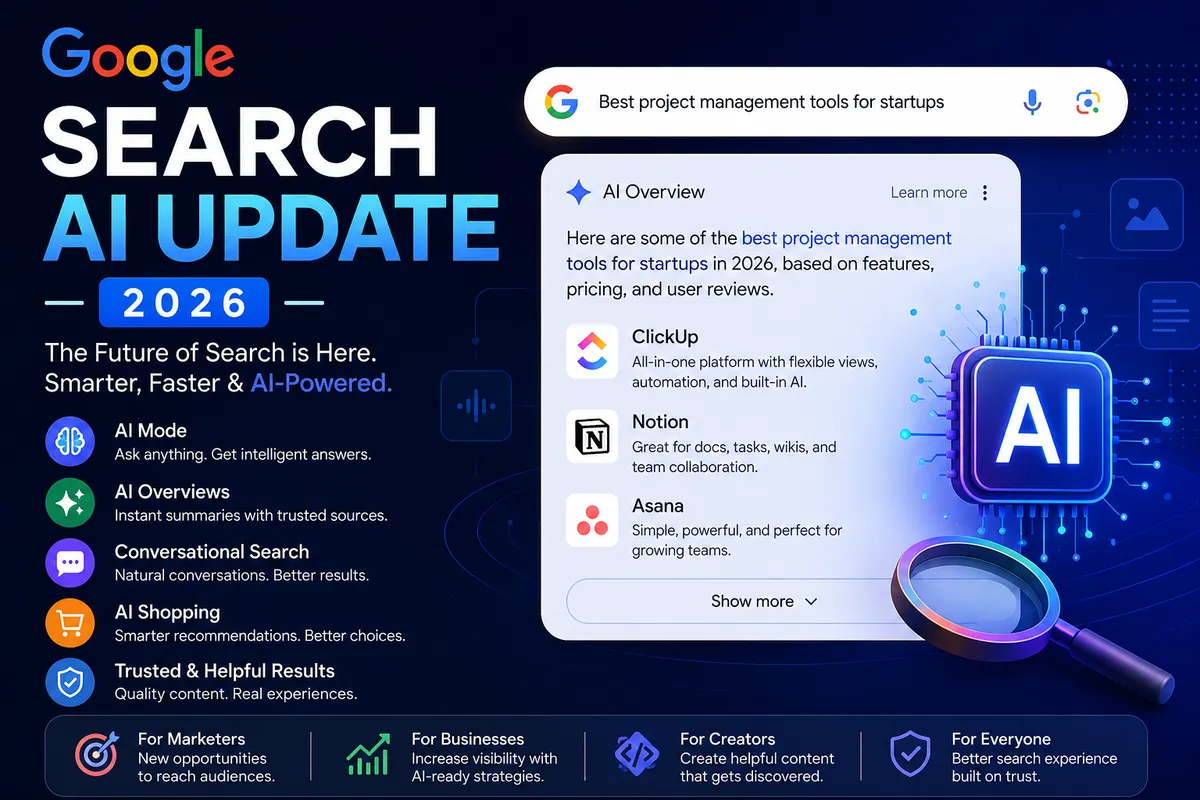
Meta Title: Google Search AI Update 2026: Complete Guide to AI Search, AI Mode & SEO
Meta Description: Learn how Google’s latest AI Search update is transforming SEO. Discover AI Mode, AI Overviews, GEO strategies, ranking factors, and how to optimize your website for AI-powered search in 2026.
URL Slug
/google-search-ai-update-2026
Google Search AI Update 2026: The Biggest Evolution of Search Since Google Was Created
Google Search has entered a new era.
Instead of simply showing a list of blue links, Google now uses artificial intelligence to understand questions, summarize information, compare products, recommend services, and even complete complex research tasks.
The latest Google AI Search update introduces powerful capabilities including:
AI Mode
AI Overviews
Conversational Search
Multi-step reasoning
Query Fan-out Search
Personalized AI Results
AI Shopping Experiences
Agentic Search Experiences
For businesses, marketers, bloggers, developers, and SEO professionals, this is one of the biggest changes in digital marketing history.
This guide explains everything you need to know.
What Changed in Google Search?
Traditional Search looked like this:
User → Keyword → List of Websites
Today’s AI Search works differently:
User → Natural Language Question → AI Understands Intent → Multiple Searches → AI Summary + Supporting Websites
Google’s AI now understands:
Context
Intent
Follow-up questions
Images
Documents
Voice
Long conversations
Instead of matching keywords, Google focuses on answering questions.
What is Google AI Mode?
AI Mode is Google’s conversational search experience.
Rather than returning ten blue links, AI Mode behaves like an AI assistant.
Users can ask:
“Which CRM is best for a startup under $100/month?”
or
“Compare React vs Angular for enterprise applications.”
Google researches multiple sources simultaneously and provides:
summarized answers
comparisons
citations
follow-up suggestions
recommended websites
What Are AI Overviews?
AI Overviews appear at the top of Google Search.
Instead of forcing users to open multiple websites, Google generates an AI summary while linking to supporting sources.
AI Overviews are designed to:
answer informational queries faster
reduce search friction
improve user experience
surface authoritative websites
This means your content can gain visibility even if it is not ranked #1 in the traditional search results.
How AI Search Works
Google’s AI Search generally follows this process:
1.User asks a question.
2.AI analyzes the intent.
3.Google performs multiple related searches.
4.Information is gathered from trusted sources.
5.AI creates a summarized response.
6.Supporting websites are cited for deeper reading.
This approach enables more comprehensive and context-aware answers than traditional keyword matching.
Biggest Ranking Factors in AI Search
AI search rewards quality over keyword stuffing.
Important ranking signals include:
1. Helpful Content
Create original content that solves real problems.
Avoid AI-generated filler.
2. Experience
Include:
real examples
screenshots
case studies
personal testing
original research
3. Topical Authority
Publish clusters around one subject instead of isolated articles.
Example:
AI Automation
↓
Make.com
↓
n8n
↓
Zapier
↓
AI Agents
↓
AutoGen
↓
Model Context Protocol
↓
LLMs
↓
RAG
Google increasingly values comprehensive topical coverage.
4. EEAT
Google still values:
Experience
Expertise
Authoritativeness
Trustworthiness
These remain foundational signals for visibility in AI-powered search.
5. Structured Data
Implement:
Organization Schema
Article Schema
FAQ Schema
Breadcrumb Schema
Service Schema
Review Schema
Schema helps AI understand your content more effectively.
6. Fresh Content
Update articles regularly.
AI search favors:
recent statistics
current screenshots
latest examples
updated information
GEO (Generative Engine Optimization)
SEO is no longer enough.
Modern websites should optimize for:
Google AI
ChatGPT
Gemini
Claude
Perplexity
Microsoft Copilot
This strategy is known as Generative Engine Optimization (GEO).
Key GEO practices include:
Answer complete questions.
Use clear headings.
Add FAQs.
Publish original research.
Include expert opinions.
Provide citations where appropriate.
Create content clusters.
Maintain factual accuracy.
SEO Strategy for AI Search
Modern SEO should focus on:
Semantic SEO
Cover an entire topic instead of repeating one keyword.
Question-Based Content
Answer questions like:
What is AI Mode?
How does AI Search work?
Is SEO still important?
How can businesses rank in AI Search?
Entity Optimization
Clearly mention:
products
companies
technologies
people
frameworks
AI understands entities better than isolated keywords.
Internal Linking
Connect related articles to build topical authority.
Example:
LLM → RAG → MCP → AI Agents → AutoGen
Digital Marketing in the AI Era
Traffic is changing.
Instead of relying only on Google rankings, businesses should diversify across:
Google AI Search
ChatGPT
Gemini
Perplexity
Medium
Dev.to
GitHub
YouTube
The goal is to become a trusted source that AI systems frequently reference.
Content Types That Perform Well
Google AI increasingly favors:
Ultimate Guides
Tutorials
Case Studies
Comparisons
Research Reports
Industry Statistics
FAQs
Checklists
How-To Guides
These formats provide the depth and clarity AI systems seek.
Common SEO Mistakes in 2026
Avoid:
Keyword stuffing
Thin AI-generated articles
Duplicate content
Clickbait headlines
Outdated information
Poor internal linking
Slow-loading pages
Missing schema markup
AI Search Checklist
Use this checklist before publishing:
✅ Helpful title
✅ Strong meta description
✅ Semantic headings
✅ FAQ section
✅ Structured data
✅ Internal links
✅ External references
✅ Original visuals
✅ Mobile-friendly design
✅ Fast page speed
✅ Updated information
Frequently Asked Questions
Is SEO dead?
No.
SEO has evolved into AI Search Optimization and GEO.
What is the difference between SEO and GEO?
SEO optimizes for traditional search rankings.
GEO optimizes content so AI assistants and AI-powered search engines can understand, cite, and recommend it.
Does Google AI replace websites?
No.
Google AI summarizes information while still directing users to authoritative websites for deeper reading.
Can small businesses rank in AI Search?
Yes.
Small businesses can compete by publishing high-quality, expert-driven, well-structured content with strong topical authority.
Final Thoughts
Google Search is evolving from a keyword-based engine into an AI-powered knowledge assistant. Success now depends on creating trustworthy, experience-based content that answers users’ questions comprehensively.
Businesses that combine strong SEO fundamentals with GEO best practices, structured data, topical authority, and helpful content will be best positioned to earn visibility in both traditional search results and AI-generated answers.
If your goal is to grow traffic in 2026 and beyond, optimize not just for rankings—but for AI recommendations.
Keywords
Google AI Search, Google AI Update 2026, AI Mode, AI Overviews, Google SEO 2026, Generative Engine Optimization, GEO, AI SEO, AI Search Optimization, AI Ranking Factors, Digital Marketing 2026, Google Search AI, SEO Strategy, AI Content Optimization, AI Search Marketing