
TECHNOVEZ
How Modern AI Platforms Use gRPC for Fast, Scalable Communication
A technical guide to gRPC, Protocol Buffers, and HTTP/2 for AI infrastructure, agentic systems, and enterprise-scale microservices.
By the Technovez Engineering Team | Reading time: ~26 minutes
Featured Snippet Answer (40–60 words)
gRPC is a high-performance, open-source remote procedure call framework built by Google on HTTP/2 and Protocol Buffers. AI platforms use gRPC for internal service-to-service communication because it offers lower latency, smaller binary payloads, native streaming, and strongly typed contracts — all critical for real-time inference and multi-agent systems.
1. Executive Summary
Direct answer: gRPC has become the default communication protocol inside modern AI platforms because it was purpose-built for the exact problem AI systems create: many services, exchanging large volumes of structured data, under strict latency budgets, often as continuous streams rather than single request-response cycles.
A typical AI platform is no longer a single application talking to a single model. It is a mesh of services — an API gateway, an inference gateway, one or more embedding services, a vector database, a retrieval layer, an orchestration layer for agents, and one or several large language model (LLM) backends — all of which need to exchange data continuously, reliably, and quickly. REST and JSON, which were designed for browser-to-server communication over HTTP/1.1, were never optimized for this kind of high-frequency, high-volume, service-to-service traffic.
gRPC, created by Google and now maintained as a Cloud Native Computing Foundation (CNCF) graduated project, was designed from the ground up for exactly this internal, service-to-service use case. It runs on HTTP/2, serializes data with Protocol Buffers (Protobuf) instead of JSON, and treats streaming as a first-class capability rather than an afterthought bolted on with WebSockets or Server-Sent Events.
This guide explains, in practical and technically grounded terms, what gRPC is, how it works, why it fits AI infrastructure so well, and how engineering teams can adopt it safely in production — including authentication, observability, performance tuning, and common pitfalls. It also compares gRPC against REST, GraphQL, and WebSockets, and looks ahead to how gRPC intersects with agentic AI and the Model Context Protocol (MCP).
This article does not present invented benchmark numbers. Where performance characteristics are discussed, they are described qualitatively and attributed to the protocol's design (binary serialization, header compression, multiplexing) rather than to specific unverified figures. Readers who need hard numbers for their own workload should benchmark their own services under their own traffic patterns.
Key Takeaways
- gRPC pairs HTTP/2 with Protocol Buffers to produce compact, strongly typed, binary messages — a better fit for internal AI service traffic than text-based REST/JSON.
- Native support for four RPC patterns (unary, server streaming, client streaming, bidirectional streaming) maps naturally onto token-by-token LLM output, live transcription, and multi-agent negotiation.
- HTTP/2 multiplexing lets many concurrent RPCs share a single TCP connection, reducing connection overhead in high-fan-out microservice topologies such as RAG pipelines.
- Protobuf's `.proto` contracts generate client and server code in Go, Python, Node.js, Java, and .NET, reducing integration bugs between polyglot AI services.
- gRPC is not a REST replacement for public, browser-facing, or highly cacheable APIs — REST and GraphQL remain appropriate there.
- Production gRPC deployments require deliberate attention to TLS/mTLS, deadlines, retries, load balancing, and observability (OpenTelemetry) — these are not automatic.
- gRPC is increasingly relevant to agentic AI and orchestration layers, where agents and tools exchange structured, high-frequency messages, complementing higher-level protocols such as the Model Context Protocol (MCP).
2. What Is gRPC?
Direct answer: gRPC (gRPC Remote Procedure Calls) is an open-source RPC framework originally developed by Google, running on top of HTTP/2 and using Protocol Buffers as its interface definition language and wire format. It lets a client call a method on a remote server as if it were a local function call.
The name gRPC is a recursive-ish backronym maintained by the gRPC project — the "g" has been associated with different Google-related terms across releases, but functionally it stands for the framework itself. Google open-sourced gRPC in 2015, building on more than a decade of internal experience with an internal RPC system called Stubby, which Google used to connect its own internal microservices at scale. gRPC is now hosted by the Cloud Native Computing Foundation (CNCF) as a graduated project, alongside Kubernetes and Prometheus.
Remote Procedure Calls (RPC)
An RPC framework lets a program call a function that executes on a different machine, without the developer manually constructing HTTP verbs, URL paths, and query strings. The developer defines a service interface once; the RPC framework handles serialization, network transport, and deserialization behind that interface. This is conceptually older than REST — RPC systems predate the web — but gRPC modernizes the approach with HTTP/2 transport, strong typing, and multi-language code generation.
HTTP/2 as the Transport Layer
gRPC is built entirely on HTTP/2, not HTTP/1.1. HTTP/2 introduces several capabilities that HTTP/1.1 lacks: multiplexing multiple concurrent request/response streams over a single TCP connection, binary framing instead of plain-text headers, header compression via HPACK, and native support for bidirectional streaming. These are documented in RFC 7540 and its associated specifications. Because gRPC uses HTTP/2 streams as its fundamental unit of communication, it can keep one long-lived connection open between two services and multiplex thousands of concurrent calls across it, avoiding the per-request connection overhead common in HTTP/1.1-based REST APIs.
Protocol Buffers (Protobuf)
Protocol Buffers is Google's language-neutral, platform-neutral mechanism for serializing structured data. Instead of describing a message in JSON (text) or XML (text with markup), Protobuf describes it in a `.proto` file using a compact interface definition language (IDL), then compiles that definition into a binary wire format and into native classes for whichever language a service is written in.
Because Protobuf messages are strongly typed and defined in a shared schema, a Go service, a Python service, and a Node.js service can all generate code from the exact same `.proto` file and be certain they agree on field names, types, and required/optional semantics. This shared-contract approach reduces an entire category of integration bugs that arise from mismatched JSON field names or implicit type coercion.
Strongly Typed APIs and Binary Serialization
Two properties of Protobuf matter most for AI infrastructure. First, strong typing: every field in a message has a declared type (string, int32, bytes, nested message, repeated field, and so on), which is enforced at compile time in the generated client and server stubs. Second, binary serialization: Protobuf messages are encoded using a compact binary format rather than human-readable text, which produces smaller payloads than the equivalent JSON representation and is faster to parse because there is no text tokenization step.
Together, HTTP/2 transport, the Protobuf IDL, and generated stubs are what let a developer write a `.proto` file once and get working, type-safe client and server code in Go, Python, Java, Node.js, and .NET — the exact mix of languages that a modern AI platform's services are typically written in.
3. Why AI Platforms Need Faster Communication
Direct answer: AI platforms combine latency-sensitive inference, large tensor and embedding payloads, continuous token streaming, and highly fan-out microservice topologies — a combination of requirements that plain REST/JSON was not designed to handle efficiently.
Model Inference Is Latency-Sensitive
When a user sends a prompt to an AI product, that request typically passes through an API gateway, an authentication layer, an inference gateway or router, possibly a retrieval step, and finally the model-serving layer itself — before a single token comes back. Every hop in that chain adds latency. Because user-perceived responsiveness (time to first token, tokens per second) is a primary quality metric for AI products, the internal hops between services need to add as little overhead as possible.
Distributed AI Systems Have Many Moving Parts
A production LLM platform is rarely one monolithic process. It typically includes separate services for request routing, prompt/context assembly, embedding generation, vector search, tool execution, safety filtering, and the model runtime itself — which may in turn be sharded across multiple GPU nodes for large models. Each additional service boundary is another place where serialization and network overhead can accumulate, and where a slow or inefficient protocol compounds across the whole call chain.
Real-Time Streaming Is the Norm, Not the Exception
Modern LLMs generate output token by token, and most production AI products stream those tokens to the caller as they are produced rather than waiting for the full response. Voice AI, live transcription, and real-time translation have the same shape: a continuous stream of partial results rather than one discrete request-response pair. REST over HTTP/1.1 was not designed around this pattern; developers commonly retrofit it using Server-Sent Events or WebSockets. gRPC treats streaming as a native RPC type, defined directly in the `.proto` contract.
Throughput and GPU Utilization
GPU inference capacity is expensive, and keeping GPUs busy — rather than idle while waiting on network or serialization overhead — is a direct cost and throughput concern. Batched inference services, in particular, benefit from a transport that can push many concurrent requests through efficiently and return streamed partial batches without excessive per-call overhead, since batching strategies are often designed around maximizing GPU occupancy.
Microservices Multiply the Number of Internal Calls
As AI platforms decompose into more granular services — a pattern common in cloud-native and Kubernetes-based architectures — the number of internal, service-to-service calls per user request grows. A protocol that is efficient for one call becomes far more consequential when a single user request fans out into a dozen internal RPCs. This is the core reason many engineering teams reserve REST/JSON for their public, browser-facing APIs and adopt gRPC specifically for internal traffic between backend and AI services.
4. How gRPC Works
Direct answer: A gRPC call starts with a client invoking a method on a generated stub; the stub serializes the request into Protobuf binary, sends it over an HTTP/2 stream, the server's generated skeleton deserializes it, business logic runs (optionally calling an AI model), and the response is serialized and streamed back the same way.
The Request Lifecycle
Client Application
|
v
Generated Client Stub (from .proto)
| (Protobuf serialization)
v
HTTP/2 Transport (multiplexed stream, TLS)
|
v
gRPC Server (generated service skeleton)
| (Protobuf deserialization)
v
Business Logic Layer
|
v
AI Model / Inference Runtime
|
v
Response serialized -> streamed back over same HTTP/2 connection
Interface Definition Language (IDL) and .proto Files
Every gRPC service starts with a `.proto` file. This file defines the service's methods, the request and response message shapes, and the RPC type (unary or one of the three streaming variants) for each method. The `.proto` file is the single source of truth for the contract between client and server — it is language-neutral by design.
syntax = "proto3";
package technovez.inference.v1;
service InferenceService {
rpc GenerateCompletion (CompletionRequest) returns (CompletionResponse);
rpc StreamCompletion (CompletionRequest) returns (stream CompletionChunk);
}
message CompletionRequest {
string prompt = 1;
string model = 2;
int32 max_tokens = 3;
float temperature = 4;
}
message CompletionResponse {
string text = 1;
int32 tokens_used = 2;
}
message CompletionChunk {
string delta = 1;
bool is_final = 2;
}
Serialization and Code Generation
The Protobuf compiler (`protoc`), or a language-specific plugin such as `protoc-gen-go` or `protoc-gen-grpc-web`, reads the `.proto` file and generates source code: message classes with typed getters/setters, a client stub with one method per RPC, and a server-side interface that the developer implements. This generation step is what removes hand-written serialization code and manual endpoint wiring from the developer's responsibility.
Streaming as a First-Class Concept
Because a `.proto` method signature can declare `stream` on either the request, the response, or both, streaming is not an add-on — it is part of the contract itself. A client generated from a streaming method automatically exposes an iterator or callback-based API appropriate to its language, rather than requiring the developer to hand-roll chunked transfer encoding or manage a WebSocket connection separately from the rest of the API surface.
5. gRPC Architecture for AI Platforms
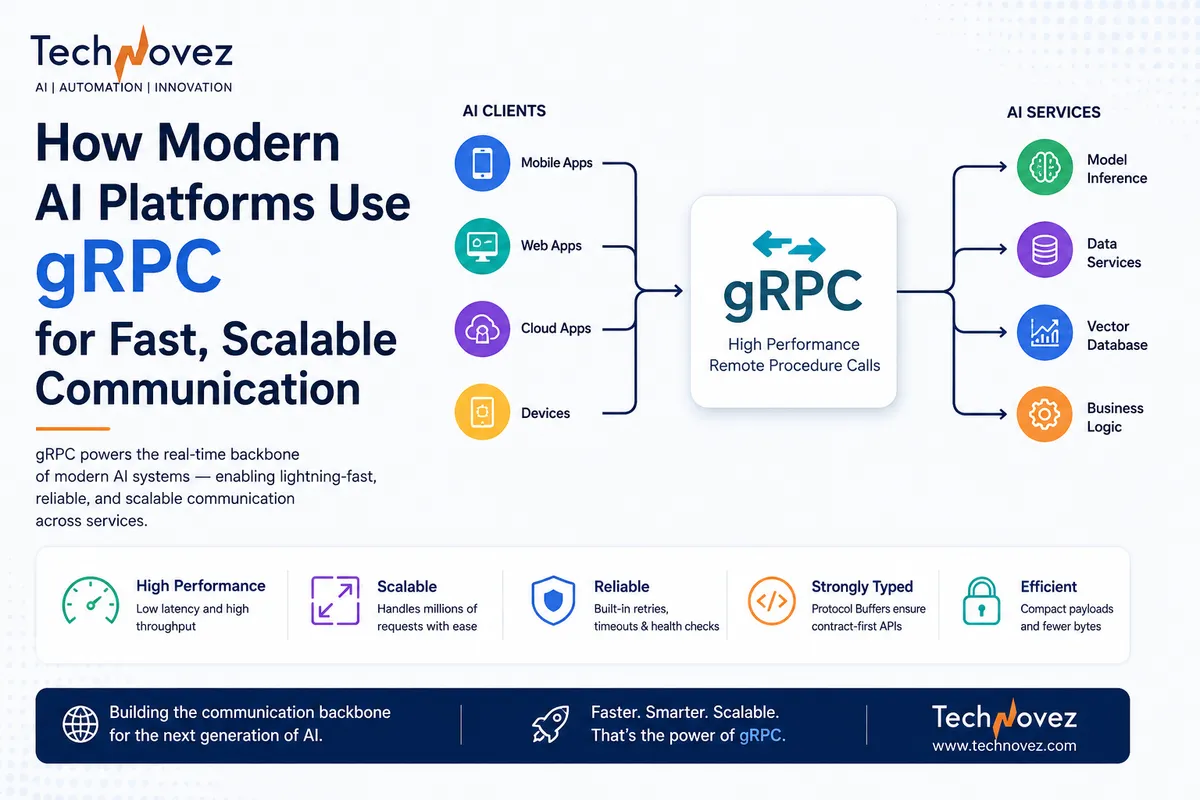
Direct answer: In a typical AI platform, gRPC sits behind the public-facing API gateway, connecting the gateway to an inference layer, embedding services, vector databases, LLM runtimes, and enterprise data sources — while the public edge often still speaks REST or GraphQL to browsers and third-party integrators.
A common, defensible pattern is to keep gRPC as an internal protocol and translate at the edge. Public clients (browsers, mobile apps, partner integrations) call a REST or GraphQL API exposed by an API gateway. That gateway then talks to internal services over gRPC, and — where a browser genuinely needs to stream from a gRPC service directly — a gRPC-Web proxy such as Envoy bridges the gap, since native gRPC (HTTP/2 trailers) is not fully supported by browser fetch/XHR APIs.
+-------------------+
| Web / Mobile App |
+---------+---------+
| REST / GraphQL (public edge)
v
+-------------------+
| API Gateway |
+---------+---------+
| gRPC (internal)
v
+-------------------+
| Inference Gateway |
+---------+---------+
gRPC | | | gRPC
v v v
+---------+ +---------+ +------------------+
| Embedding| | LLM | | Tool / Agent |
| Service | | Runtime | | Execution Service |
+----+-----+ +----+----+ +---------+--------+
| gRPC | | gRPC
v | v
+---------------+ | +------------------+
| Vector Database|<---- + | Enterprise Data |
+-------+--------+ RAG retrieval | Sources / APIs |
| +------------------+
v
+---------------+
| Knowledge Base |
+---------------+
Each internal boundary in this diagram — gateway to inference gateway, inference gateway to embedding service, retrieval service to vector database — is a candidate for gRPC because each is high-frequency, internal, and often needs streaming (token-by-token generation, incremental retrieval results, progressive tool output). The public edge, by contrast, is a candidate for REST or GraphQL because it needs browser compatibility, cacheability, and the lower ceremony of JSON for third-party integrators.
6. Why AI Platforms Prefer gRPC Over REST
Direct answer: gRPC's binary Protobuf payloads, HTTP/2 multiplexing, native streaming, and generated strongly-typed clients reduce the serialization and connection overhead that accumulates across the many internal calls a single AI request typically triggers.
Lower Latency Per Call
Because Protobuf is a binary format parsed directly into typed fields — rather than text that must be tokenized and parsed as JSON — encoding and decoding overhead per message is generally lower. HTTP/2's HPACK header compression also reduces the overhead of repeated headers across many calls on the same connection, which matters when a single user request fans out into several internal RPCs.
Smaller Payloads
Protobuf's binary encoding is typically more compact than the equivalent JSON document, since it omits field names from the wire format (fields are identified by number, per the `.proto` schema) and avoids the overhead of textual number and string encoding. Smaller payloads translate into less bandwidth consumed and less time spent transmitting data between services, which is more consequential at high internal call volumes.
HTTP/2 Multiplexing
HTTP/1.1 REST clients typically open a limited number of TCP connections and can suffer head-of-line blocking when many requests are in flight. HTTP/2 multiplexes many concurrent streams over a single TCP connection, so a service can issue a large number of concurrent gRPC calls to another service without paying the cost of establishing a new connection (and, for TLS, a new handshake) for each one.
Native Streaming
REST has no built-in concept of a stream; developers typically layer Server-Sent Events, chunked transfer encoding, or a separate WebSocket connection on top of a REST API to approximate streaming. gRPC defines four RPC types directly in the `.proto` contract, including bidirectional streaming, so the client and server code generated from that contract already understands how to consume or produce a stream.
Type Safety and Contract-First Development
A `.proto` file is a single, versioned, language-neutral contract. Both client and server code are generated from it, so a change to a field's type is caught at compile time rather than surfacing as a runtime error from mismatched JSON parsing. This matters more, not less, as an AI platform's service count grows and different teams own different services in different languages.
Automatic Code Generation Across Languages
Because the same `.proto` file can generate idiomatic client and server code for Go, Python, Java, Node.js, and .NET, polyglot AI platforms — which commonly mix Python for model serving, Go for infrastructure services, and Node.js or .NET for application backends — avoid hand-writing and hand-maintaining a separate client library per language.
Scalability
gRPC's connection efficiency and lower per-call overhead make it easier to scale horizontally, since the marginal cost of adding more concurrent internal calls is lower than with connection-per-request HTTP/1.1 patterns. gRPC's built-in support for client-side and proxy-based load balancing (covered in Section 10) further supports horizontal scaling patterns common in Kubernetes-based deployments.
7. gRPC Streaming
Direct answer: gRPC supports four RPC patterns — unary, server streaming, client streaming, and bidirectional streaming — each defined directly in the .proto contract, and each maps to a distinct class of AI workload.
Unary RPC
A single request produces a single response — functionally similar to a traditional REST call. This fits AI use cases such as a classification call, a single embedding lookup, or a moderation check, where the caller needs one complete answer and there is no benefit to streaming partial results.
rpc ClassifyText (ClassifyRequest) returns (ClassifyResponse);
Server Streaming
A single request produces a stream of responses from the server. This is the natural fit for LLM token generation: the client sends one prompt and receives a continuous stream of generated tokens or chunks until the model signals completion. It is also used for progressive search results and long-running job status updates.
rpc StreamCompletion (CompletionRequest) returns (stream CompletionChunk);
Client Streaming
A stream of requests from the client produces a single response from the server. A common AI example is real-time speech-to-text: the client streams audio chunks as they are captured from the microphone, and the server returns a single final transcript once the audio stream ends (or periodic partial transcripts, depending on design).
rpc TranscribeAudio (stream AudioChunk) returns (TranscriptResponse);
Bidirectional Streaming
Both client and server stream messages to each other independently and concurrently over the same connection. This pattern fits real-time translation (continuous audio or text in one language, continuous translated output in another), live voice AI assistants, and multi-agent systems where two agents (or an agent and an orchestrator) exchange a continuous back-and-forth of structured messages rather than a single request-response pair.
rpc LiveTranslate (stream AudioChunk) returns (stream TranslatedChunk);
8. REST vs GraphQL vs gRPC
Direct answer: REST is the most broadly compatible and cacheable option for public APIs; GraphQL is best when clients need flexible, client-shaped queries over a single endpoint; gRPC is best for internal, high-throughput, streaming-heavy service-to-service communication.
| Dimension | REST | GraphQL | gRPC |
| Transport | HTTP/1.1 (commonly) | HTTP/1.1 (commonly) | HTTP/2 |
| Payload format | JSON (text) | JSON (text) | Protobuf (binary) |
| Payload size | Larger (text overhead) | Larger (text overhead) | Smaller (binary, compact) |
| Streaming | Not native (SSE/WebSocket add-ons) | Subscriptions (via WebSocket) | Native (4 RPC types) |
| Caching | Strong (HTTP caching semantics) | Limited / custom | Limited (not HTTP-cache-friendly) |
| Browser support | Native | Native | Requires gRPC-Web proxy |
| Type safety | Optional (OpenAPI/JSON Schema) | Strong (GraphQL schema) | Strong (Protobuf schema, compiled) |
| Developer experience | Simple, ubiquitous tooling | Flexible querying, single endpoint | Contract-first, generated stubs |
| Security model | Standard HTTP auth (OAuth, JWT, TLS) | Standard HTTP auth (OAuth, JWT, TLS) | TLS/mTLS, auth interceptors |
| Scalability (internal calls) | Moderate (connection overhead) | Moderate | High (multiplexed HTTP/2) |
| Learning curve | Low | Moderate | Moderate–High |
| Best fit | Public APIs, simple CRUD, cacheable resources | Client-driven data shaping, aggregation layers | Internal microservices, AI inference, streaming |
9. AI Use Cases
Direct answer: gRPC is used across the AI stack: LLM inference and token streaming, embedding generation, RAG pipelines, vector search, speech-to-text, real-time translation, multi-agent orchestration, AI copilots, recommendation engines, and autonomous workflows.
LLM Inference
Server-streaming RPCs deliver generated tokens to the caller as they are produced, minimizing time-to-first-token and matching the incremental nature of autoregressive generation.
Embedding Services
Unary or batched RPCs convert text, images, or other inputs into vector embeddings; Protobuf's compact binary encoding is well suited to transmitting the resulting float arrays.
RAG Pipelines
A retrieval-augmented generation pipeline chains multiple internal calls — query embedding, vector search, re-ranking, context assembly, generation — each of which benefits from low per-call overhead since latency accumulates across the chain.
Vector Search
Vector database clients (for services such as Milvus, Qdrant, and others that expose gRPC APIs) use gRPC to submit similarity queries and stream back ranked results efficiently.
Speech-to-Text
Client-streaming RPCs let a caller push audio chunks continuously as they are captured, enabling near-real-time transcription rather than waiting for a complete audio file.
Real-Time Translation
Bidirectional streaming allows simultaneous inbound audio/text and outbound translated output, supporting live-interpreter-style AI products.
Multi-Agent Systems
Agents and orchestrators exchange structured, typed messages — task assignments, intermediate results, tool call requests — which benefits from Protobuf's schema enforcement and from streaming for long-running agent turns.
AI Copilots
Copilot backends stream partial suggestions, code completions, or reasoning steps to the client application as they are generated, rather than blocking on a full response.
Recommendation Engines
High-frequency internal calls to ranking and feature-serving services benefit from gRPC's low per-call overhead, particularly at the request volumes typical of recommendation systems.
Autonomous Workflows
Long-running, multi-step autonomous agents use streaming RPCs to report progress and intermediate state back to a monitoring or orchestration layer without polling.
10. Production Best Practices
Direct answer: Running gRPC in production requires deliberate handling of transport security (TLS/mTLS), request authentication and authorization, deadlines and retries, health checking, load balancing, and distributed tracing — none of these are automatic defaults.
Authentication and Authorization
gRPC supports pluggable authentication via interceptors (also called middleware). A common pattern is to validate a JSON Web Token (JWT) passed in call metadata on every incoming request, then attach the resulting identity/claims to the request context for downstream authorization checks.
// Node.js — server-side auth interceptor
function authInterceptor(call, callback, next) {
const metadata = call.metadata;
const token = metadata.get('authorization')[0];
if (!token) {
return callback({
code: grpc.status.UNAUTHENTICATED,
message: 'Missing authorization token',
});
}
try {
const decoded = jwt.verify(token.replace('Bearer ', ''), JWT_PUBLIC_KEY);
call.user = decoded;
next();
} catch (err) {
callback({ code: grpc.status.UNAUTHENTICATED, message: 'Invalid token' });
}
}
TLS and mTLS
Production gRPC traffic should run over TLS at minimum. For internal service-to-service traffic inside a cluster, mutual TLS (mTLS) — where both client and server present certificates — is a common pattern, often provided by a service mesh (such as Istio or Linkerd) rather than implemented individually in each service.
Rate Limiting and Deadlines
Every gRPC call should set a deadline (a maximum time the caller is willing to wait), propagated automatically to downstream calls made within that request's context. Without deadlines, a slow downstream dependency can hold resources indefinitely and cascade into a broader outage. Rate limiting, typically implemented as an interceptor or at a gateway/mesh layer, protects services from being overwhelmed by a caller — including a misbehaving internal service.
Retries
gRPC clients can be configured with retry policies (built into modern gRPC client libraries) that automatically retry idempotent calls on transient failures, using exponential backoff. Retry policies should be scoped to genuinely idempotent operations to avoid duplicating side effects such as writes.
Health Checks and Load Balancing
gRPC defines a standard health-checking protocol that load balancers and orchestration systems can query to determine whether a service instance is ready to receive traffic. In Kubernetes, this is typically wired into readiness and liveness probes. gRPC supports both client-side load balancing (the client resolves multiple backend addresses and distributes calls itself) and proxy-based load balancing (through a service mesh or gRPC-aware load balancer such as Envoy), since HTTP/2's persistent, multiplexed connections behave differently from HTTP/1.1 under traditional round-robin load balancers.
Observability and Distributed Tracing
Because a single AI request typically fans out across several gRPC calls, distributed tracing is essential for diagnosing latency and failures. OpenTelemetry provides gRPC instrumentation that propagates trace context through call metadata, allowing a request to be traced end-to-end across every service it touches, and integrates with common observability backends for metrics, logs, and traces.
11. Performance Optimization
Direct answer: gRPC performance in AI platforms is primarily tuned through connection reuse, compression, batching, keepalive settings, asynchronous processing, and horizontal autoscaling — not through protocol changes.
Connection Pooling and Reuse
Because HTTP/2 multiplexes many concurrent calls over one connection, clients should reuse a small number of long-lived channels rather than opening a new connection per call. Most gRPC client libraries manage this automatically, but it is worth verifying that client code does not inadvertently create a new channel per request.
Compression
gRPC supports message-level compression (commonly gzip) that can be enabled per call or per channel. Compression trades CPU time for reduced payload size, and is most beneficial for larger messages such as embedding vectors or long generated text; it can add unnecessary overhead for very small messages.
Batching
For workloads such as embedding generation, batching multiple inputs into a single RPC call (rather than issuing one call per input) reduces per-call overhead and can improve GPU utilization on the serving side, since many inference runtimes are optimized for batched execution.
Keepalive Settings
HTTP/2 keepalive pings detect dead connections and prevent intermediate proxies or load balancers from silently closing idle connections. Keepalive intervals should be tuned to the specific network environment — too aggressive a setting adds unnecessary traffic, too relaxed a setting risks using a stale connection.
Asynchronous Processing
Non-blocking, asynchronous gRPC server implementations (available in Go via goroutines, in Node.js via its event loop, and in Python via `asyncio`-based gRPC) allow a single service instance to handle many concurrent streaming calls without dedicating a thread per call, which matters for long-lived streaming RPCs such as token generation.
Horizontal Scaling, Kubernetes, and Autoscaling
gRPC services deployed on Kubernetes benefit from horizontal pod autoscaling based on CPU, memory, or custom metrics (such as in-flight RPC count). Because HTTP/2 connections are long-lived, gRPC-aware load balancing (via a service mesh or an L7-aware ingress such as Envoy or the Kubernetes Gateway API) is important to ensure new pods actually receive a share of traffic, since naive L4 load balancing can pin all traffic from a client to a single long-lived connection.
apiVersion: apps/v1
kind: Deployment
metadata:
name: inference-gateway
spec:
replicas: 3
selector:
matchLabels:
app: inference-gateway
template:
metadata:
labels:
app: inference-gateway
spec:
containers:
- name: inference-gateway
image: registry.technovez.com/inference-gateway:1.4.0
ports:
- containerPort: 50051
readinessProbe:
grpc:
port: 50051
livenessProbe:
grpc:
port: 50051
---
apiVersion: v1
kind: Service
metadata:
name: inference-gateway
spec:
selector:
app: inference-gateway
ports:
- port: 50051
targetPort: 50051
type: ClusterIP
Caching Where Appropriate
gRPC itself does not provide HTTP-style caching semantics. Where responses are cacheable (for example, repeated embedding lookups for identical input, or frequently requested static reference data), caching should be implemented explicitly at the application layer or via a dedicated cache service, rather than relied upon at the transport layer.
12. Common Mistakes
Direct answer: The most common gRPC adoption mistakes are applying it where REST would be simpler, ignoring its streaming capabilities, designing poor Protobuf schemas, sending oversized messages, skipping retry/timeout strategy, under-investing in monitoring, and failing to version APIs.
| Mistake | Why It Hurts |
| Using REST for internal AI services by default | Teams sometimes reach for REST out of familiarity even for high-frequency internal calls where gRPC's connection and serialization efficiency would meaningfully reduce overhead. |
| Ignoring streaming capabilities | Implementing token-by-token generation as repeated unary calls or a hand-rolled polling loop, instead of using a server-streaming RPC that gRPC already supports natively. |
| Poor Protobuf schema design | Overly generic messages (a single message with dozens of optional fields), missing field-numbering discipline, or reusing field numbers across schema changes, which breaks backward compatibility. |
| Sending oversized messages | Passing very large payloads (for example, full images or long documents) as a single Protobuf message instead of streaming them in chunks or referencing them by ID from separate storage. |
| No retry or timeout strategy | Omitting deadlines entirely, or applying retries indiscriminately to non-idempotent calls, both of which create reliability and correctness risks under load. |
| Weak monitoring | Deploying gRPC services without distributed tracing or per-method latency/error metrics, which makes diagnosing cross-service latency in a fan-out AI request very difficult. |
| No API versioning strategy | Making breaking changes to a `.proto` contract without a versioning convention (such as `v1`, `v2` packages), which forces simultaneous deployment of client and server changes and increases operational risk. |
13. Future of gRPC in AI
Direct answer: As AI platforms move toward agentic architectures — where autonomous agents call tools, other agents, and models in continuous loops — gRPC's streaming and strong-typing model is well positioned to remain a core transport layer beneath higher-level agent and context protocols.
AI-Native Infrastructure
As more infrastructure is purpose-built around AI workloads rather than general web traffic, the case for a protocol designed for structured, high-frequency, streaming communication — rather than one designed for browsers — continues to strengthen for internal AI service communication.
Agentic AI and Multi-Agent Orchestration
Agentic systems, where an orchestrator coordinates multiple specialized agents that each call tools and models, generate substantially more internal traffic per user request than a single-model chat interface. That traffic is a natural fit for gRPC's low-overhead, streaming-capable transport, particularly for long-running agent turns that need to report intermediate progress.
Model Context Protocol (MCP)
The Model Context Protocol (MCP) is an emerging open standard for connecting AI models and agents to external tools, data sources, and context providers in a structured way. MCP operates at a higher level of abstraction than gRPC — it standardizes how an AI application discovers and invokes tools and retrieves context — and can be implemented over different transports. Teams building MCP servers and clients on top of a gRPC transport can gain the same low-latency, streaming benefits described throughout this article, while MCP handles the higher-level semantics of tool and context exchange.
Distributed Inference and Edge AI
As models are increasingly served across multiple nodes (for very large models) or pushed closer to the edge (for latency-sensitive applications), the communication layer connecting those distributed components again benefits from a protocol engineered for efficient, structured, streaming data exchange rather than one engineered for document delivery.
Toward AI Operating Systems
Some engineering teams describe the emerging layer of orchestration, tool-calling, memory, and multi-agent coordination sitting above individual models as an "AI operating system." Whatever terminology is used, that layer will need a transport for the many internal calls between its components — a role gRPC is architecturally well suited to continue filling.
14. How Technovez Helps
Technovez is an enterprise software and AI infrastructure partner for organizations building or modernizing distributed, cloud-native, AI-enabled platforms. Our engineering teams design and implement the internal architecture described throughout this guide — not just the AI model integration, but the gRPC services, Kubernetes deployment, and observability stack that make it reliable in production.
AI Infrastructure: Designing inference gateways, embedding services, and RAG pipelines with gRPC as the internal communication backbone.
Enterprise Software Development: Building production-grade, strongly typed service contracts and generated client libraries across Go, Python, Node.js, and .NET.
Cloud-Native Architecture: Deploying gRPC microservices on Kubernetes with proper health checking, load balancing, and autoscaling.
gRPC API Implementation: Designing `.proto` contracts, streaming RPC patterns, and authentication interceptors for internal AI services.
AI Automation and Agentic Systems: Architecting multi-agent orchestration layers and integrating tools via protocols including MCP.
Digital Transformation: Modernizing legacy REST-only backends into hybrid architectures that keep REST at the public edge and gRPC internally.
Call to Action
If your organization is building an AI platform that needs to scale beyond a single model and a single service — or if your existing REST-based backend is starting to show latency and reliability strain under real-time AI workloads — Technovez's engineering team can help design and implement a gRPC-based AI infrastructure built for production from day one.
Get in touch: Contact Technovez at technovez.com/contact to discuss AI infrastructure, enterprise gRPC API development, and cloud-native architecture for your platform.
Comparison Tables
gRPC vs REST
| Aspect | gRPC | REST |
| Transport | HTTP/2 | HTTP/1.1 (commonly) |
| Payload | Protobuf (binary) | JSON (text) |
| Streaming | Native, 4 RPC types | Add-on (SSE/WebSocket) |
| Contracts | `.proto`, code-generated | OpenAPI (optional) |
| Browser support | Requires gRPC-Web proxy | Native |
| Best for | Internal microservices, AI inference | Public/browser-facing APIs |
gRPC vs GraphQL
| Aspect | gRPC | GraphQL |
| Query flexibility | Fixed method signatures | Client-specified query shape |
| Payload format | Protobuf (binary) | JSON (text) |
| Streaming | Native | Subscriptions (via WebSocket) |
| Typical use | Service-to-service RPC | Client-facing data aggregation |
| Schema | Protobuf IDL | GraphQL SDL |
gRPC vs WebSockets
| Aspect | gRPC | WebSockets |
| Message structure | Strongly typed (Protobuf) | Unstructured (developer-defined) |
| RPC semantics | Defined methods and message types | Raw bidirectional byte/message stream |
| Code generation | Yes, from `.proto` | No, manual protocol design |
| Built on | HTTP/2 | HTTP/1.1 Upgrade handshake |
| Best for | Structured service-to-service streaming | Simple bidirectional messaging, browser push |
Unary vs Streaming RPC
| RPC Type | Direction | Typical AI Example |
| Unary | 1 request → 1 response | Text classification, single embedding lookup |
| Server streaming | 1 request → N responses | LLM token generation |
| Client streaming | N requests → 1 response | Streaming audio for speech-to-text |
| Bidirectional streaming | N requests ↔ N responses | Real-time translation, live agent conversation |
Code Examples
Node.js gRPC Server
const grpc = require('@grpc/grpc-js');
const protoLoader = require('@grpc/proto-loader');
const packageDef = protoLoader.loadSync('inference.proto', {
keepCase: true,
longs: String,
enums: String,
defaults: true,
oneofs: true,
});
const proto = grpc.loadPackageDefinition(packageDef).technovez.inference.v1;
function streamCompletion(call) {
const { prompt, max_tokens } = call.request;
const tokens = generateTokens(prompt, max_tokens); // your model client
tokens.forEach((delta, i) => {
call.write({ delta, is_final: i === tokens.length - 1 });
});
call.end();
}
function main() {
const server = new grpc.Server();
server.addService(proto.InferenceService.service, { StreamCompletion: streamCompletion });
server.bindAsync('0.0.0.0:50051', grpc.ServerCredentials.createInsecure(), () => {
server.start();
console.log('gRPC server listening on 50051');
});
}
main();
Go gRPC Service
package main
import (
"log"
"net"
pb "technovez.com/inference/proto"
"google.golang.org/grpc"
)
type inferenceServer struct {
pb.UnimplementedInferenceServiceServer
}
func (s *inferenceServer) StreamCompletion(req *pb.CompletionRequest, stream pb.InferenceService_StreamCompletionServer) error {
tokens := generateTokens(req.Prompt, req.MaxTokens)
for i, t := range tokens {
chunk := &pb.CompletionChunk{Delta: t, IsFinal: i == len(tokens)-1}
if err := stream.Send(chunk); err != nil {
return err
}
}
return nil
}
func main() {
lis, err := net.Listen("tcp", ":50051")
if err != nil {
log.Fatalf("failed to listen: %v", err)
}
grpcServer := grpc.NewServer()
pb.RegisterInferenceServiceServer(grpcServer, &inferenceServer{})
log.Println("gRPC server listening on :50051")
if err := grpcServer.Serve(lis); err != nil {
log.Fatalf("failed to serve: %v", err)
}
}
Python gRPC Client
import grpc
import inference_pb2
import inference_pb2_grpc
def stream_completion(prompt: str, max_tokens: int = 256):
channel = grpc.secure_channel(
'inference.internal.technovez.com:443',
grpc.ssl_channel_credentials(),
)
stub = inference_pb2_grpc.InferenceServiceStub(channel)
request = inference_pb2.CompletionRequest(prompt=prompt, max_tokens=max_tokens)
for chunk in stub.StreamCompletion(request, timeout=30):
print(chunk.delta, end='', flush=True)
if chunk.is_final:
break
if __name__ == '__main__':
stream_completion('Explain gRPC in one sentence.')
.NET gRPC Client
using Grpc.Net.Client;
using Technovez.Inference.V1;
var channel = GrpcChannel.ForAddress("https://inference.internal.technovez.com");
var client = new InferenceService.InferenceServiceClient(channel);
var request = new CompletionRequest
{
Prompt = "Explain gRPC in one sentence.",
MaxTokens = 256,
};
using var call = client.StreamCompletion(request);
await foreach (var chunk in call.ResponseStream.ReadAllAsync())
{
Console.Write(chunk.Delta);
if (chunk.IsFinal) break;
}
Bidirectional Streaming (Node.js)
function liveTranslate(call) {
call.on('data', async (audioChunk) => {
const translated = await translateChunk(audioChunk); // model call
call.write({ text: translated, is_final: false });
});
call.on('end', () => {
call.write({ text: '', is_final: true });
call.end();
});
}
Checklists
Production Deployment Checklist
- TLS enabled on every external and internal gRPC endpoint
- mTLS configured for internal service-to-service traffic (directly or via service mesh)
- Health checking protocol implemented and wired to Kubernetes readiness/liveness probes
- Deadlines set on every outbound call, propagated through the call chain
- Retry policy configured only for idempotent methods
- Distributed tracing (OpenTelemetry) instrumented across all services
- Structured logging correlated with trace IDs
- Load balancing strategy chosen deliberately (client-side or mesh/proxy-based) for HTTP/2 connections
- API versioning convention established for `.proto` packages
- Autoscaling policy defined based on relevant load metrics
Security Checklist
- All traffic encrypted in transit (TLS 1.2+)
- mTLS for internal service identity verification
- JWT or equivalent token validation on every authenticated method
- Authorization checks applied per-method, not just per-service
- Rate limiting applied at gateway and/or per-client level
- Secrets and credentials managed via a secrets manager, not embedded in code or `.proto` files
- Input validation on all incoming message fields, not assumed from the schema alone
- Audit logging for sensitive operations (model access, data retrieval)
Performance Optimization Checklist
- Channels reused across calls rather than created per request
- Compression enabled selectively for larger payloads
- Batching implemented for high-volume operations such as embedding generation
- Keepalive settings tuned to the network environment
- Asynchronous, non-blocking server implementations used for streaming methods
- Horizontal autoscaling configured and load-tested
- Application-layer caching added for cacheable, repeated queries
API Design Checklist
- Services and messages organized under a versioned package (e.g., `technovez.inference.v1`)
- Field numbers never reused or renumbered after release
- New fields added as optional, not inserted into existing required structures
- Streaming RPC type chosen deliberately based on the data flow (unary vs. the three streaming types)
- Message sizes kept reasonable; large binary payloads chunked or referenced by ID
- Consistent naming conventions applied across services and methods
- Backward-compatibility reviewed before every schema change
Decision Framework: When Should You Choose gRPC?
| Scenario | Recommendation | Reasoning |
| Internal APIs (service-to-service) | gRPC | High call volume, streaming needs, and controlled environments favor gRPC's efficiency and type safety. |
| Public APIs (third-party integrators) | REST (or GraphQL) | Broad compatibility, human-readable payloads, and HTTP caching matter more than raw efficiency. |
| AI platforms (inference, RAG, agents) | gRPC internally, REST/GraphQL at the edge | Streaming and low latency matter internally; public clients need browser compatibility. |
| General microservices | gRPC | Contract-first development and generated clients reduce integration risk across teams. |
| Serverless functions | REST or event-driven (often HTTP/1.1) | Many serverless platforms and triggers are built around HTTP/1.1 or event payloads; verify platform-level gRPC support before committing. |
| IoT | gRPC (often via gRPC-Web/lightweight variants) or MQTT | Depends on device constraints; gRPC fits when devices can maintain persistent connections and need structured schemas. |
| Real-time systems (chat, live data) | gRPC (bidirectional streaming) or WebSockets | Choose gRPC when structured, typed messages are valuable; choose WebSockets for simpler, less structured real-time messaging. |
Frequently Asked Questions (People Also Ask)
What is gRPC?
gRPC is an open-source remote procedure call framework built by Google on HTTP/2 and Protocol Buffers, allowing a client to call a method on a remote server as though it were a local function.
Why do AI platforms use gRPC?
AI platforms use gRPC because it offers lower per-call overhead, native streaming for token-by-token generation, and strongly typed contracts across the many internal services an AI request typically passes through.
Is gRPC faster than REST?
gRPC's binary Protobuf encoding and HTTP/2 transport generally produce lower serialization overhead and smaller payloads than JSON-over-HTTP/1.1 REST, though actual performance depends on the specific workload and should be validated with benchmarks on your own traffic.
Does gRPC use HTTP/2?
Yes. gRPC is built entirely on HTTP/2, using its multiplexing, binary framing, and header compression capabilities.
Can gRPC replace REST?
gRPC can replace REST for internal, service-to-service communication, but REST typically remains preferable for public, browser-facing APIs due to native browser support and HTTP caching.
Does gRPC work in browsers?
Not natively. Browsers cannot fully support gRPC's use of HTTP/2 trailers, so browser clients typically use gRPC-Web, which requires a proxy such as Envoy to translate between gRPC-Web and native gRPC.
Is gRPC good for AI inference?
Yes. Server-streaming RPCs map naturally onto token-by-token LLM output, and gRPC's low overhead benefits latency-sensitive inference pipelines with multiple internal service hops.
Can Kubernetes run gRPC services?
Yes. Kubernetes supports gRPC health-check probes natively, and gRPC services are commonly deployed as standard Kubernetes Deployments behind gRPC-aware load balancing (via a service mesh or an L7 ingress).
What is Protocol Buffers (Protobuf)?
Protocol Buffers is Google's language-neutral mechanism for serializing structured data, using a `.proto` schema to generate compact binary messages and typed client/server code.
What are .proto files used for?
A `.proto` file defines a gRPC service's methods, request/response message shapes, and field types; it is compiled into client and server code for multiple programming languages.
What RPC types does gRPC support?
gRPC supports four types: unary, server streaming, client streaming, and bidirectional streaming.
Is gRPC suitable for public APIs?
It can be, particularly for partner or B2B integrations where both sides can adopt gRPC/Protobuf tooling, but it is less common for general public APIs due to limited browser support and caching.
How does gRPC handle authentication?
Through interceptors (middleware) that validate credentials such as JWTs from call metadata, combined with TLS or mTLS for transport-level security.
What is mTLS in gRPC?
Mutual TLS, where both the client and server present certificates to verify each other's identity, commonly used for internal service-to-service gRPC traffic.
How does gRPC compare to GraphQL?
GraphQL is optimized for client-driven data querying and aggregation over a single public endpoint; gRPC is optimized for structured, high-throughput, streaming service-to-service calls.
How does gRPC compare to WebSockets?
WebSockets provide an unstructured bidirectional message stream that developers must design a protocol on top of; gRPC provides structured, typed, code-generated bidirectional streaming out of the box.
What languages does gRPC support?
gRPC has official support for many languages, including Go, Python, Java, Node.js/TypeScript, C++, and .NET/C#, among others.
Does gRPC support load balancing?
Yes, both client-side load balancing and proxy/mesh-based load balancing are supported and commonly used, since HTTP/2's persistent connections require gRPC-aware load balancing strategies.
How is gRPC related to the Model Context Protocol (MCP)?
MCP is a higher-level protocol for connecting AI models and agents to tools and context sources; it can be implemented over different transports, and gRPC is one option for that underlying transport where low-latency streaming is valuable.
Is gRPC difficult to learn?
gRPC has a moderate-to-higher learning curve than REST due to the Protobuf schema workflow and code generation step, but this investment typically pays off in reduced integration bugs and better performance for internal AI service communication.
Recommended Schema Markup
Article Schema: Use schema.org/Article (or TechArticle) with headline, author (Organization: Technovez), datePublished, dateModified, and mainEntityOfPage set to the canonical URL.
FAQ Schema: Use schema.org/FAQPage with each of the 20 questions above as a Question/acceptedAnswer pair.
HowTo Schema: Use schema.org/HowTo for the Production Deployment Checklist and Performance Optimization Checklist sections, with each checklist item as a HowToStep.
Organization Schema: Use schema.org/Organization for Technovez, including name, url, logo, and sameAs links to official social profiles.
Breadcrumb Schema: Use schema.org/BreadcrumbList reflecting Home > Blog > gRPC for AI Platforms.
Internal Linking Suggestions
- Link the phrase "enterprise API development" to https://www.technovez.com/services
- Link the phrase "read more on the Technovez blog" to https://www.technovez.com/blog
- Link "contact our engineering team" to https://www.technovez.com/contact
- Link the Technovez brand mention in the introduction to https://www.technovez.com/
- Link "tRPC" (in Section 8 or the comparison tables) to a related Technovez article: tRPC Explained
- Link "Model Context Protocol (MCP)" (Section 13) to a related Technovez article: Model Context Protocol (MCP) Explained
- Link "agentic AI" and "multi-agent orchestration" (Sections 9 and 13) to related Technovez articles: Agentic AI and Multi-Agent Orchestration
- Link "AI infrastructure" (Section 1 and Section 14) to a related Technovez article: AI Infrastructure
- Link "enterprise AI governance" where security/compliance is discussed (Section 10) to a related Technovez article: Enterprise AI Governance
Authoritative References
- gRPC Official Documentation — grpc.io/docs
- Protocol Buffers Documentation — protobuf.dev
- HTTP/2 Specification — RFC 7540 (IETF)
- Kubernetes Documentation — kubernetes.io/docs
- Google Cloud Architecture Center — cloud.google.com/architecture
- OpenTelemetry Documentation — opentelemetry.io/docs
- Microsoft Learn: gRPC for .NET — learn.microsoft.com
- Node.js Documentation — nodejs.org/docs
- Go Documentation — go.dev/doc
- Python gRPC Documentation — grpc.io/docs/languages/python
Image SEO
| Field | Value |
| Hero image concept | A clean, modern architecture illustration showing a web app connecting through an API gateway to internal gRPC microservices (embedding service, LLM runtime, vector database), using a blue/navy enterprise color palette. |
| AI image generation prompt | Minimalist technical architecture diagram illustration, blue and white color palette, showing connected microservice nodes labeled Gateway, Inference, Vector DB, LLM, flat vector style, enterprise SaaS aesthetic, no text artifacts, clean lines |
| Alt text | Architecture diagram showing gRPC connecting an API gateway to AI inference, embedding, and vector database microservices |
| SEO-friendly filename | grpc-for-ai-platforms-architecture-diagram.png |
| Caption | A typical gRPC-based architecture connecting an API gateway to internal AI inference, embedding, and retrieval services. |
Social Media Assets
LinkedIn Article Summary
Modern AI platforms aren't one model talking to one app — they're a mesh of inference, embedding, retrieval, and agent services that all need to talk to each other, fast. This guide breaks down why gRPC, Google's HTTP/2-based RPC framework, has become the default choice for that internal communication layer: smaller binary payloads via Protocol Buffers, native streaming for token-by-token generation, and strongly typed contracts across polyglot services. It covers the architecture, production best practices, and where gRPC fits alongside REST, GraphQL, and the emerging Model Context Protocol.
LinkedIn Post
Most AI products don't feel slow because the model is slow. They feel slow because of everything happening between the model and the user — gateway hops, retrieval calls, embedding lookups, each adding its own overhead. We wrote a deep technical guide on why gRPC has become the default protocol for that internal layer in modern AI platforms: streaming built into the protocol itself, compact binary Protobuf payloads, and strongly typed contracts across Go, Python, Node.js, and .NET services. Read the full guide on the Technovez blog. #gRPC #AIInfrastructure #Microservices #SoftwareArchitecture
X (Twitter) Thread — 10 Posts
- 1/ Why do AI platforms keep reaching for gRPC instead of REST for their internal services? A quick thread on the architecture behind fast, scalable AI infrastructure.
- 2/ A modern AI request rarely hits just one service. Gateway → inference router → embedding service → vector DB → LLM. Every hop adds latency. The transport between those hops matters more than people think.
- 3/ gRPC runs on HTTP/2, not HTTP/1.1. That means multiplexed streams over one connection, binary framing, and compressed headers — all reducing per-call overhead across a chain of internal services.
- 4/ Instead of JSON, gRPC uses Protocol Buffers: a binary, strongly typed format defined in a .proto file. Same contract generates client + server code in Go, Python, Node.js, .NET, Java.
- 5/ Streaming is native in gRPC, not bolted on. Four RPC types: unary, server streaming, client streaming, bidirectional. Token-by-token LLM output maps directly onto server streaming.
- 6/ REST isn't going away. Public, browser-facing APIs still favor REST (or GraphQL) for compatibility and caching. The pattern: REST at the edge, gRPC internally.
- 7/ Production gRPC isn't 'set and forget.' TLS/mTLS, deadlines, retries scoped to idempotent calls, health checks, and gRPC-aware load balancing all need deliberate setup.
- 8/ Common mistake: treating streaming as optional. Polling a unary endpoint to fake streaming adds latency and complexity that a server-streaming RPC already solves natively.
- 9/ Looking ahead: agentic AI and multi-agent orchestration generate a lot more internal traffic than single-model chat. That's exactly the traffic pattern gRPC was built for.
- 10/ Full technical breakdown — architecture diagrams, code examples in Go/Python/Node/.NET, production checklists — on the Technovez blog. Link in bio.
Facebook Post
Building AI products that need to scale? The protocol connecting your internal services matters as much as the model itself. Our latest technical guide explains why engineering teams building AI platforms are choosing gRPC over REST for internal communication — covering architecture, streaming, security, and production best practices. Read it on the Technovez blog.
Medium Introduction
If you've built or scaled an AI product past its first prototype, you've likely felt the pain of internal latency: a gateway, an inference router, an embedding service, a vector database, and a model runtime, all needing to talk to each other quickly and reliably. This is the exact problem gRPC — Google's HTTP/2-based, Protocol-Buffers-powered RPC framework — was designed to solve. This guide walks through what gRPC is, how it works, why it fits AI infrastructure so well, and how to run it safely in production, with architecture diagrams and working code examples in Go, Python, Node.js, and .NET.
NLP Keyword List
gRPC, gRPC for AI platforms, Protocol Buffers, Protobuf, HTTP/2, AI infrastructure, AI architecture, AI microservices, AI communication, service-to-service communication, LLM infrastructure, AI agents, agentic AI, multi-agent systems, Model Context Protocol, MCP, retrieval-augmented generation, RAG, distributed systems, Kubernetes, Node.js gRPC, Go gRPC, Python gRPC, .NET gRPC, REST vs gRPC, GraphQL vs gRPC, gRPC streaming, unary RPC, server streaming, client streaming, bidirectional streaming, AI inference, enterprise APIs, vector database, embedding service, mTLS, JWT authentication, OpenTelemetry, distributed tracing, service mesh, Envoy, load balancing, protoc, IDL, binary serialization, LLM token streaming, real-time translation, speech-to-text, AI copilots, recommendation engines, autonomous workflows, cloud-native architecture, digital transformation.
Related Search Queries
- gRPC vs REST for microservices
- how does gRPC work with AI models
- gRPC streaming explained
- Protocol Buffers vs JSON performance
- best protocol for LLM inference API
- gRPC Kubernetes deployment example
- gRPC authentication best practices
- Model Context Protocol vs gRPC
- gRPC vs GraphQL for AI backends
- how to secure gRPC services with mTLS
AI-Generated Infographic Ideas
- "REST vs gRPC vs GraphQL" side-by-side comparison infographic using the table in Section 8.
- "The Four RPC Types" infographic showing unary, server streaming, client streaming, and bidirectional streaming with one AI example icon each.
- "Anatomy of a gRPC Call" infographic tracing the request lifecycle diagram from Section 4.
- "gRPC Architecture for AI Platforms" infographic based on the architecture diagram in Section 5, suitable for LinkedIn carousel format.
- "Production gRPC Checklist" infographic summarizing the Security and Deployment checklists as a one-page visual reference.
Content Gap Analysis
Compared with existing gRPC and AI infrastructure articles commonly found in search results, this article's differentiators and remaining opportunities are summarized below.
| Area | Typical Existing Coverage | This Article's Approach |
| AI-specific framing | Most gRPC content is generic microservices content with little AI-specific context | Explicitly maps gRPC's four RPC types and architecture to LLM inference, RAG, embeddings, and agentic AI use cases |
| GEO / AI-search optimization | Rare — most existing content is written for traditional SEO only | Definition-first sections, direct-answer callouts, and structured FAQs designed for AI Overviews and answer engines |
| Multi-language code examples | Often single-language (usually Go or Python only) | Includes Node.js, Go, Python, and .NET examples for both server and client roles |
| Production operations depth | Frequently limited to "gRPC is fast" claims without operational guidance | Dedicated sections on auth, TLS/mTLS, deadlines, retries, health checks, load balancing, and observability |
| Agentic AI and MCP context | Largely absent from existing gRPC content, since MCP is newer than most published gRPC articles | Dedicated forward-looking section connecting gRPC to agentic AI and the Model Context Protocol |
| Decision guidance | Comparison tables without actionable recommendations | Includes an explicit decision framework mapping scenarios (internal APIs, public APIs, IoT, serverless) to a recommended protocol |
Remaining opportunity for future Technovez content: a dedicated hands-on tutorial repository (companion to this article) walking through building the full architecture in Section 5 end-to-end, and a follow-up article benchmarking gRPC against REST on a specific, reproducible AI workload with published methodology.