
Introduction
Generative AI is only as useful as the data behind it, and only as safe as the controls around it. That is why more companies in the United States and Europe are moving from generic chatbots to Retrieval Augmented Generation (RAG): AI that answers questions from your own policies, contracts, tickets and product docs.
The catch is security. A RAG system connects a large language model (LLM) directly to your most sensitive knowledge. Built carelessly, it can leak salary data to an intern or follow instructions hidden inside a PDF.
This guide explains how to build a secure RAG application for your business, step by step. It draws on the OWASP Top 10 for LLM Applications 2025 and on what the Technovez team applies in enterprise RAG projects.
Quick answer: What is a secure RAG application? A secure RAG application is an AI system that retrieves information from a company’s own documents and passes it to an LLM to generate answers, while enforcing access control, data privacy, prompt injection defenses and audit logging at every stage of the RAG pipeline. Each user only ever receives answers built from documents they are already allowed to see.
How does RAG work with enterprise data?
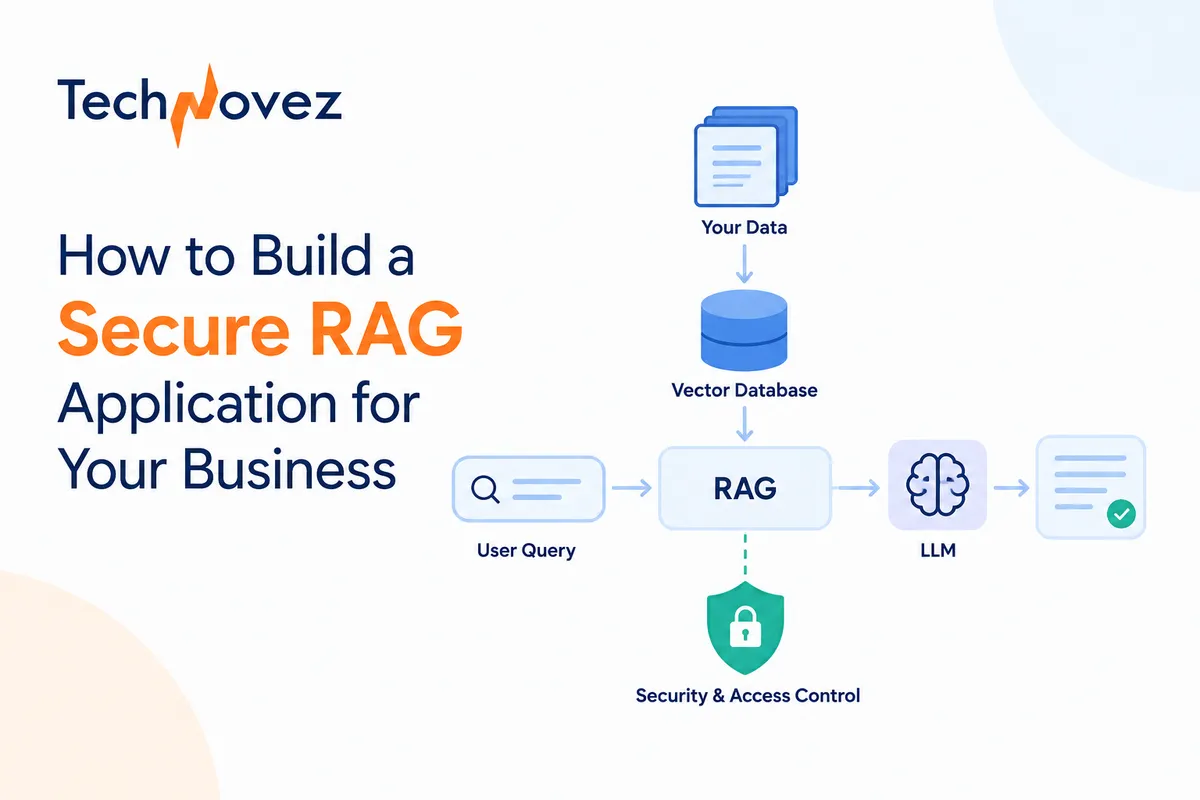
RAG works by searching your company’s knowledge first, then asking the LLM to answer using only what it found. Instead of retraining a model, you keep data in a searchable store and feed the relevant pieces into each prompt. That makes RAG cheaper to update and easier to govern than fine-tuning.
A typical RAG pipeline has five stages:
- Ingestion. Documents are pulled from sources such as SharePoint, Google Drive, Confluence, CRM or ticketing systems.
- Chunking and embedding. Each document is split into passages and converted into numeric vectors by an embedding model.
- Storage. Vectors and metadata are saved in a vector database for RAG (for example pgvector, Pinecone, Weaviate or Qdrant).
- Retrieval. A user’s question is embedded, and the closest matching passages are returned.
- Generation. The LLM receives the question plus the retrieved passages and writes a grounded answer with citations.
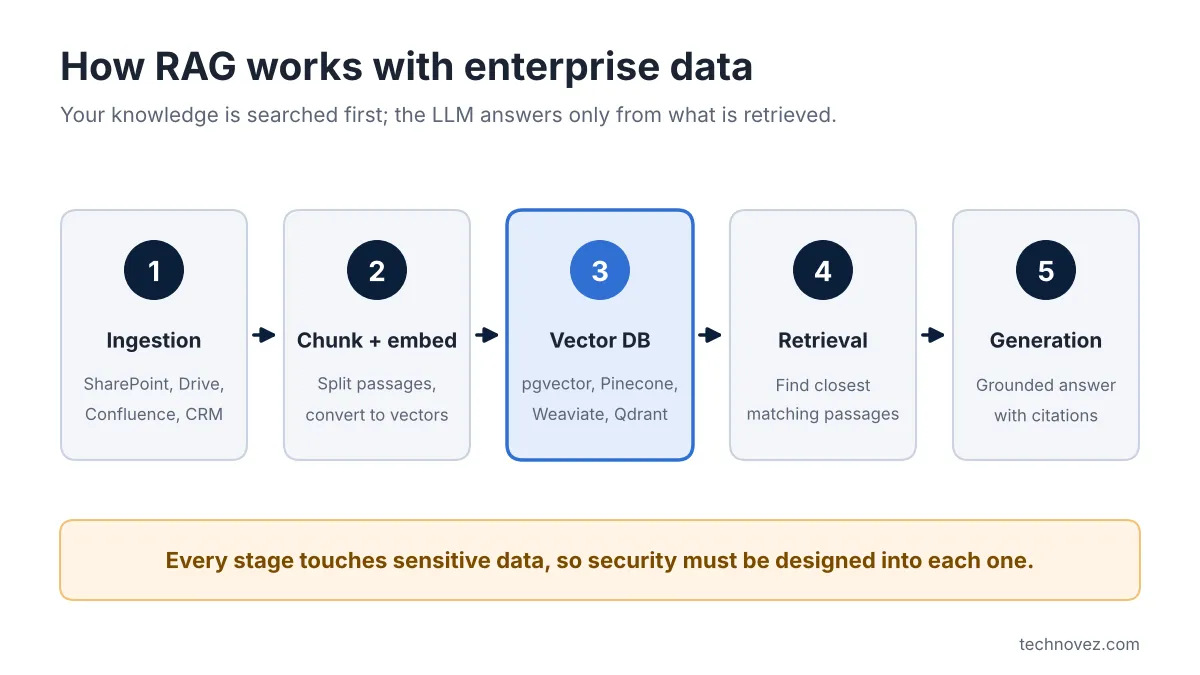
Every one of these stages touches sensitive data. That is why RAG system design has to treat security as an architecture decision, not a feature added at the end.
RAG security risks and solutions
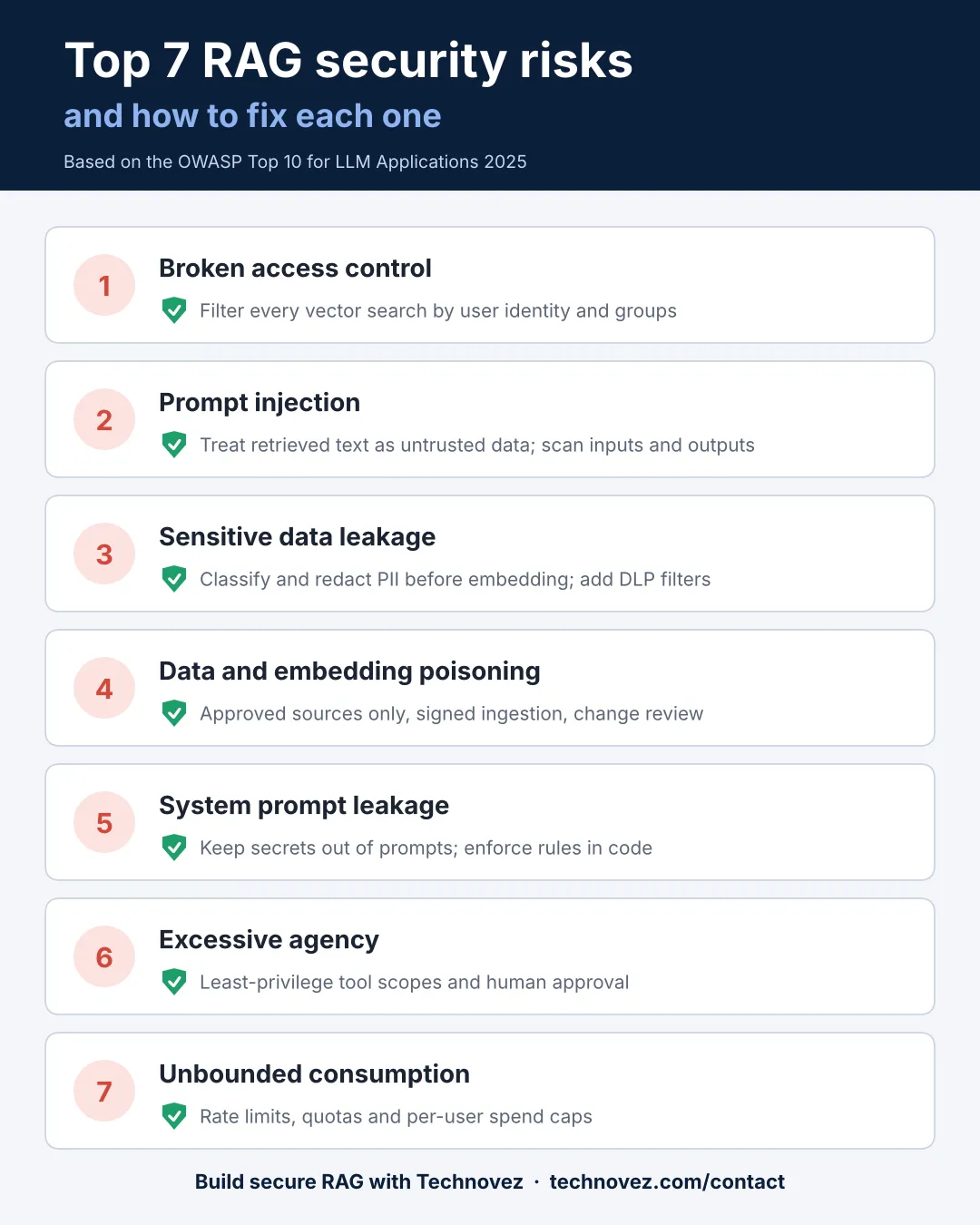
The biggest RAG security risks are unauthorized data exposure and prompt injection. OWASP’s 2025 list ranks Prompt Injection (LLM01) and Sensitive Information Disclosure (LLM02) first and second. It also added Vector and Embedding Weaknesses (LLM08), a risk specific to RAG.
| Risk | What goes wrong | Solution |
| Broken access control | A user retrieves chunks from documents they cannot open in the source system | Permission-aware retrieval: filter every vector search by the user’s identity and groups |
| Prompt injection in RAG | Hidden text in a retrieved file tells the LLM to ignore rules or reveal data | Treat retrieved content as untrusted data, separate it from instructions, scan inputs and outputs |
| Sensitive data leakage | PII, PHI or secrets end up in the index and in answers | Classify and redact before embedding; apply output filters (DLP) |
| Data and embedding poisoning | Attackers plant false or malicious documents in the knowledge base | Approved sources only, signed ingestion jobs, change review |
| System prompt leakage | Users extract internal instructions and configuration | Keep secrets out of prompts; enforce rules in code, not in prompt text |
| Excessive agency | A RAG agent calls tools or APIs it should not | Least-privilege tool scopes and human approval for actions |
| Unbounded consumption | Abuse drives runaway token and infrastructure costs | Rate limits, quotas and per-user spend caps |
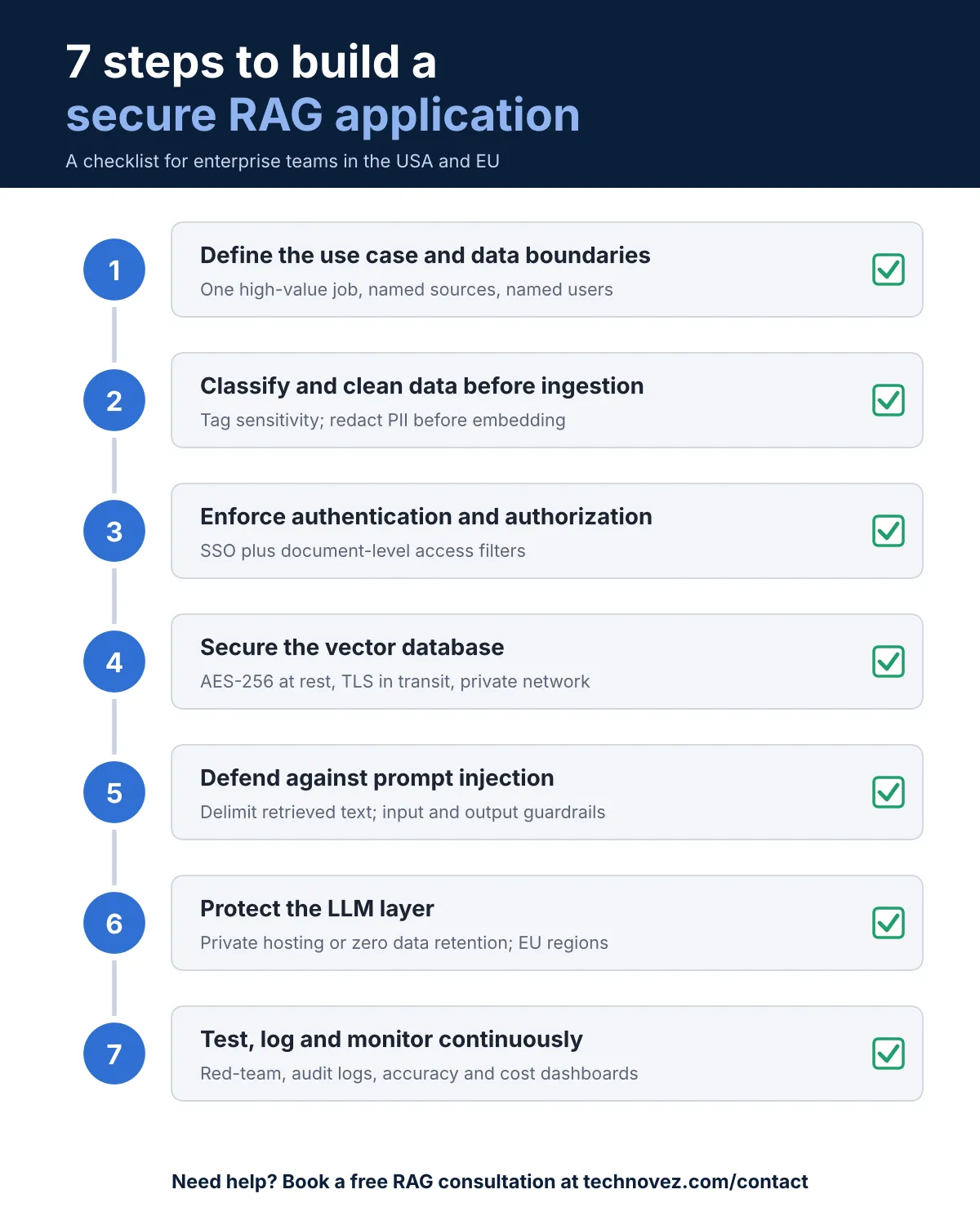
How to build a secure RAG application in 7 steps
To build a secure RAG application, define the use case and data scope, classify data, enforce permission-aware retrieval, defend against prompt injection, protect the model layer, then test and monitor continuously. Here is how each step works in practice.
Step 1: Define the use case and data boundaries
Start with one high-value job, such as an internal HR assistant or a secure RAG chatbot for enterprises handling customer support. List exactly which sources it may read and who its users are. A narrow scope reduces risk and speeds up RAG implementation for businesses.
Step 2: Classify and clean data before ingestion
This is how to protect sensitive data in RAG at the source. Tag every document as public, internal, confidential or restricted. Redact or tokenize personal data (names, SSNs, health records, card numbers) before it is embedded, because data inside a vector index is hard to delete later.
Step 3: Enforce RAG authentication and authorization
Connect the app to your identity provider (Okta, Microsoft Entra ID or Google Workspace) through SSO. Store each chunk’s source permissions as metadata, then filter every search by the signed-in user’s groups. This document-level RAG access control means users never retrieve what they could not open in the original system.
Step 4: Secure the vector database
Treat the vector database for RAG as a production data store. Encrypt it at rest (AES-256) and in transit (TLS 1.2+), place it on a private network and use separate namespaces per tenant or department. Sync deletions from source systems so removed files disappear from the index too.
Step 5: Defend against prompt injection in RAG
Wrap retrieved text in clear delimiters and instruct the model to treat it as reference data only. Add input and output guardrails that detect injection patterns, block secrets and strip unsafe links. Never let the LLM decide permissions; enforce them in application code.
Step 6: Protect the LLM layer
Choose model hosting that fits your data residency needs: a private cloud deployment or an enterprise API with zero data retention. For EU users, keep processing in EU regions where required. Limit any tools an AI agent can call to the minimum scope.
Step 7: Test, log and monitor continuously
Red-team the system with jailbreak and injection tests before launch. Log every query, retrieved source and answer for audit. Track answer accuracy, citation quality, cost per query and blocked attempts on a dashboard.
What is the best architecture for secure RAG?
The best architecture for secure RAG is a layered, zero-trust design in which identity, retrieval filtering, guardrails and audit logging each act as an independent control. If one layer fails, the next still blocks the leak.
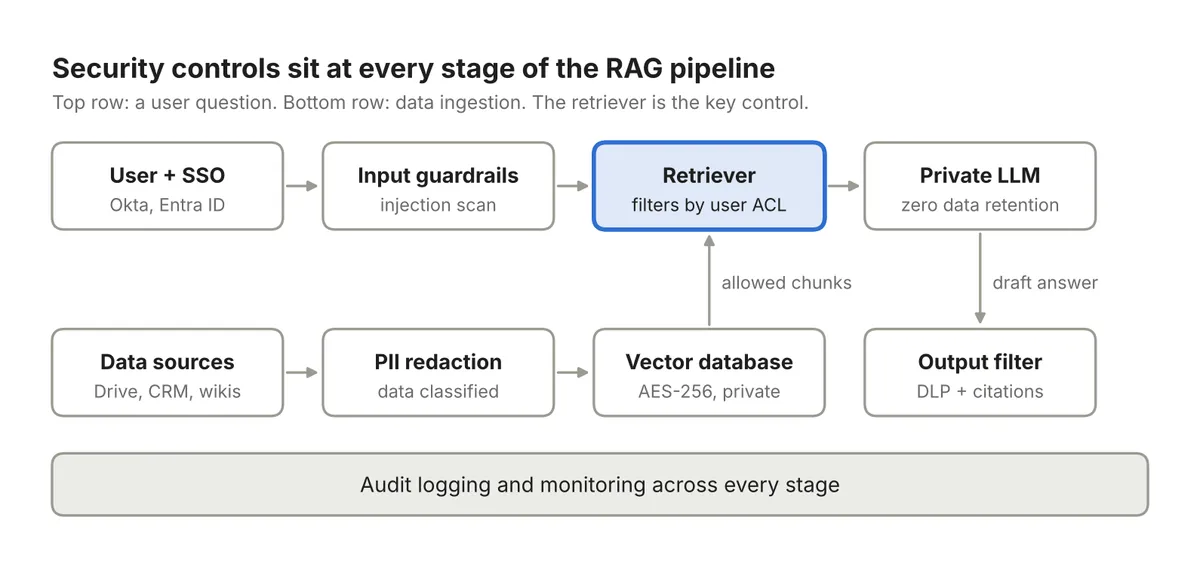
The retriever is the most important control: it only returns chunks the signed-in user is allowed to read, so the LLM never sees anything else.
Compliance for USA and EU businesses
A secure RAG architecture also has to satisfy the regulations your customers care about.
| Region | Rules that typically apply | What it means for your RAG system |
| United States | HIPAA (health), GLBA (finance), CCPA/CPRA (California), SOC 2 expectations from enterprise buyers, NIST AI RMF (voluntary) | Encrypt PHI and financial data, sign BAAs with model vendors, keep audit trails |
| European Union | GDPR, EU AI Act | Lawful basis and data minimization, EU data residency, honor erasure requests inside the vector index, tell users they are talking to AI |
Under the EU’s Digital Omnibus, AI Act obligations for stand-alone high-risk systems (Annex III, such as AI used in hiring) moved from August 2, 2026 to December 2, 2027. Most internal RAG assistants are not high-risk, but an HR screening bot could be, so plan for it now.
Build in-house or hire a RAG development company in the USA?
Build in-house if you have ML engineers, security architects and time to maintain the pipeline. Hire a specialist if you need a production-ready, compliant system in weeks rather than quarters.
A good RAG development company USA businesses can trust should offer:
- Security-first RAG system design with permission-aware retrieval built in from day one
- Custom RAG solutions USA teams can host in their own AWS, Azure or Google Cloud account
- RAG chatbot development that connects to the tools your staff already use
- Experience across regulated industries and both US and EU compliance needs
- Ongoing monitoring, evaluation and support after launch
Technovez is an AI development company USA clients use for enterprise AI development, with headquarters in St. Petersburg, Florida. The team has served 120+ businesses across 20+ industries, delivering AI automation, custom AI agents and enterprise RAG solutions USA organizations can scale. Explore our AI and software development services or see recent client projects.
Frequently asked questions
How do you secure a RAG application?
Secure a RAG application by enforcing document-level access control at retrieval, redacting sensitive data before embedding, encrypting the vector database, filtering inputs and outputs for prompt injection and leaks, and logging every query for audit.
What is prompt injection in RAG?
Prompt injection in RAG happens when a retrieved document contains hidden instructions that try to override the system’s rules. The defense is to treat retrieved text as untrusted data and enforce permissions in code, never in the prompt.
Is RAG more secure than fine-tuning an LLM?
Usually, yes. With RAG, data stays in a store you control, permissions apply per user, and a document can be removed instantly. Fine-tuned data is baked into model weights and cannot be selectively deleted.
How long does enterprise RAG implementation take?
A focused pilot with one data source and one user group often takes 4 to 8 weeks. Enterprise rollouts with multiple sources, SSO and compliance reviews typically take 3 to 6 months.
Can a RAG application be GDPR compliant?
Yes. It needs a lawful basis for processing, data minimization, EU-region hosting where required, and a process that deletes personal data from both the source and the vector index on request.
Have a different question? Visit our FAQ page or ask our team directly.
Ready to build a secure RAG application?
Turn your company knowledge into a secure AI assistant. Technovez designs and builds secure RAG development USA and EU businesses rely on, from architecture and data security to SSO, guardrails and launch. Tell us about your data and use case, and we will map out a secure RAG architecture for you.
Book a Free RAG Consultation → | Explore Our AI Services →
Call +1 (727) 276-4724 · Email sales@technovez.com · 7901 4th St N, Ste 300, St. Petersburg, FL 33702
Design note for the CTA tab: full-width brand-color banner, primary button “Book a Free RAG Consultation” (links to /contact), secondary outline button “Explore Our AI Services” (links to /services). Add UTM parameters, e.g. ?utm_source=blog&utm_campaign=secure-rag.