
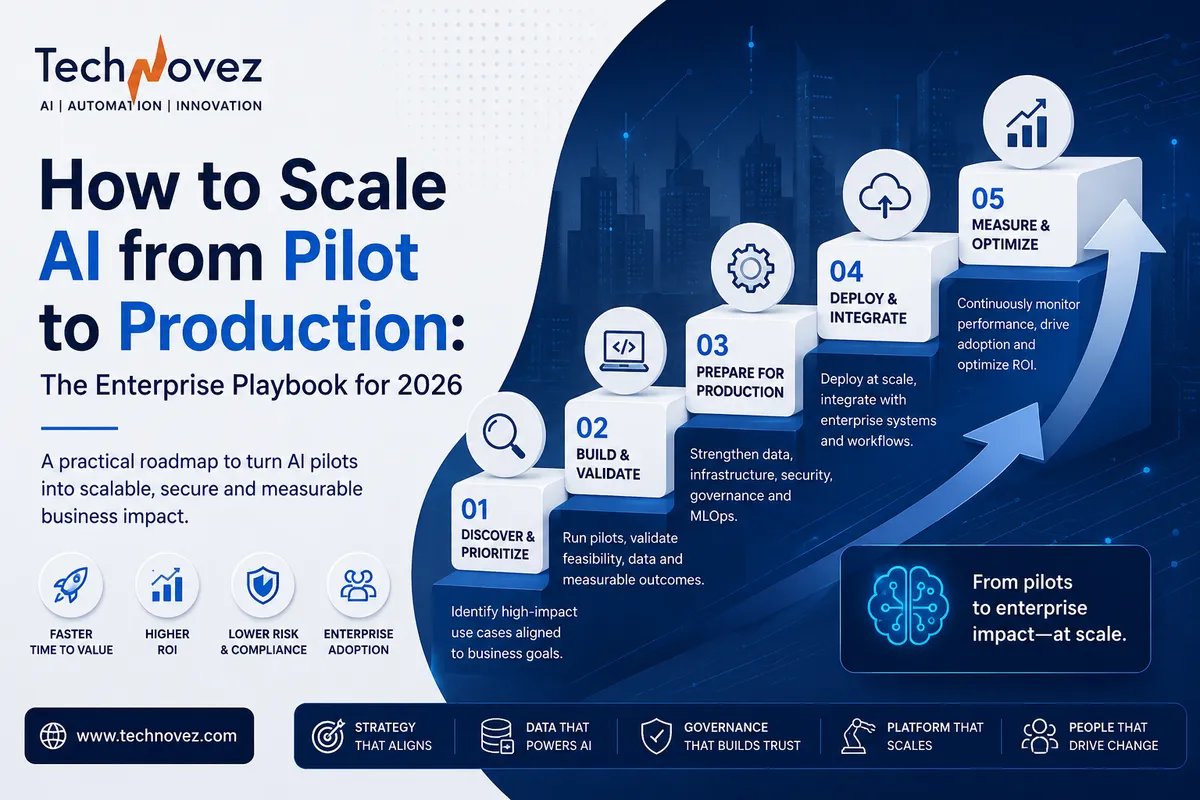
How to Scale AI from Pilot to Production: The Enterprise Playbook for 2026
By the Technovez Enterprise AI Advisory Team
Executive Summary
Most enterprises today are not short on AI pilots — they are short on AI that survives contact with production. Across industries, teams have built impressive proofs of concept using large language models, copilots, and automation tools, yet a large share of these projects never reach a stable, governed, business-critical state. This guide explains why that gap exists and lays out a practical, technically grounded playbook for moving AI initiatives from experimentation to secure, scalable, production-grade systems. It covers the enterprise AI lifecycle, infrastructure requirements, governance and security controls, the Microsoft AI ecosystem (Copilot Studio, Azure AI Foundry, Power Automate), a scaling roadmap, common mistakes, best practices, and where the industry is heading through 2030. The goal is not to make AI adoption sound simple — it is to make it repeatable.
Key Takeaways
- A pilot proves an idea works technically; production proves it works reliably, securely, and economically at scale — these are different engineering and organizational problems.
- Most AI pilots stall not because the model underperforms, but because of missing governance, weak data foundations, unclear ownership, and no infrastructure plan for monitoring and scaling.
- Production AI requires the same rigor as production software: reliability, observability, security, access control, and a clear owner accountable for outcomes.
- Microsoft's enterprise AI stack — Azure AI Foundry, Microsoft Copilot Studio, Power Automate, and Microsoft Entra ID — gives organizations a governed path to production without building everything from scratch.
- Agentic AI introduces new architectural and governance requirements, including tool permissions, human-in-the-loop checkpoints, and multi-agent orchestration controls.
- Organizations that succeed treat AI as a lifecycle discipline (MLOps/LLMOps), not a one-time project, with continuous evaluation, monitoring, and improvement built in from day one.
1. Introduction
Enterprise interest in artificial intelligence has moved well past curiosity. Boards ask about it, budgets are allocated to it, and nearly every department wants a chatbot, a copilot, or an automated workflow of its own. Yet a consistent pattern shows up across industries and geographies: organizations launch AI pilots quickly, generate excitement, and then struggle to translate that early momentum into something durable. The proof of concept works in a demo; six months later, it is still a proof of concept, running on someone's personal Azure subscription, unmonitored, unowned, and quietly ignored.
This is not a failure of the underlying technology. Foundation models from OpenAI and Anthropic, along with Microsoft's Azure AI Foundry and Copilot Studio platforms, are mature enough to support serious enterprise workloads. The failure is almost always organizational and architectural: unclear ownership, missing governance, absent infrastructure planning, and a mismatch between what a pilot needs to prove and what production requires.
This article defines what it actually means for AI to be "production ready," why so many pilots never get there, and what a realistic, technically sound path to enterprise-scale AI looks like in 2026. It is written for the people who have to make this work: CIOs, CTOs, enterprise architects, AI engineers, and the operations leaders who will be accountable for the systems long after the pilot's novelty has worn off.
2. Why AI Pilots Fail to Reach Production
Short answer: AI pilots typically fail to reach production because they are evaluated and built as demonstrations rather than as systems — they lack governance, data readiness, infrastructure, clear ownership, and a defined path to measurable business value.
A pilot is designed to answer one question: can this idea work at all? It is intentionally narrow in scope, often built by a small team, sometimes outside standard IT processes, using sample data and a friendly test group. That narrowness is exactly what makes pilots fast — and exactly what makes them unfit for production without significant additional work. The most common failure points include the following.
Lack of business alignment. Many pilots start from a technology capability ("we can build a chatbot with this LLM") rather than a business problem with an owner, a budget, and a measurable outcome. Without a sponsor who is accountable for results, the project has no natural path to funding beyond the pilot stage.
Poor data quality and readiness. Pilots often use a curated, clean subset of data. Production systems must handle the messy reality of enterprise data: inconsistent formats, outdated records, access-control boundaries, and content scattered across SharePoint, file shares, CRM systems, and legacy databases. When that foundation isn't addressed early, the model's real-world accuracy drops sharply outside the demo environment.
Weak or absent governance. Pilots are frequently exempt from formal review because they are "just a test." That exemption becomes a liability the moment the system touches real customer data, generates content that goes external, or makes decisions that affect employees or customers.
No infrastructure or scaling plan. A pilot running on a developer's laptop or a single low-throughput API key cannot survive contact with hundreds or thousands of concurrent users. Moving to production requires deliberate decisions about hosting, throughput, latency, caching, and cost control.
Limited stakeholder support. If legal, security, compliance, and business unit leaders are not engaged during the pilot, they will surface objections during the production review — often late enough to stall the project entirely.
Unclear return on investment. Enterprise finance teams naturally ask what a system will save, generate, or improve. Pilots rarely capture this rigorously, which makes it difficult to justify the additional investment production requires.
Security and compliance concerns. Regulated industries in the United States, the United Kingdom, and the European Union face real obligations around data residency, explainability, and auditability. A pilot that ignores these will not clear a security or legal review.
The "prototype mentality." Perhaps the most common cause: treating the pilot's code, prompts, and architecture as something that will simply be "hardened later." In practice, production-grade AI systems usually need to be re-architected, not patched, once governance, scale, and security requirements are added.
3. What Does AI Production Mean?
Short answer: Production AI is an AI system that operates reliably, securely, and predictably at enterprise scale, with defined ownership, monitoring, governance, and a measurable connection to business outcomes — not a one-off demonstration of technical capability.
Moving from pilot to production is not simply a matter of "turning it on" for more users. It requires the system to meet a different bar across seven dimensions.
Reliability. The system behaves consistently across normal and edge-case inputs, has defined uptime expectations, and degrades gracefully — through fallbacks or human handoff — rather than failing silently.
Scalability. The architecture can absorb growth in users, data volume, and request complexity without a proportional increase in cost or a decline in performance. This typically means designing for concurrency, caching, and elastic compute from the outset.
Security. Access is controlled through enterprise identity systems, data in transit and at rest is encrypted, and the system is tested against known attack patterns for AI applications, including prompt injection and data exfiltration risks described in the OWASP Top 10 for LLM Applications.
Monitoring and observability. Teams can see what the system is doing in near real time: request volume, latency, error rates, model output quality, and cost per interaction. Without this, problems are discovered by end users rather than by the team responsible for the system.
Governance. There is a documented owner, a review process for changes, an escalation path for incidents, and alignment with frameworks such as the NIST AI Risk Management Framework or ISO/IEC 42001 where applicable.
Performance and quality. Model outputs are evaluated against defined quality benchmarks, not just "it looked right in testing." This includes structured evaluation of accuracy, relevance, tone, and safety on a representative and ongoing basis.
Business value. The system is tied to a measurable outcome — reduced handling time, faster resolution, improved accuracy, cost avoidance — that can be reported to stakeholders in the same language used for any other enterprise investment.
4. The Enterprise AI Lifecycle
Short answer: Enterprise AI moves through ten connected phases — strategy, use case selection, data readiness, model development, pilot, validation, deployment, monitoring, optimization, and continuous improvement — and skipping any phase is the single most common reason pilots stall before production.
Business strategy. Before any model is chosen, leadership defines which business problems AI should address and how success will be measured. This phase should produce a short list of prioritized use cases tied to business KPIs, not a list of technologies to experiment with.
Use case selection. Not every process benefits from AI, and not every AI use case deserves scarce engineering time. Strong candidates have a clear owner, measurable value, available data, and a tolerance for the kind of probabilistic output that generative AI produces.
Data readiness. This phase assesses where relevant data lives, who can access it, how current it is, and what governance rules apply. For retrieval-augmented generation (RAG) use cases, this includes deciding what content should be indexed and what should explicitly be excluded.
Model development. Teams select an appropriate foundation model (for example, via Azure OpenAI Service or Anthropic's Claude models), design prompts, and — where necessary — build retrieval pipelines, agent logic, or fine-tuning strategies.
Pilot. A controlled test with a defined user group, success criteria, and time box. The purpose of the pilot is to gather evidence, not to declare victory.
Validation. Before wider release, the system is evaluated against accuracy, safety, and business benchmarks defined earlier — typically through structured model evaluation, red-teaming, and user acceptance testing.
Deployment. The system moves into a governed production environment with the infrastructure, monitoring, and access controls described later in this guide.
Monitoring. Once live, the system is continuously observed for performance drift, cost anomalies, safety incidents, and user satisfaction.
Optimization. Based on monitoring data, teams tune prompts, retrieval quality, agent permissions, and infrastructure to improve outcomes and control cost.
Continuous improvement. Production AI is never "finished." Models change, business needs evolve, and new risks emerge — so the lifecycle repeats on a regular cadence rather than ending at launch.
5. AI Infrastructure Requirements
Short answer: Production AI infrastructure requires a cloud foundation, a governed AI platform, retrieval and knowledge systems, integration APIs, MLOps/LLMOps tooling, and observability — assembled deliberately rather than accumulated ad hoc during a pilot.
Cloud infrastructure. Most enterprises standardize on a hyperscale cloud — Microsoft Azure, AWS, or Google Cloud — for compute, storage, networking, and identity integration. Azure is especially common where Microsoft 365, Power Platform, and Dynamics 365 are already core to operations.
AI platforms. Platforms such as Azure AI Foundry provide a governed environment for building, evaluating, deploying, and monitoring AI applications, including model catalogs, safety filters, and evaluation tooling in one place.
Large language models (LLMs). Enterprises typically use a mix of models — for example, models available through Azure OpenAI Service or Anthropic's Claude — chosen based on task complexity, latency needs, cost, and data residency requirements rather than a single "best" model for everything.
Retrieval-augmented generation (RAG). RAG grounds model responses in an organization's own content, reducing hallucination and keeping answers current without retraining the underlying model. This requires a pipeline for ingesting, chunking, and indexing enterprise content.
Vector databases. Vector stores (such as Azure AI Search with vector capabilities, or dedicated vector database products) enable semantic retrieval by storing numerical representations of content for similarity search, forming the backbone of most RAG architectures.
Knowledge bases. Curated, access-controlled repositories of source content — SharePoint sites, Confluence spaces, product documentation, policy manuals — that feed the retrieval layer and must be kept current to avoid stale or incorrect answers.
APIs and integration layers. Production AI rarely operates in isolation; it needs to read from and write to CRM, ERP, ticketing, and collaboration systems through well-defined APIs, typically fronted by an API gateway for security and rate control.
Model Context Protocol (MCP). MCP is an open standard for connecting AI applications and agents to external tools, data sources, and systems in a consistent, secure way, reducing the need for custom point-to-point integrations for every new tool an agent needs to use.
AI agents. Agentic systems extend beyond single question-and-answer interactions to plan multi-step tasks and call tools or other systems to complete them, which introduces new requirements for permissioning, monitoring, and human oversight covered later in this guide.
MLOps and LLMOps. Disciplined lifecycle management — versioning prompts and models, automated testing, deployment pipelines, and rollback procedures — brings the same engineering rigor to AI systems that DevOps brought to software.
Observability, monitoring, and logging. Production systems need dashboards and alerting for latency, error rates, token usage and cost, and output quality, along with structured logs suitable for audit and incident investigation.
Disaster recovery. As with any production system, enterprises need defined recovery time and recovery point objectives, backup strategies for indexes and configuration, and a tested plan for model or service outages, including fallback models or degraded-mode operation.
6. Production Architecture
Short answer: A production-grade enterprise AI architecture routes user requests through an application layer, an API gateway, and an AI gateway before reaching the language model and retrieval layer, with every step logged, secured, and connected back to enterprise systems of record.
A representative production architecture pattern looks like this:
Users (employees, customers, partners)
|
Applications (web, Teams, mobile, Copilot experiences)
|
API Gateway (authentication, rate limiting, routing)
|
AI Gateway (model routing, prompt security, cost control, logging)
|
LLMs (Azure OpenAI, Anthropic Claude, or other governed models)
|
RAG Layer (retrieval orchestration, grounding, citations)
|
Vector Database (semantic index of enterprise content)
|
Enterprise Systems of Record
|
CRM | ERP | Microsoft 365 | SharePoint | SQL Databases | GitHub
The AI gateway layer deserves particular attention because it is frequently missing from pilots. It centralizes model routing (so teams aren't hardcoding a single model everywhere), enforces prompt-level security controls, tracks token consumption for cost governance, and provides the single point where logging and monitoring can be consistently applied across every AI-powered application in the enterprise — rather than each team building its own, inconsistent version.
7. Governance & Security
Short answer: Production AI governance combines Responsible AI principles, role-based access control, encryption, audit logging, human approval checkpoints, and identity management to ensure AI systems behave safely, stay compliant, and remain accountable to a named owner.
Responsible AI and AI governance. Enterprises need documented principles covering fairness, transparency, safety, and accountability, along with a governance body empowered to review new use cases before launch. Frameworks such as the NIST AI Risk Management Framework and the ISO/IEC 42001 standard for AI management systems give organizations a structured, recognized starting point rather than building governance from scratch.
Role-based access control (RBAC). Access to AI applications, underlying data sources, and administrative controls should follow the same least-privilege principles as any other enterprise system, typically enforced through Microsoft Entra ID or an equivalent identity provider.
Encryption. Data should be encrypted in transit and at rest, including any content indexed for retrieval, prompts and completions stored for logging, and cached responses.
Audit logging. Every meaningful interaction — user queries, retrieved content, model responses, and any actions taken by an agent — should be logged in a way that supports compliance review and incident investigation after the fact.
Human approval and human-in-the-loop controls. For any action with real-world consequence (sending an external email, modifying a record, approving a transaction), a human checkpoint should be required until the system has a proven track record and the organization has explicitly accepted the risk of full automation.
Compliance. Depending on industry and geography, this may include GDPR in the European Union and United Kingdom, sector-specific regulations in financial services and healthcare, and internal data handling policies — all of which should be reviewed before, not after, a production launch.
Identity management. Centralized identity, using Microsoft Entra ID or a comparable provider, ensures that AI applications inherit the same authentication and conditional access policies as the rest of the enterprise, rather than maintaining a separate, weaker set of credentials.
AI-specific monitoring. Beyond standard application monitoring, production AI needs monitoring for model drift, unusual output patterns, and potential misuse, ideally with alerting thresholds defined during the governance review.
Prompt security. Systems should be tested against prompt injection and jailbreak attempts, consistent with guidance in the OWASP Top 10 for LLM Applications, particularly for any AI system that processes untrusted external input.
Secrets management. API keys, connection strings, and credentials used by AI applications and agents should be stored in a dedicated secrets vault (such as Azure Key Vault) rather than embedded in code, prompts, or configuration files.
8. Microsoft AI Ecosystem
Short answer: Microsoft's enterprise AI stack — Azure AI Foundry, Azure OpenAI Service, Microsoft Copilot Studio, Power Automate, Power Platform, Microsoft Fabric, and Microsoft Entra ID — gives organizations a governed, integrated path from pilot to production, particularly for companies already standardized on Microsoft 365 and Azure.
Microsoft Copilot Studio provides a low-code environment for building custom copilots and agents that can be governed centrally, connected to enterprise data, and deployed across Microsoft Teams, websites, and other channels — making it a practical entry point for business-led AI initiatives that still need IT oversight.
Azure AI Foundry is Microsoft's platform for building, evaluating, and operating AI applications at scale, bringing together model selection, prompt engineering tools, safety evaluations, and deployment management in a single governed environment.
Azure OpenAI Service provides enterprise access to OpenAI's models with the security, compliance, and regional availability controls that regulated organizations require, including private networking and data handling commitments documented in Microsoft's compliance offerings.
Power Automate and Power Platform extend AI capabilities into everyday business workflows, connecting copilots and agents to hundreds of enterprise systems without custom integration code for every connection, and giving business teams a governed way to automate processes.
Microsoft Fabric unifies data engineering, analytics, and AI workloads on a single platform, which matters for production AI because retrieval quality and agent effectiveness both depend heavily on well-managed, current enterprise data.
SharePoint and Teams frequently serve as both the source of truth for retrieval content and the delivery channel for AI experiences, since employees already work inside these tools daily.
Dynamics 365 provides a natural integration point for AI agents that need to read or update customer, sales, or service records as part of a broader workflow.
Microsoft Entra ID anchors identity and access management across the entire stack, ensuring that every AI application and agent respects the same permission boundaries as the humans using it.
Together, this ecosystem allows an enterprise to move from a Copilot Studio pilot to an Azure AI Foundry-governed, Power Automate-integrated production system without switching platforms — which materially reduces the re-architecture work that so often stalls AI projects between pilot and production.
9. Enterprise Scaling Roadmap
Short answer: A realistic enterprise AI scaling roadmap moves through assessment, business case development, infrastructure planning, a governed pilot, security and governance review, production deployment, monitoring, and continuous optimization — typically over two to six months for a well-scoped use case, longer for complex or highly regulated environments.
Phase 1 — Assessment. Evaluate current data readiness, existing AI initiatives, technical infrastructure, and organizational appetite for AI-driven change. This phase should produce an honest picture of what is actually in place today.
Phase 2 — Business case. Define the target use case, expected value, required investment, and success metrics in terms the business already uses to evaluate other investments.
Phase 3 — Infrastructure planning. Decide on the cloud platform, AI platform (such as Azure AI Foundry), integration approach, and data architecture needed to support the use case at the scale it will eventually reach.
Phase 4 — Governed pilot. Run a time-boxed pilot with defined success criteria, real (not just sample) data where possible, and governance review built in from the start rather than added afterward.
Phase 5 — Governance and security review. Before wider release, formally review the system against the organization's Responsible AI principles, security requirements, and applicable compliance obligations.
Phase 6 — Deployment. Release the system into the production environment with the architecture, access controls, and monitoring described earlier in this guide.
Phase 7 — Monitoring. Establish ongoing operational visibility into performance, cost, safety, and user adoption from day one of production use.
Phase 8 — Optimization and continuous improvement. Use monitoring data and user feedback to refine prompts, retrieval quality, and infrastructure, and formally revisit the use case on a regular cadence as models and business needs evolve.
10. Common Mistakes
Short answer: The most common mistakes enterprises make when scaling AI are treating a pilot's architecture as production-ready, skipping governance, deploying without monitoring, underinvesting in infrastructure, neglecting prompt engineering discipline, having no fallback strategy, ignoring business KPIs, and never formally evaluating model quality.
- Treating pilots as production. Reusing pilot code and prompts unchanged in production, without addressing scale, security, or monitoring gaps.
- Ignoring governance until forced to. Waiting for a security or legal objection to trigger governance work, rather than building it into the process from the start.
- No monitoring. Discovering problems through user complaints instead of dashboards and alerts.
- Weak infrastructure planning. Underestimating throughput, latency, and cost requirements once real user volume arrives.
- Poor prompt engineering discipline. Treating prompts as disposable text rather than versioned, tested artifacts that directly affect output quality and safety.
- No fallback strategy. Assuming the model or service will always be available, with no defined behavior for outages, rate limits, or degraded responses.
- Ignoring business KPIs. Measuring success by usage alone rather than by the business outcome the system was meant to improve.
- No formal AI evaluation. Relying on subjective impressions ("it seems good") instead of structured, repeatable evaluation against defined quality and safety benchmarks.
11. Best Practices
Short answer: Enterprises that scale AI successfully secure executive sponsorship, build cross-functional teams, establish an AI Center of Excellence and governance board, and treat continuous evaluation, prompt versioning, and human oversight as standard operating practice rather than optional extras.
- Executive sponsorship. A named business leader accountable for outcomes gives the initiative funding, priority, and organizational cover to work through cross-team friction.
- Cross-functional teams. Successful production AI projects combine business owners, data teams, security, legal/compliance, and engineering from the start, not as a late-stage review.
- AI Centers of Excellence. A central team that sets standards, reviews use cases, and shares reusable infrastructure prevents every business unit from solving the same governance and architecture problems independently.
- AI governance boards. A recurring review body — not just a one-time checklist — keeps pace with new use cases, new models, and evolving regulation.
- Continuous evaluation. Regular, structured testing of model outputs against defined benchmarks catches quality drift before users do.
- Prompt versioning. Treating prompts like code, with version control and change review, prevents silent regressions when someone "just tweaks the wording."
- Model benchmarking. Periodically comparing model options on cost, latency, and quality prevents lock-in to a model that is no longer the best fit.
- Human oversight. Maintaining human review for high-stakes decisions, even after automation is largely trusted, protects against rare but costly failure modes.
- Infrastructure scalability. Designing for the traffic and data volume the system will need in a year, not just for the pilot's user group, avoids a costly re-architecture later.
12. Future Trends (2026–2030)
Short answer: Over the next several years, enterprise AI is expected to shift from single-purpose copilots toward agentic AI, multi-agent orchestration, and continuous AI delivery — supported by dedicated AI observability platforms and, for some organizations, an increasingly "AI-native" way of designing workflows from the start.
Agentic AI. Systems are moving from answering questions to planning and executing multi-step tasks, calling tools, and coordinating with other systems — which raises the stakes on governance and monitoring described earlier in this guide.
AI operating systems. Some vendors are positioning unified platforms that manage models, agents, data, and governance as a coherent layer across the enterprise, rather than a collection of separate point solutions.
Multi-agent orchestration. Complex workflows increasingly involve multiple specialized agents coordinating on a task, which introduces new architectural questions around task handoff, shared context (an area where the Model Context Protocol is gaining relevance), and failure containment.
Autonomous workflows. As trust and evaluation maturity increase, more workflows are expected to run with reduced human checkpoints — though enterprises in regulated sectors will likely retain human oversight for consequential decisions well into this period.
AI-native enterprises. Organizations are beginning to design processes around AI capability from the outset, rather than retrofitting AI onto existing workflows — a shift that has implications for how roles, data architecture, and governance are structured.
Continuous AI delivery. Borrowing from continuous integration and delivery in software engineering, organizations are building pipelines that continuously evaluate and redeploy prompts, retrieval configurations, and even model choices as conditions change.
AI observability platforms. Purpose-built tooling for tracking model quality, drift, cost, and safety at scale is maturing quickly, reflecting the recognition that standard application monitoring is not sufficient for probabilistic AI systems.
13. How Technovez Helps
Scaling AI from pilot to production is as much an organizational and architectural challenge as it is a technology choice. Technovez works with enterprises across the United States, Canada, the United Kingdom, and Europe as an implementation partner for exactly this transition — helping organizations move from scattered pilots to governed, production-grade AI systems.
Technovez's work spans enterprise AI strategy and use case prioritization, AI production readiness assessments, Microsoft Copilot Studio agent development, Azure AI Foundry and Azure OpenAI implementation, AI infrastructure design (including RAG pipelines and vector search), AI governance frameworks aligned to recognized standards, Power Automate and Power Platform automation, agentic AI architecture, and broader enterprise automation and digital transformation initiatives. Rather than treating AI as an isolated technology project, Technovez focuses on the governance, infrastructure, and operating model changes that determine whether an AI initiative survives past its first six months. Organizations exploring this transition can review Technovez's approach at technovez.com, browse related implementation guidance on the Technovez blog, explore the full range of enterprise AI and automation services, or contact the Technovez team to discuss a specific pilot-to-production transition.
Comparison Tables
AI Pilot vs. Production AI
| Dimension | AI Pilot | Production AI |
| Purpose | Prove technical feasibility | Deliver reliable, ongoing business value |
| Data | Curated sample data | Full, governed enterprise data |
| Users | Small, friendly test group | Broad employee, customer, or partner base |
| Governance | Often informal or skipped | Formal review, ownership, and audit trail |
| Monitoring | Minimal or none | Continuous observability and alerting |
| Security | Basic, sometimes deferred | Enterprise-grade, reviewed by security teams |
| Ownership | Individual or small team | Named business and technical owner |
| Success metric | "It worked in the demo" | Measurable KPI improvement |
| Lifespan | Weeks to a few months | Ongoing, with a defined improvement cadence |
Traditional Software Deployment vs. AI Deployment
| Dimension | Traditional Software | AI Deployment |
| Behavior | Deterministic — same input, same output | Probabilistic — outputs can vary and require evaluation |
| Testing | Unit and integration tests against fixed expected results | Model evaluation against quality, safety, and accuracy benchmarks |
| Change management | Code review and version control | Prompt/model versioning plus code review |
| Failure modes | Bugs, crashes, exceptions | Hallucination, drift, bias, unsafe outputs, in addition to standard bugs |
| Monitoring focus | Uptime, latency, error rate | Uptime, latency, error rate, plus output quality and cost per request |
| Data dependency | Moderate | High — output quality is directly tied to data and retrieval quality |
| Security risks | Standard application security (OWASP Top 10) | Standard risks plus prompt injection and data leakage (OWASP Top 10 for LLM Applications) |
MLOps vs. LLMOps
| Dimension | MLOps | LLMOps |
| Focus | Managing the lifecycle of traditional ML models (classification, regression, forecasting) | Managing the lifecycle of large language model applications, including prompts, retrieval, and agents |
| Core artifacts | Trained models, feature pipelines | Prompts, retrieval indexes, model choices, agent tool configurations |
| Evaluation | Accuracy, precision, recall, F1 and similar metrics | Relevance, faithfulness, safety, tone, and task completion, often using LLM-assisted evaluation |
| Retraining | Periodic retraining on new labeled data | Often no retraining at all — improvement comes from better prompts, retrieval, and context |
| Key risk | Model drift as data patterns change | Hallucination, prompt injection, and inconsistent outputs across similar inputs |
| Typical tooling | Feature stores, experiment tracking, model registries | Prompt registries, RAG evaluation tools, AI gateways, agent orchestration frameworks |
Enterprise AI Production Readiness Checklist
- [ ] Business owner and success metrics are documented and agreed
- [ ] Data sources are identified, access-controlled, and current
- [ ] Retrieval/RAG pipeline (if used) is tested against representative queries
- [ ] Model choice is justified on cost, latency, and quality grounds
- [ ] Prompts are version-controlled and peer-reviewed
- [ ] AI gateway or equivalent layer is in place for routing, logging, and cost control
- [ ] Authentication and authorization use enterprise identity (e.g., Microsoft Entra ID)
- [ ] Data is encrypted in transit and at rest
- [ ] Audit logging captures inputs, outputs, and agent actions
- [ ] Human-in-the-loop checkpoints are defined for high-stakes actions
- [ ] Monitoring dashboards cover latency, errors, cost, and output quality
- [ ] Fallback behavior is defined for outages or rate limits
- [ ] Security review has been completed, including prompt injection testing
- [ ] Compliance requirements (e.g., GDPR, sector-specific rules) have been reviewed
- [ ] A governance owner is named and a review cadence is scheduled
- [ ] A rollback plan exists for prompt, model, or configuration changes
AI Deployment Checklist
- [ ] Infrastructure sized for expected concurrent usage, not just pilot volume
- [ ] Staging environment mirrors production for pre-release testing
- [ ] Load testing completed against realistic traffic patterns
- [ ] Disaster recovery plan documented, including RTO/RPO targets
- [ ] Secrets and API keys stored in a managed vault, not in code or prompts
- [ ] Deployment pipeline supports controlled rollout (e.g., phased or canary release)
- [ ] Cost monitoring and budget alerts are configured
- [ ] Support and escalation process defined for production incidents
- [ ] End-user communication and training plan is ready
- [ ] Post-launch review scheduled within 30–90 days
AI Governance Checklist
- [ ] Responsible AI principles documented and approved by leadership
- [ ] AI governance board or equivalent review body established
- [ ] Use case intake and review process defined for new AI initiatives
- [ ] Alignment reviewed against NIST AI RMF and/or ISO/IEC 42001 where applicable
- [ ] Data privacy and residency requirements confirmed for the use case
- [ ] Bias and fairness considerations reviewed for the specific use case
- [ ] Explainability requirements defined for regulated or high-stakes decisions
- [ ] Incident response plan defined for AI-specific failures
- [ ] Third-party model and vendor terms reviewed for data usage rights
- [ ] Periodic re-review scheduled as models, data, or regulations change
Decision Framework: Is Your AI Pilot Ready for Production?
Use this maturity scoring model to assess readiness. Score each category from 0 (not started) to 3 (fully in place), for a maximum of 21 points.
| Category | 0 – Not started | 1 – Early | 2 – Developing | 3 – Mature |
| Business alignment | No defined owner or KPI | Owner identified, KPI vague | Owner and KPI defined | KPI tracked and reported regularly |
| Data readiness | Ad hoc sample data only | Some governed data identified | Most relevant data access-controlled and current | Full governed data pipeline in place |
| Infrastructure | Single developer environment | Basic cloud deployment | Scalable architecture, untested at volume | Load-tested, elastic infrastructure |
| Governance | No review process | Informal review | Formal review, inconsistent | Standing governance board with defined cadence |
| Security | Not assessed | Basic authentication only | Enterprise identity and encryption in place | Full security review including prompt injection testing |
| Monitoring | None | Basic uptime checks | Latency and error monitoring | Full observability including output quality and cost |
| Evaluation | Subjective impressions only | Occasional manual review | Defined benchmarks, tested periodically | Continuous, automated evaluation pipeline |
Scoring guide:
- 0–7 points: Early pilot stage. Focus on business alignment and data readiness before investing further in scale.
- 8–14 points: Developing. Core building blocks exist; prioritize governance and monitoring gaps before wider release.
- 15–21 points: Production-ready or close to it. Focus on continuous evaluation and optimization rather than foundational gaps.
Frequently Asked Questions
Why do most AI pilots fail to reach production? Most AI pilots fail to reach production because they are built to prove an idea works, not to operate reliably at scale — they typically lack governance, monitoring, a clear business owner, and an infrastructure plan for real-world data and traffic volumes.
What is AI production? AI production refers to an AI system operating reliably, securely, and at scale in real business use, with defined ownership, monitoring, governance, and a measurable connection to business outcomes, rather than existing only as a demonstration or proof of concept.
How long does AI deployment take? For a well-scoped use case with existing data and infrastructure, moving from a governed pilot to production typically takes two to six months; more complex, multi-system, or highly regulated use cases can take longer.
What is MLOps? MLOps is the discipline of managing the lifecycle of machine learning models in production, including versioning, testing, deployment, monitoring, and retraining, using practices adapted from DevOps.
What is LLMOps? LLMOps applies similar lifecycle discipline specifically to large language model applications, covering prompt versioning, retrieval pipeline management, model evaluation, and agent behavior monitoring rather than traditional model retraining.
How do you scale AI securely? Scaling AI securely requires enterprise identity integration, encryption of data in transit and at rest, role-based access control, audit logging, and testing against known AI-specific risks such as prompt injection, in addition to standard application security practices.
What infrastructure is required to run AI in production? Production AI typically requires cloud compute, a governed AI platform (such as Azure AI Foundry), a retrieval layer with a vector database for grounding responses, an AI gateway for routing and logging, integration APIs to enterprise systems, and monitoring and observability tooling.
Can Microsoft Copilot Studio support production AI? Yes. Microsoft Copilot Studio is designed to support production use, particularly when paired with centralized governance, Microsoft Entra ID-based access control, and integration with Azure AI Foundry or Azure OpenAI Service for more advanced model and evaluation capabilities.
What is the difference between an AI pilot and a proof of concept? In practice, the two terms are often used interchangeably; both describe a limited-scope test intended to validate feasibility rather than a governed, scalable system ready for broad business use.
What is Agentic AI? Agentic AI refers to AI systems that can plan and execute multi-step tasks, call external tools or systems, and make decisions with some degree of autonomy, rather than simply responding to a single question or prompt.
What is Retrieval-Augmented Generation (RAG)? RAG is an architectural pattern that grounds a language model's responses in retrieved content from an organization's own data, improving accuracy and reducing hallucination without retraining the underlying model.
What is the Model Context Protocol (MCP)? MCP is an open standard that defines how AI applications and agents connect to external tools, data sources, and systems in a consistent way, reducing the need for custom integration code for every new connection.
How do you measure ROI on enterprise AI? ROI is typically measured against the specific business KPI the use case targeted before launch — such as reduced handling time, faster resolution, or error reduction — rather than generic usage statistics like number of queries.
What role does AI governance play in scaling AI? AI governance provides the review process, ownership structure, and alignment to recognized frameworks (such as the NIST AI RMF or ISO/IEC 42001) that allow an organization to scale AI use cases consistently and defensibly, rather than case by case.
Do enterprises need a dedicated AI Center of Excellence? Not every organization needs a formal Center of Excellence, but most enterprises scaling AI across multiple business units benefit from a central team that sets standards, reviews use cases, and shares reusable infrastructure and governance practices.
Call to Action
Scaling AI from pilot to production is rarely a technology problem alone — it is a governance, architecture, and operating model problem that most internal teams have not solved before. Technovez helps enterprises across the United States, Canada, the United Kingdom, and Europe build the strategy, infrastructure, and governance needed to move AI initiatives safely and confidently into production.
If your organization has a promising AI pilot that has stalled, or you are planning your first production AI deployment, contact Technovez to discuss enterprise AI strategy, Microsoft Copilot Studio development, Azure AI Foundry implementation, AI governance, AI infrastructure, agentic AI, and broader digital transformation support. Explore more implementation guidance on the Technovez blog or review the full set of enterprise AI and automation services at technovez.com.
Schema Markup Recommendations
- Article schema — mark up headline, author (Technovez), datePublished, dateModified, image, and publisher for standard article eligibility in search results.
- FAQPage schema — mark up the Frequently Asked Questions section above so individual Q&A pairs are eligible for rich results and AI answer engines.
- Organization schema — mark up Technovez's name, logo, URL, and sameAs (social profiles) on the site-wide template so search and AI engines can associate this content with the publisher.
- BreadcrumbList schema — mark up the navigation path (Home > Blog > How to Scale AI from Pilot to Production) for clearer site structure signals.
- HowTo schema — optional; can be applied to the Enterprise Scaling Roadmap (Section 9) if presented as a discrete numbered process on the page.
Internal Linking Suggestions
- Homepage: anchor text "Technovez's enterprise AI and automation practice" linking to https://www.technovez.com/
- Blog hub: anchor text "more enterprise AI implementation guides on the Technovez blog" linking to https://www.technovez.com/blog
- Services: anchor text "Technovez's Microsoft Copilot Studio, Azure AI, and AI governance services" linking to https://www.technovez.com/services
- Contact: anchor text "talk to Technovez's enterprise AI team" linking to https://www.technovez.com/contact
Authoritative References
- Microsoft Learn — Azure AI Foundry documentation
- Microsoft Learn — Microsoft Copilot Studio documentation
- Microsoft Learn — Azure OpenAI Service documentation
- OpenAI documentation (platform and API guidance)
- Anthropic documentation (Claude models and usage guidance)
- NIST AI Risk Management Framework (AI RMF 1.0)
- ISO/IEC 42001:2023 — AI management systems standard
- OWASP Top 10 for LLM Applications
- Model Context Protocol (MCP) documentation
Image SEO
Hero image concept: A clean, modern enterprise visual showing an abstract pipeline moving from a small "pilot" node through governance and infrastructure checkpoints into a larger, connected "production" network — evoking structure and scale rather than generic robot or circuit-board AI imagery.
AI image generation prompt: "A minimalist enterprise technology illustration showing a glowing pathway transforming from a single small node labeled concept into a larger interconnected network of nodes representing production systems, in a corporate blue and white color palette, flat vector style, no text, no people."
Alt text: "Diagram-style illustration representing an AI pilot scaling into a connected enterprise production system"
SEO-friendly filename: scale-ai-pilot-to-production-enterprise-playbook-2026.jpg
Caption: "Moving from AI pilot to production requires infrastructure, governance, and monitoring built in from the start."
Social Media Assets
LinkedIn Post
Most companies don't have an AI strategy problem — they have an AI production problem. Pilots are easy to launch and hard to scale, mainly because they're built to prove an idea works, not to run reliably, securely, and cost-effectively at enterprise volume. In our latest guide, we break down why AI pilots stall before production and what a realistic path forward looks like — covering infrastructure, governance, the Microsoft AI ecosystem, and the mistakes we see most often. If your team has a pilot that's stuck, this is worth a read. Link in comments.
Facebook Post
Why do so many promising AI pilots quietly stall before ever reaching production? It usually isn't the technology — it's missing governance, unclear ownership, and no real infrastructure plan. Our new guide walks through what it actually takes to move enterprise AI from a promising demo to a secure, scalable, production-ready system. Take a look if your organization is navigating this right now.
Medium Introduction
Enterprises have never had an easier time launching an AI pilot — and rarely a harder time turning that pilot into something that actually runs in production. This guide is written for the people who have to make that transition work: the CIOs, architects, and engineering leaders responsible for turning a promising demo into a system the business can actually depend on. It covers why pilots stall, what production readiness really requires, and a practical roadmap grounded in real enterprise implementation patterns — not hype.
AI Glossary
- Agentic AI — AI systems capable of planning and executing multi-step tasks, often by calling external tools or other systems, rather than simply responding to a single prompt.
- AI Governance — The policies, processes, and oversight structures that ensure AI systems are developed and used responsibly, safely, and in compliance with relevant regulations.
- AI Gateway — A centralized layer that manages routing, security, logging, and cost control for requests sent to one or more AI models.
- Azure AI Foundry — Microsoft's platform for building, evaluating, deploying, and monitoring AI applications, including model selection and safety evaluation tools.
- Azure OpenAI Service — Microsoft's enterprise offering providing access to OpenAI models with added security, compliance, and regional controls.
- Continuous AI Delivery — The practice of continuously testing, evaluating, and redeploying prompts, retrieval configurations, or models as conditions change, borrowing from CI/CD practices in software engineering.
- LLMOps — The discipline of managing the lifecycle of large language model applications, including prompt versioning, retrieval pipeline management, and output evaluation.
- MLOps — The discipline of managing the lifecycle of machine learning models, including training, versioning, deployment, and monitoring.
- Model Context Protocol (MCP) — An open standard for connecting AI applications and agents to external tools and data sources in a consistent, secure way.
- Microsoft Copilot Studio — A low-code platform for building custom copilots and agents that can be governed and deployed across Microsoft 365 and other channels.
- Power Automate — A Microsoft Power Platform tool for automating workflows and connecting AI capabilities to enterprise systems.
- Retrieval-Augmented Generation (RAG) — A pattern that grounds AI-generated responses in retrieved content from an organization's own data sources.
- Responsible AI — A set of principles guiding the fair, safe, transparent, and accountable development and use of AI systems.
- Vector Database — A database optimized for storing and searching numerical representations (embeddings) of content, used to power semantic retrieval in RAG systems.
People Also Ask
- How do you know if an AI pilot is ready to scale?
- What is the difference between AI governance and AI security?
- Why is data quality important for AI production?
- What is an AI Center of Excellence?
- How does Microsoft Copilot Studio compare to building a custom AI application?
- What are the biggest risks of scaling AI too quickly?
- How much does it cost to move AI from pilot to production?
NLP Keyword List
Scale AI from pilot to production, enterprise AI, AI production readiness, AI deployment, AI adoption, AI transformation, AI infrastructure, AI governance, agentic AI, AI agents, MLOps, LLMOps, AI operations, Azure AI Foundry, Microsoft Copilot Studio, Power Automate, Power Platform, Microsoft Fabric, Microsoft Entra ID, enterprise automation, digital transformation, responsible AI, AI lifecycle management, AI monitoring, AI security, model evaluation, continuous AI delivery, retrieval-augmented generation, vector database, NIST AI RMF, ISO/IEC 42001, OWASP Top 10 for LLM Applications, Model Context Protocol, AI Center of Excellence, AI governance board, prompt engineering, human-in-the-loop.
Related Search Queries
- how to move AI from pilot to production
- enterprise AI deployment best practices
- AI production readiness checklist
- why do AI projects fail
- Microsoft Copilot Studio production deployment
- Azure AI Foundry enterprise architecture
- MLOps vs LLMOps explained
- agentic AI enterprise use cases
- AI governance framework enterprise
- RAG architecture enterprise AI
Suggested Featured Image Title
"Scaling Enterprise AI: From Pilot to Production — The 2026 Playbook"
AI-Generated Infographic Ideas
- The Enterprise AI Lifecycle — a horizontal ten-step flow from Business Strategy through Continuous Improvement, matching Section 4.
- Pilot vs. Production at a Glance — a side-by-side visual scorecard summarizing the comparison table in Section 10 (data, governance, monitoring, ownership).
- Production Architecture Stack — a vertical layered diagram matching the architecture in Section 6, from Users down to Enterprise Systems of Record.
- AI Readiness Maturity Score — a radar/spider chart visualizing the seven categories from the decision framework, showing example "early," "developing," and "mature" profiles.
- Microsoft AI Ecosystem Map — a hub-and-spoke diagram connecting Azure AI Foundry, Copilot Studio, Power Automate, Fabric, and Entra ID around a central "Production AI" node.
Content Gap Analysis vs. Leading Enterprise AI Implementation Articles
Many existing enterprise AI articles on this topic tend to stop at high-level advice — "start small," "get executive buy-in," "focus on data quality" — without translating that advice into concrete architecture, checklists, or a scoring model teams can apply immediately. This guide closes several common gaps: it includes an explicit production architecture pattern (Section 6) rather than describing infrastructure only in the abstract; it provides a numeric maturity scoring model rather than a generic readiness statement; it names specific, verifiable frameworks and standards (NIST AI RMF, ISO/IEC 42001, OWASP Top 10 for LLM Applications, MCP) instead of vague references to "best practices"; and it grounds the Microsoft ecosystem discussion in how Copilot Studio, Azure AI Foundry, Power Automate, and Entra ID work together, rather than listing products without connecting them. One area many competing articles also skip is the MLOps-vs-LLMOps distinction, which this guide addresses directly, along with a realistic (not inflated) timeline for pilot-to-production transitions.