
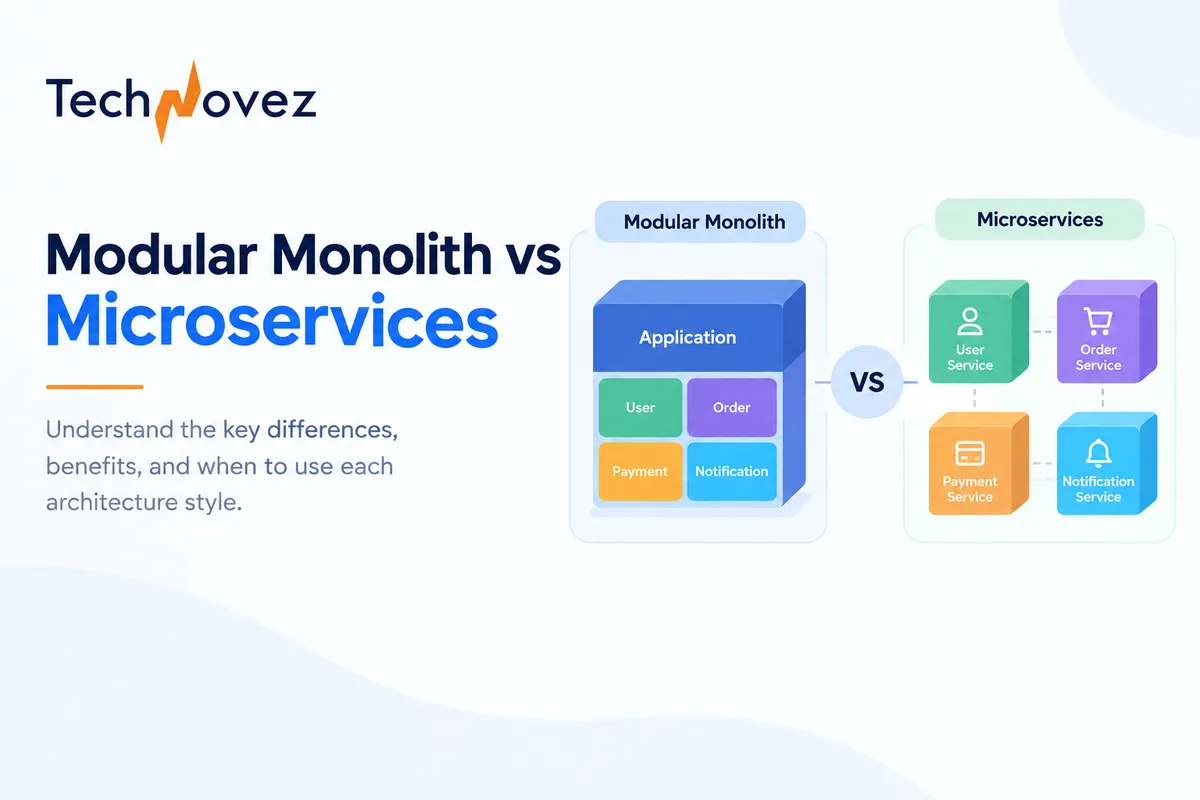
Modular Monolith vs Microservices: The Complete 2026 Guide to Choosing the Right Backend Architecture
If you're planning a new product or re-architecting an existing one, you've almost certainly landed on the same debate every engineering team in the US and EU is having right now: modular monolith vs microservices. It's one of the most consequential decisions in modern software architecture, and getting it wrong can cost months of engineering time and millions in cloud spend.
This guide breaks down monolithic architecture, modular monolith architecture, and microservices architecture in plain language, compares them head-to-head, and gives you a practical framework for choosing the right scalable backend architecture for your team size, traffic, and growth stage in 2026.
What Is Monolithic Architecture?
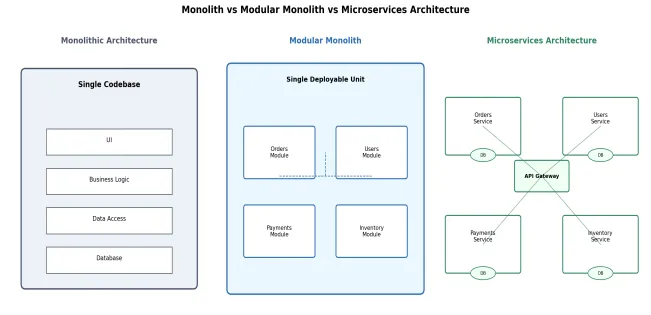
Monolithic architecture is the traditional approach to building software: the entire application UI, business logic, and data access layer lives in a single codebase and deploys as one unit.
Pros:
- Simple to develop, test, and deploy in the early stages
- Easier debugging since everything runs in one process
- Lower operational overhead (one deployment pipeline, one database)
Cons:
- Becomes a "big ball of mud" as the codebase grows
- A single bug can bring down the entire application
- Scaling means scaling everything, even parts that don't need it
- Slower deployments as teams and code grow
This is where the industry split into two very different answers: the modular monolith and microservices architecture.
What Is a Modular Monolith?
A modular monolith keeps the single-deployment simplicity of a monolith but enforces strict internal boundaries between business domains orders, users, payments, inventory each living in its own well-defined module with a clear public interface.
This modular architecture approach is having a major resurgence in 2026 because it gives teams:
- Domain isolation without network overhead modules communicate in-process, not over HTTP
- Independent development teams can own a module without stepping on each other
- A migration path a well-built modular monolith can be split into microservices later, module by module, if and when the business actually needs it
- Lower infrastructure cost one deployable, one database (with clean schema boundaries), far simpler observability
Companies like Shopify have publicly discussed running modular monoliths at massive scale, proving that "monolith" doesn't have to mean "unscalable" it means "well-organized."
What Is Microservices Architecture?
Microservices architecture breaks an application into small, independently deployable services, each owning its own data store and business capability, communicating over the network (typically REST, gRPC, or async messaging).
This is a form of distributed systems architecture, and it solves real problems at real scale:
- Independent scaling scale only the payments service during a flash sale, not the entire app
- Technology flexibility each service can use the language/stack best suited to its job
- Team autonomy large organizations can have dozens of squads shipping independently
- Fault isolation one service failing doesn't necessarily take down the whole system
But this power comes at a cost. In a distributed architecture vs monolith comparison, microservices introduce:
- Network latency and partial-failure handling
- Distributed transactions and eventual consistency
- Significantly higher DevOps, observability, and orchestration overhead
- A real risk of building a "distributed monolith" microservices that are still tightly coupled, giving you all the complexity with none of the benefits
Modular Monolith vs Microservices: Key Differences
| Factor | Modular Monolith | Microservices |
| Deployment | Single deployable unit | Many independently deployable services |
| Communication | In-process function calls | Network calls (HTTP/gRPC/messaging) |
| Data | Usually one database, schema-isolated | One database per service |
| Team size fit | Small to mid-sized teams | Large, multi-team organizations |
| Operational complexity | Low to moderate | High (orchestration, service mesh, observability) |
| Scaling | Scale the whole app | Scale individual services independently |
| Best for | Startups, MVPs, mid-size SaaS products | High-traffic, multi-team enterprise systems |
When people search monolith vs microservices or microservices vs monolith, they're usually really asking one question: "Do I need distributed systems complexity yet, or can I get the same organizational benefits from disciplined modularity?" For the majority of products — especially pre-Series-B startups and mid-market companies the honest answer in 2026 is: start modular, split later.
Choosing the Right Architecture for Scalable Systems
There's no universally "correct" answer in the microservices architecture vs monolith debate — only the right answer for your context. Here's a practical decision framework we use with clients at Technovez when designing enterprise application architecture:
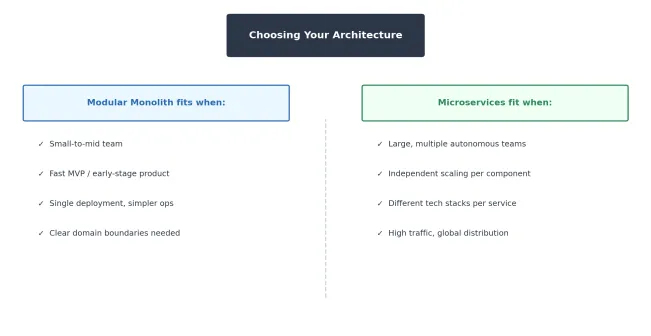
Choose a modular monolith when:
- You're a startup or small-to-mid engineering team (under ~25 engineers)
- You need to ship fast and iterate on product-market fit
- You want a scalable application architecture without premature infrastructure investment
- You expect to modularize now and possibly extract services later
Choose microservices when:
- You have multiple autonomous teams working on different domains
- Different components have wildly different scaling or reliability needs
- You're operating at genuine enterprise scale with dedicated platform/DevOps teams
- Regulatory or data-residency requirements (common across EU deployments) demand strict service-level isolation
Microservices & Modular Monolith Best Practices for 2026
Whichever path you choose, these backend architecture patterns separate systems that scale gracefully from ones that collapse under their own complexity.
Modular monolith best practices 2026:
- Enforce module boundaries with linters or architecture tests (e.g., ArchUnit, dependency-cruiser) — don't rely on developer discipline alone
- Give every module its own schema/namespace inside the shared database
- Design internal APIs between modules as if they were network calls — this makes future extraction painless
- Avoid shared mutable state between modules; communicate through well-defined interfaces or domain events
Microservices architecture best practices 2026:
- Design around business capabilities (Domain-Driven Design bounded contexts), not technical layers
- Invest early in observability distributed tracing, centralized logging, and metrics are non-negotiable
- Use an API gateway and service mesh to manage cross-cutting concerns like auth, rate limiting, and retries
- Adopt asynchronous, event-driven communication where possible to reduce tight coupling
- Automate everything: CI/CD, infrastructure-as-code, and container orchestration (Kubernetes remains the default in 2026)
These principles apply across modern software architecture broadly — the goal is always the same: minimize coupling, maximize cohesion, and make change safe.
How Technovez Helps You Build the Right Architecture
At Technovez, we help startups and enterprises across the US and EU design enterprise application architecture that fits their actual growth stage — not the architecture that looks impressive in a conference talk. Whether that means a disciplined modular monolith that ships fast, or a full microservices platform built for global scale, our engineering team designs, builds, and migrates systems using proven software architecture patterns.
Explore our software architecture and backend engineering services to see how we approach scalable system design, or get in touch with our team for a free architecture consultation tailored to your product and roadmap.
Frequently Asked Questions
What is the main difference between modular monolith and microservices?
A modular monolith is deployed as a single unit with strict internal module boundaries, while microservices are deployed as many independent services communicating over a network. The modular monolith trades some scaling flexibility for dramatically lower operational complexity.
Is a modular monolith a good starting point before microservices?
Yes. Most successful microservices migrations start as a well-structured modular monolith. Clean module boundaries make it far easier to extract individual services later, only when there's a proven business need.
Do microservices always scale better than a monolith?
Not automatically. Microservices allow independent scaling of components, but a poorly designed microservices system can perform worse than a well-optimized monolith due to network overhead and distributed complexity. Scalability comes from good design, not from the architecture label alone.
Which is cheaper to run: modular monolith or microservices?
A modular monolith is generally cheaper to operate for small-to-mid-size teams because it requires far less infrastructure, tooling, and DevOps overhead. Microservices become cost-effective at a scale where independent deployment and scaling deliver measurable ROI.
How do I know when to migrate from a modular monolith to microservices?
Common signals include: specific modules needing independent scaling, teams frequently blocking each other during deployments, or compliance requirements demanding strict service isolation. If none of these apply yet, staying modular is usually the right call.
Ready to Design an Architecture That Scales With You?
Choosing between a modular monolith and microservices architecture shouldn't be a guessing game. Technovez's engineering team has designed and migrated backend systems for startups and enterprises across the US and EU and we can help you make this decision with confidence.