
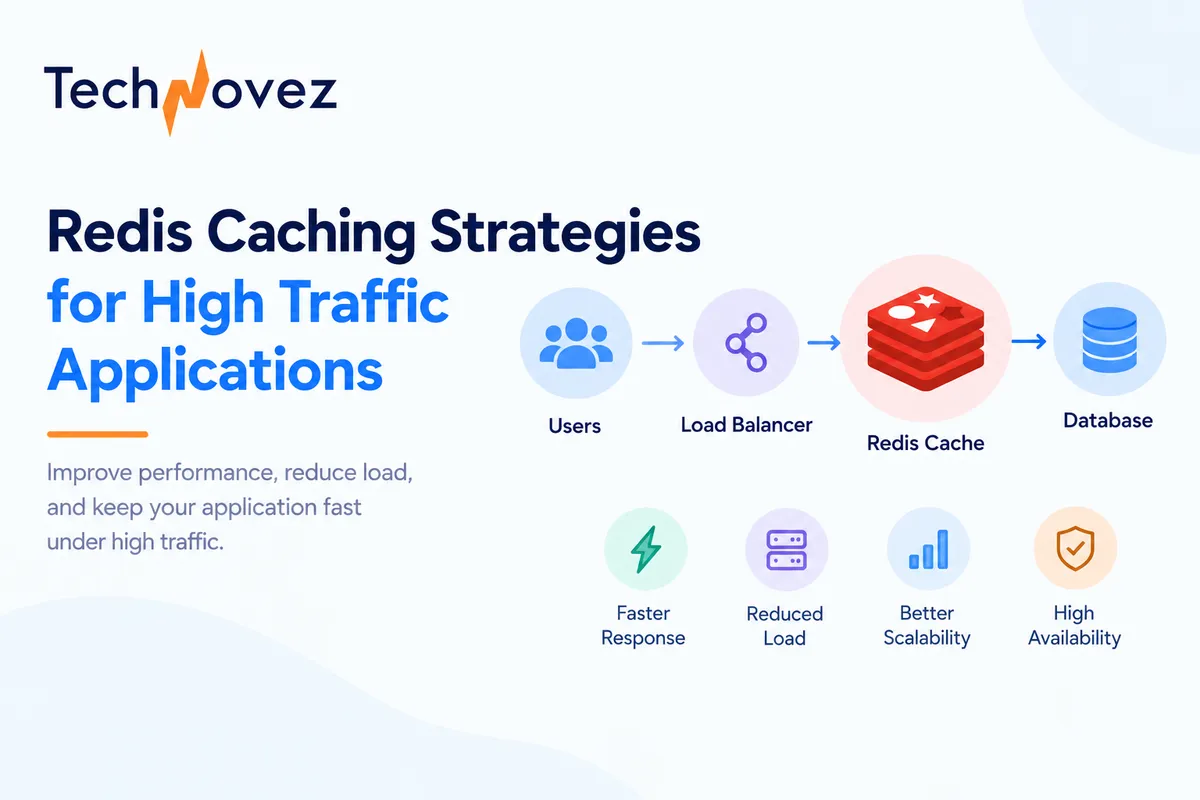
TECHNOVEZ
Redis Caching Strategies for High-Traffic Applications
Architecture, caching patterns, invalidation strategies, and performance tuning for teams running Redis in production at scale.
When traffic spikes, the database is almost always what breaks first. Connection pools exhaust, query latency climbs, and pages that used to load in 80ms start taking seconds. Redis caching is the most common fix — and also the most commonly misapplied one. Bolting an unstructured cache onto a slow query doesn't fix architecture problems; it just hides them until the cache goes cold or the data goes stale.
This guide covers Redis caching strategies for high-traffic applications end to end: what Redis actually does architecturally, the core caching patterns engineering teams rely on, how to handle cache invalidation without breaking consistency, and how to scale Redis as a distributed cache under real production load including guidance specific to microservices and Node.js applications.
What Is Redis Caching?
Redis cache is an in-memory data store used to hold frequently accessed data so an application doesn't have to hit a slower backing store usually a relational database on every request. Because Redis keeps data in memory rather than on disk, reads and writes typically complete in sub millisecond time, which is why Redis caching is the default choice for high traffic application architecture across nearly every stack.
Redis is not just a key-value cache, though. It supports strings, hashes, sets, sorted sets, streams, and pub/sub which is why a Redis caching strategy can go well beyond simple “store and expire” logic into rate limiting, session storage, leaderboards, and real-time messaging.
Why Redis for High-Traffic Applications
At low traffic, database latency is barely noticeable. At high traffic, every millisecond multiplies. Redis for high-traffic applications solves three problems simultaneously:
- Read amplification a single popular resource can be requested thousands of times per second; caching it once avoids thousands of redundant database queries.
- Latency under load in-memory access is orders of magnitude faster than disk-backed queries, especially once a database's working set no longer fits in its own memory.
- Database protection Redis absorbs read pressure so the primary database can be reserved for writes and queries that genuinely need strong consistency.
The tradeoff is complexity: once data lives in two places, keeping them consistent becomes an explicit engineering problem rather than something the database handles for you.
Redis Architecture for Scalable Applications
A typical Redis architecture for scalable applications sits between the application layer and the primary datastore. The application checks Redis first; on a miss, it falls back to the database and populates the cache for next time.
Production Redis architecture usually adds:
- Replication one or more replica nodes for read scaling and failover.
- Redis Sentinel automated failover and monitoring for a primary/replica setup.
- Redis Cluster sharding across multiple nodes so both memory and throughput scale horizontally.
- Eviction policies rules like allkeys-lru or volatile-ttl that decide what gets removed when memory fills up.
This layered setup is what separates a Redis cache design for high traffic from a single-instance cache that works fine in staging and falls over in production.
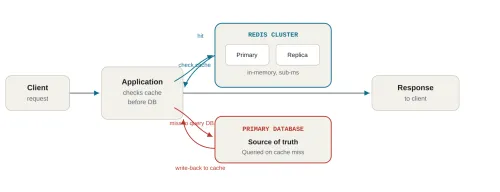
Fig. 1 — Cache-aside pattern: the application checks Redis first, falling back to the primary database on a miss and writing the result back to cache.
Core Redis Caching Strategies and Patterns
There isn't one “correct” Redis caching strategy the right Redis cache strategies depend on your read/write ratio and your tolerance for stale data.
| Pattern | How it works | Best for |
| Cache-aside | App checks cache first; on miss, reads DB and populates cache | Read-heavy, general-purpose caching |
| Read-through | Caching layer owns the miss-fetch logic, not the app code | Centralized caching libraries / proxies |
| Write-through | Writes go to cache and DB synchronously | Data that must stay always-consistent |
| Write-behind | Writes hit cache first, flushed to DB asynchronously | High write throughput, tolerant of eventual persistence |
Cache-aside (lazy loading) is the most common Redis caching pattern because it only caches data that's actually requested, and a Redis outage degrades gracefully back to the database. Write-through keeps the cache always warm and consistent, at the cost of added write latency. Write-behind is fast but risks data l
Redis Cache Invalidation Strategies
Cache invalidation is famously one of the two hard problems in computer science, and Redis doesn't remove that difficulty it just gives you fast tools to manage it. A solid Redis cache invalidation strategy typically combines several techniques:
- TTL-based expiration set a time-to-live on every cached key so stale data self-expires.
- Explicit invalidation on write delete or update the corresponding cache key immediately when data changes.
- Versioned or namespaced keys bump a version number in the key itself (e.g. user:42:v3) so old entries age out unused.
- Event-driven invalidation a change in one service publishes an event that tells other services to invalidate their cache entries.
Knowing how to handle cache invalidation with Redis is often what separates a caching layer that quietly serves stale prices or permissions from one that stays trustworthy under load.
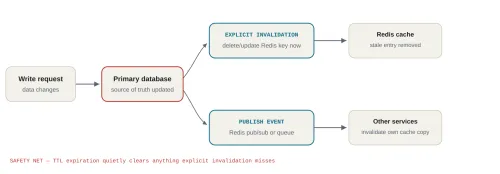
Fig. 2 — Cache invalidation workflow: explicit key deletion runs alongside an event published for dependent services, with TTL as a background safety net.
Redis Performance Optimization and Tuning
Redis performance optimization is rarely about Redis being “slow” it's almost always about how it's being used. A Redis performance tuning checklist:
- Right-size your data structures use hashes instead of many individual string keys for related fields.
- Avoid large keys and KEYS * use SCAN instead, and cap value sizes.
- Pipeline and batch commands to reduce round-trip overhead.
- Set sensible TTLs everywhere unbounded keys are the most common cause of memory bloat.
- Monitor hit rate, not just uptime.
- Choose the right eviction policy for your workload allkeys-lru for general caching, volatile-ttl for mixed use.
How to Scale Redis for High Traffic
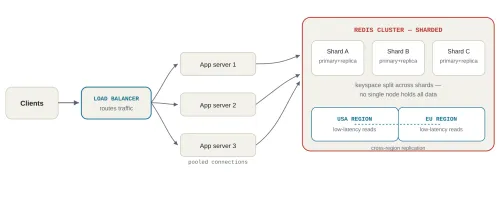
Fig. 3 — Scaling Redis for high traffic: load-balanced app servers, sharded Redis Cluster with per-shard replicas, and multi-region deployment across USA and EU.
- Read replicas to distribute read load across multiple nodes.
- Redis Cluster sharding to split the keyspace across nodes.
- Connection pooling at the application layer.
- Regional or multi-AZ deployment to reduce latency for geographically distributed users — especially relevant for teams serving both USA and EU traffic.
This is where Redis distributed cache architecture stops being a single-node convenience and becomes genuine infrastructure that needs the same operational rigor as the primary database.
Redis Caching for Microservices and Node.js Applications
Redis caching for microservices introduces a wrinkle that monolithic applications don't have: multiple services may read and write overlapping data, so cache ownership needs to be explicit. Best practice is to have the service that owns a piece of data also own invalidation of its cache entries.
Redis caching for Node.js applications is especially common given Node's single-threaded, I/O-bound nature — usually implemented with a client like ioredis or node-redis, wrapped in a thin caching layer around existing data-access functions.
Redis Caching Best Practices (2026)
- Cache computed results, not just raw rows.
- Set TTLs based on data volatility, not a single global default.
- Design for cache failure degrade to the database gracefully if Redis is unavailable.
- Separate caching Redis from queue/pub-sub Redis in high-throughput systems.
- Use structured keys (resource:id:field) for readability and easier bulk invalidation.
- Load test cache-cold scenarios, not just steady state.
Frequently Asked Questions
What is the best Redis caching strategy for high-traffic applications?
Cache-aside is the most widely used starting point because it only caches data that's actually requested and degrades gracefully if Redis becomes unavailable. Write-through or write-behind patterns are added selectively where write consistency or write latency matter more.
How do you handle cache invalidation with Redis?
Most production systems combine TTL-based expiration as a safety net with explicit invalidation on write, and use versioned keys or event-driven invalidation in distributed and microservice architectures.
Can Redis replace a database?
No. Redis is an in-memory cache and data structure store, not a durable system of record by default. It's designed to sit in front of a database, not replace one, even though it supports optional persistence.
How do you scale Redis for high traffic?
Combine read replicas for read scaling, Redis Cluster for sharding across nodes, connection pooling at the application layer, and regional deployment to reduce latency for geographically distributed users.
Build High-Performance Redis Caching Architecture with Technovez
Technovez designs and implements Redis caching architecture, distributed systems, and high-traffic application infrastructure for teams across the USA and EU.
Explore our backend and infrastructure services: technovez.com/services
Contact our team: technovez.com/contact