
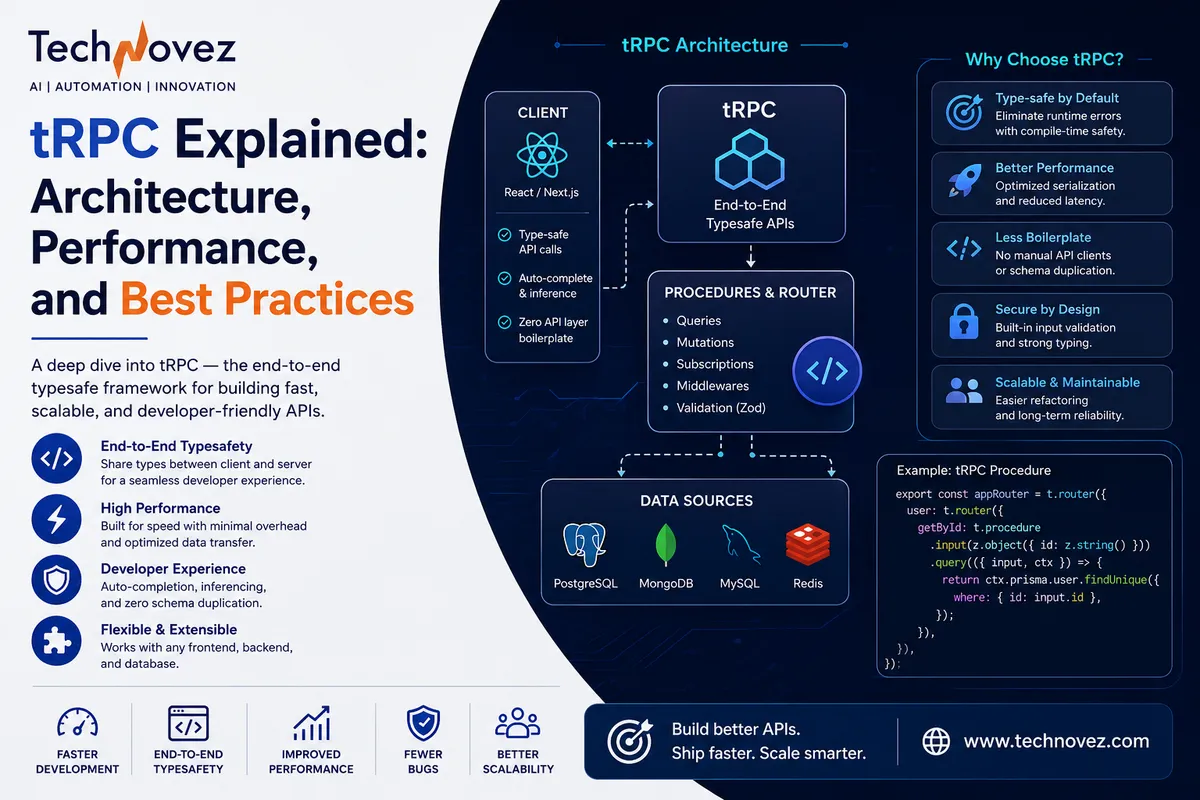
tRPC Explained
Architecture, Performance, and Best Practices
A comprehensive, enterprise-grade technical guide for engineering teams evaluating or building with tRPC — covering architecture, end-to-end type safety, performance, security, and production best practices.
Published by Technovez — Full-Stack Development, TypeScript, Node.js, React, Next.js & AI Application Engineering
1. Executive Summary
tRPC (TypeScript Remote Procedure Call) is an open-source library that lets developers build fully type-safe APIs between a TypeScript client and a TypeScript server without writing a schema, generating code, or maintaining separate DTOs. Function signatures on the server become callable, autocompleted functions on the client, with types inferred automatically at compile time.
For teams that already own both ends of the stack — a Next.js or React front end and a Node.js backend, all written in TypeScript — tRPC removes an entire category of integration bugs. There is no OpenAPI spec to keep in sync, no GraphQL schema to maintain, and no manual type definitions that drift from the actual API. The contract between client and server is the TypeScript compiler itself.
tRPC is not a universal replacement for REST or GraphQL. It is purpose-built for TypeScript monorepos and full-stack applications where the same team, or the same organization, controls both the client and the server. When those conditions hold, tRPC typically reduces boilerplate, catches integration errors before runtime, and speeds up iteration. When they don't — public APIs, multi-language clients, or third-party integrations — REST or GraphQL remain the more appropriate choice.
Key Takeaways
- tRPC provides end-to-end type safety without code generation, using TypeScript's type inference across the network boundary.
- It is built on top of standard HTTP (or WebSockets for subscriptions) and works naturally with TanStack Query for caching, retries, and request deduplication.
- It is best suited to full-stack TypeScript applications — particularly Next.js — where the same team owns client and server.
- It is not designed for public, multi-language, or third-party-consumed APIs; REST or GraphQL remain better fits there.
- Production tRPC applications still need the same discipline as any API: validation with Zod, authentication, authorization, rate limiting, and observability.
2. What Is tRPC?
tRPC stands for TypeScript Remote Procedure Call. It is a library for building APIs where server-side functions ("procedures") can be called directly from the client with full type safety, without a REST controller layer, GraphQL resolver layer, or generated client SDK.
2.1 RPC, briefly
Remote Procedure Call (RPC) is an older pattern than REST or GraphQL: instead of modeling an API around resources (REST) or a query language (GraphQL), RPC exposes functions that a client can invoke as if they were local. tRPC applies this idea to TypeScript specifically, using the language's own type system as the contract instead of a separate interface-definition language like Protocol Buffers or GraphQL SDL.
2.2 Why tRPC was created
Full-stack TypeScript teams building REST or GraphQL APIs traditionally had to solve the same problem twice: define types on the server, then re-define or generate matching types on the client. Tools like OpenAPI codegen or GraphQL Code Generator narrowed this gap, but still required a build step, a schema file, and a generation pipeline that could fall out of sync. tRPC's premise is that if both ends of the application are already TypeScript, the compiler can infer the contract directly from the source — no schema, no generation step, no drift.
2.3 Problems tRPC solves
- Type drift between frontend and backend, where API contracts silently diverge from what the client expects.
- Boilerplate from maintaining separate request/response types, DTOs, or generated SDKs.
- Runtime errors from malformed requests that could have been caught at compile time.
- Slow iteration speed caused by manually updating client code after every backend change.
2.4 What tRPC is not
tRPC is not a network protocol, not a replacement for HTTP, and not a schema language. It is a thin, typed layer over standard HTTP (and optionally WebSockets) that pairs naturally with TanStack Query on the client and any Node.js-compatible server runtime — Node.js, Bun, Deno, or edge runtimes — on the backend.
3. How tRPC Works
A tRPC request flows from a typed client call, through an HTTP or WebSocket transport, into a router that dispatches to a specific procedure. The procedure runs any attached middleware, validates its input (typically with Zod), executes business logic against a context object, and returns a response whose type the client already knows at compile time.
3.1 Core building blocks
- Router: groups related procedures (e.g., a userRouter, postRouter) and merges into a single appRouter that defines the entire API surface.
- Procedure: a single callable unit — a query (read), mutation (write), or subscription (real-time stream).
- Context: a per-request object (typically containing the request, response, session, and database client) available to every procedure and middleware.
- Middleware: composable functions that run before a procedure, commonly used for authentication, logging, and authorization.
- Input/output validation: procedures declare a Zod schema for input; tRPC parses and validates it before your handler runs, and can validate output the same way.
4. tRPC Architecture
A typical tRPC deployment stacks a React or Next.js client using TanStack Query on top of a tRPC client link, communicating over HTTP or WebSockets to a tRPC server whose routers call into a service layer backed by Prisma or Drizzle and, ultimately, a relational database such as PostgreSQL.
This layering matters for maintainability: routers stay thin and dispatch only to the service layer, the service layer holds business logic and is framework-agnostic, and the ORM layer isolates database access so it can be swapped or mocked in tests.
5. End-to-End Type Safety
End-to-end type safety in tRPC means the TypeScript types your server procedures declare are inferred directly by the client, with no code generation step, so the compiler flags a mismatched field, missing argument, or renamed endpoint before the code ever runs.
5.1 How type inference crosses the network boundary
The server exports a single type — typically named AppRouter — representing the shape of every router and procedure. The client imports only that type (never any server runtime code) and uses it to type a proxy object. Calling client.user.getById.query({ id }) is fully typed: the input shape, the return shape, and even nested optional fields are all inferred.
5.2 Practical benefits
- Autocomplete for every available procedure, input field, and return value in the editor.
- Compile-time errors when a server field is renamed or removed, instead of a runtime 404 or undefined value.
- No generated SDK to regenerate and commit after every backend change.
- Refactors (renaming a field, changing a type) surface every affected call site immediately.
6. Performance Analysis
tRPC itself adds minimal runtime overhead beyond a typical HTTP JSON API: the type safety is enforced at compile time, not at request time, so the wire format is ordinary JSON (or a superset via transformers) sent over standard HTTP or WebSockets. Real-world performance depends mainly on network conditions, database queries, and caching strategy — not on tRPC as a layer.
6.1 Where the overhead actually is
- Serialization: tRPC serializes to JSON by default. Optional transformers (e.g., superjson) allow Dates, Maps, and Sets to round-trip correctly, at a small added parsing cost.
- Input validation: Zod parsing runs on every request; this is generally inexpensive but scales with schema complexity.
- Network round trips: each query or mutation is still an HTTP request unless batched.
6.2 Batching
tRPC's HTTP batch link can combine multiple client-initiated calls that fire in the same tick into a single HTTP request, reducing round trips when a page fires several independent queries at once.
6.3 Caching
Because the React and Next.js clients are built on TanStack Query, tRPC inherits its caching model: stale-while-revalidate semantics, query deduplication, automatic refetching, and manual cache invalidation after mutations. This is the same caching layer teams already use for any TanStack Query-based data fetching, not something specific to tRPC.
6.4 Streaming and subscriptions
For real-time use cases, tRPC supports subscriptions over WebSockets (via a WebSocket link and a compatible server adapter) and, in modern versions, HTTP-based streaming responses for long-running operations. Choose subscriptions when you need server-initiated push updates; use polling or on-demand refetch for simpler cases.
6.5 Cold starts and edge/serverless deployment
tRPC handlers are plain functions and can run on serverless platforms or edge runtimes with the appropriate adapter. Cold-start behavior is governed by the runtime (Node.js vs. edge) and by what the procedure does — database connection setup is typically the larger contributor to cold-start latency than the tRPC layer itself.
This guide intentionally avoids citing specific benchmark numbers. Actual latency and throughput depend heavily on deployment target, database, and payload shape; teams should benchmark their own workloads rather than rely on generic figures.
7. tRPC vs REST vs GraphQL vs gRPC
tRPC, REST, GraphQL, and gRPC solve overlapping but distinct problems. tRPC optimizes for developer experience inside a single-language (TypeScript) full-stack team; REST optimizes for universal HTTP compatibility and cacheability; GraphQL optimizes for flexible, client-driven queries across many consumers; gRPC optimizes for high-performance, strongly-typed service-to-service communication across languages.
| Dimension | tRPC | REST | GraphQL | gRPC |
| Type Safety | Compile-time, inferred, no codegen | Manual or via OpenAPI codegen | Schema-driven, codegen typical | Schema-driven (Protobuf), codegen required |
| Learning Curve | Low for TypeScript teams | Low, widely known | Moderate to high | Moderate to high |
| Language Support | TypeScript-to-TypeScript only | Any language | Any language | Any language (Protobuf-based) |
| Caching | Via TanStack Query (client-managed) | Native HTTP caching | Requires client-side normalized cache | Application-managed |
| Streaming | WebSockets / HTTP streaming | Limited (SSE, long polling) | Subscriptions (via extensions) | Native bidirectional streaming |
| Tooling Maturity | Growing, TS-ecosystem-specific | Extremely mature | Mature | Mature, enterprise-heavy |
| Public API Fit | Poor (TS clients only) | Excellent | Good | Good for internal services |
| Microservices Fit | Limited (same-language only) | Common | Common | Very common |
| Browser Support | Native (JSON over HTTP) | Native | Native | Requires grpc-web proxy |
| Enterprise Suitability | Strong for internal TS monorepos | Universal default | Strong for aggregation layers | Strong for polyglot microservices |
Quick Comparisons
tRPC vs REST
REST models an API as resources and verbs, is cacheable by default at the HTTP layer, and is understood by every client language — making it the right default for public or multi-consumer APIs. tRPC trades that universality for compile-time type safety and less boilerplate, but only within a TypeScript-to-TypeScript relationship.
tRPC vs GraphQL
GraphQL gives clients the flexibility to request exactly the fields they need across a flexible graph of types, which is valuable when many different clients (web, mobile, partners) consume the same API differently. tRPC assumes one client codebase and one server codebase evolving together, so it doesn't need a query language — the client already knows the exact shape of every call because the compiler tells it.
tRPC vs gRPC
gRPC is designed for high-throughput, cross-language service-to-service communication, using Protocol Buffers and HTTP/2. It's a common choice for polyglot microservice backends. tRPC targets a narrower niche: full-stack TypeScript applications where both ends are already the same language, so a binary wire protocol and separate IDL aren't necessary.
8. Building a Production tRPC Application
A production-ready tRPC application separates concerns into routers (thin dispatch), a service layer (business logic), and a data layer (Prisma or Drizzle), with Zod validation, centralized error handling, structured logging, rate limiting, and pagination applied consistently across procedures.
8.1 Validation with Zod
Every procedure input should be validated with a Zod schema. This is not optional in production: it is the primary defense against malformed or malicious payloads, and it doubles as the source of the inferred TypeScript types on the client.
8.2 Authentication and authorization
Authentication typically happens once, in the context creation function, by reading a session or JWT. Authorization is then layered as middleware — a protectedProcedure that requires a session, and role- or permission-specific procedures built on top of it for RBAC.
8.3 React Server Components
In the Next.js App Router, Server Components can call tRPC procedures directly on the server (without going over HTTP) using a server-side caller, while Client Components use the standard tRPC React hooks. This lets teams fetch data on the server for initial render and hydrate the same typed cache on the client.
8.4 Rate limiting, caching, and pagination
- Apply rate limiting as middleware, keyed by user or IP, using a store like Redis for distributed deployments.
- Use cursor-based pagination for large lists; offset pagination degrades at scale.
- Wrap multi-step writes in database transactions at the service layer, not in the router.
9. Security Best Practices
tRPC does not replace standard API security practices — it still requires authentication, authorization, input validation, rate limiting, and secrets management, applied through middleware and context rather than through framework-specific hooks.
| Area | Practice |
| Authentication | Verify JWT or session in createContext; reject invalid tokens before reaching procedures. |
| Authorization (RBAC) | Compose role-checking middleware on top of protectedProcedure per resource. |
| Input Validation | Zod schema on every input; never trust client-supplied IDs or roles. |
| Output Sanitization | Explicitly select returned fields; never return full database rows with sensitive columns. |
| Rate Limiting | Apply per-user/IP limits via middleware backed by Redis or a similar store. |
| CORS | Restrict allowed origins explicitly in the HTTP adapter configuration. |
| CSRF | Use SameSite cookies and verify origin for cookie-based sessions. |
| Secrets Management | Load secrets from environment variables or a secrets manager, never hard-code them. |
| Logging & Monitoring | Log procedure name, duration, and outcome; avoid logging raw payloads with PII. |
Security Checklist
- ☐ All mutations require authentication unless explicitly public
- ☐ Every procedure input has a Zod schema
- ☐ Sensitive fields excluded from query results by default
- ☐ Rate limiting applied to public-facing procedures
- ☐ CORS origins explicitly whitelisted
- ☐ Secrets loaded from environment/secret manager, not source
- ☐ Structured logs exclude passwords, tokens, and PII
- ☐ Dependencies (tRPC, Zod, ORM) kept on current patch versions
10. Enterprise Architecture
tRPC fits cleanly into monoliths and modular monoliths where a single Node.js service owns the whole API surface. It can be adopted per-service in a microservices environment, but cross-service calls lose type safety unless services share a TypeScript package — making it best suited to internal APIs rather than service-to-service contracts across language boundaries.
10.1 Deployment models
- Monolith: a single Next.js or Node.js app serving both UI and API — the most common and simplest tRPC deployment.
- Modular monolith: one deployable service, internally organized into bounded router/service modules — a common middle ground for growing teams.
- Microservices: each service can run its own tRPC server; type safety between services requires publishing the AppRouter type as an internal package.
- Serverless: tRPC procedures map naturally onto serverless functions via the fetch or Lambda adapters.
- Edge computing: tRPC can run on edge runtimes (e.g., Vercel Edge, Cloudflare Workers) using the fetch adapter, subject to the same constraints as any edge function (no persistent TCP connections, limited APIs).
10.2 Cloud, containers, and CI/CD
A tRPC server is an ordinary Node.js (or Bun) HTTP service and containerizes with Docker like any other Node.js application. It can be orchestrated with Kubernetes, deployed behind a standard load balancer, and integrated into existing CI/CD pipelines with standard TypeScript build, lint, and test steps — no tRPC-specific deployment tooling is required.
11. Common Mistakes
The most common tRPC mistakes are architectural, not tRPC-specific: putting business logic directly in routers, skipping input validation, building a single oversized router, and neglecting authorization checks on mutations.
| Mistake | Consequence | Fix |
| Business logic inside routers | Untestable, tightly coupled code | Move logic to a service layer; routers only validate and delegate |
| One giant router file | Merge conflicts, poor discoverability | Split by domain and merge via router({...}) composition |
| Skipping Zod validation "for internal use" | Runtime errors, injection risk | Validate every input, even for internal-only procedures |
| Over-sharing server types with client | Client bundle bloat, leaked internals | Export only the AppRouter type, never server runtime code |
| No output validation on sensitive endpoints | Accidental data leakage (e.g., password hashes) | Explicitly shape returned objects or use output schemas |
| Ignoring caching/query invalidation | Stale UI after mutations | Invalidate relevant TanStack Query keys after mutations |
| Weak authorization checks | Privilege escalation | Enforce RBAC/ownership checks in middleware, not ad hoc in handlers |
| No monitoring or tracing | Blind spots in production incidents | Instrument with OpenTelemetry and structured logging |
12. Best Practices
Production-grade tRPC codebases keep routers thin, push logic into a service layer, share validation schemas between input and output, and treat testing and observability as first-class concerns rather than afterthoughts.
Best Practices Cheat Sheet
- Keep routers thin — validation and delegation only, no business logic.
- Centralize business logic in a service layer that is framework-agnostic and unit-testable.
- Use a repository pattern around Prisma/Drizzle to isolate data access from services.
- Define Zod schemas once and reuse them for input validation, output shaping, and form validation on the client.
- Wrap known failure modes in typed TRPCError codes (NOT_FOUND, UNAUTHORIZED, BAD_REQUEST) rather than generic throws.
- Write integration tests against the router using a test context, not just unit tests on services.
- Instrument procedures with OpenTelemetry spans for request tracing across the stack.
- Document routers with comments that describe intent — tRPC's type safety covers shape, not meaning.
13. Future of tRPC
tRPC's near-term trajectory is closely tied to the Next.js App Router, React Server Components, and Server Actions — all of which reduce the need for a client-side data-fetching layer for some use cases while leaving tRPC well positioned for client-driven queries, mutations, and real-time subscriptions.
React Server Components and Next.js Server Actions overlap with part of what tRPC does — calling server-side logic from the client without hand-written REST endpoints. For many teams, the two are complementary: Server Actions handle simple form mutations, while tRPC continues to serve as the typed API layer for complex client-side data fetching, caching, and real-time updates via TanStack Query.
As AI-powered applications grow, the same end-to-end type safety that tRPC provides for conventional CRUD APIs is increasingly being applied to typed AI service layers — wrapping LLM calls, agentic workflows, and tool invocations behind strongly-typed procedures so that front-end code gets the same compile-time guarantees for AI features that it already gets for the rest of the application.
14. How Technovez Helps
Technovez is a software engineering and AI consulting company specializing in full-stack TypeScript development, with deep hands-on experience across React, Next.js, Node.js, tRPC, Prisma, Drizzle ORM, and enterprise API architecture. Our engineering team helps organizations design, build, and scale type-safe applications — from early-stage MVPs to enterprise systems supporting large user bases.
Where Technovez adds value:
- Full-stack TypeScript development — React, Next.js, Node.js, and tRPC architecture designed for long-term maintainability.
- Enterprise API design — REST, GraphQL, tRPC, and gRPC, chosen based on your actual consumers and constraints, not defaults.
- AI-powered application development — integrating LLMs and agentic workflows behind type-safe service layers.
- Cloud and DevOps — Docker, Kubernetes, CI/CD pipelines, and observability with OpenTelemetry.
- Digital transformation — modernizing legacy APIs into type-safe, well-tested, well-documented systems.
If your team is evaluating tRPC for a new product, migrating an existing REST or GraphQL API, or building an AI-powered application on a TypeScript stack, Technovez can help you design the architecture, implement it, and get it into production with confidence.
Get in touch:
Explore our services, read more on the Technovez blog, or contact our team to discuss your project.
Checklists
Production Readiness Checklist
- ☐ Routers are thin; logic lives in a service layer
- ☐ Every procedure has Zod input validation
- ☐ Authentication enforced in context; authorization enforced in middleware
- ☐ Errors mapped to appropriate TRPCError codes
- ☐ Structured logging and tracing in place (OpenTelemetry)
- ☐ Rate limiting on public-facing procedures
- ☐ Pagination implemented for list endpoints
- ☐ CI runs type checks, lint, and tests on every PR
Performance Optimization Checklist
- ☐ Batch link enabled for simultaneous client queries
- ☐ TanStack Query cache times tuned per data volatility
- ☐ Database queries indexed and reviewed for N+1 patterns
- ☐ Subscriptions used only where real-time push is genuinely needed
- ☐ Payloads shaped to return only required fields
Architecture Checklist
- ☐ Domain-based router organization, merged into a single appRouter
- ☐ Shared Zod schemas between client forms and server validation
- ☐ Repository pattern isolating ORM calls
- ☐ Client imports only the AppRouter type, never server code
- ☐ Clear boundary decision documented: tRPC (internal) vs REST/GraphQL (public)
When Should You Choose tRPC?
Choose tRPC when your client and server are both TypeScript, owned by the same team, and you want compile-time type safety without a schema or codegen step. Choose REST or GraphQL when you need to serve multiple languages, external partners, or the public.
| Scenario | Recommendation |
| Startup, single TypeScript monorepo | Strong fit — fastest iteration, least boilerplate |
| Enterprise internal APIs (TS-only teams) | Strong fit — type safety scales well with team size |
| Microservices (polyglot) | Weak fit — use gRPC or REST for cross-language contracts |
| Internal APIs consumed only by your own frontend | Strong fit |
| Public APIs for third-party developers | Poor fit — use REST or GraphQL with published docs/OpenAPI |
| Serverless / edge deployments | Good fit — adapters exist for fetch-based and edge runtimes |
| AI-powered applications (typed tool/service layer) | Good fit — wraps AI calls with compile-time-checked contracts |
Frequently Asked Questions
What is tRPC?
tRPC is a TypeScript library for building end-to-end type-safe APIs between a TypeScript client and server, without a schema or code generation step.
How is tRPC different from REST?
REST models APIs as resources over HTTP and works with any client language; tRPC infers types directly from TypeScript source and only works between TypeScript client and server.
How is tRPC different from GraphQL?
GraphQL uses a query language and schema so clients can request exactly the fields they need; tRPC uses direct function calls typed by the compiler, with no query language.
Is tRPC production-ready?
Yes. tRPC is used in production by many TypeScript teams, particularly in Next.js applications, and is actively maintained with a stable core API.
Can tRPC replace REST?
Only within a single TypeScript codebase relationship. For public or multi-language APIs, REST remains the more appropriate choice.
Can tRPC work with React Native?
Yes, the tRPC client works in React Native the same way it does in web React, since it's just typed HTTP calls.
Does tRPC support WebSockets?
Yes, tRPC supports subscriptions over WebSockets for real-time, server-initiated updates.
Can tRPC scale for enterprise applications?
Yes, when paired with a proper service layer, caching strategy, and standard horizontal scaling of the underlying Node.js server.
Does tRPC require a database?
No. tRPC is transport- and data-layer-agnostic; it's commonly paired with Prisma or Drizzle ORM but doesn't require any specific database.
Does tRPC work with Next.js App Router?
Yes, via the fetch adapter, and it integrates with Server Components for server-side data fetching.
Is tRPC the same as gRPC?
No. They share the RPC concept but differ entirely in implementation — gRPC uses Protocol Buffers and HTTP/2 for cross-language services; tRPC uses TypeScript inference for same-language stacks.
Does tRPC need a schema file?
No. The TypeScript source code itself is the schema; there's no separate IDL or schema file to maintain.
How do I validate input in tRPC?
By attaching a Zod schema to each procedure using .input(), which tRPC parses and validates before your handler runs.
Can tRPC be used with Express?
Yes, via the Express adapter, in addition to adapters for Next.js, Fastify, and standalone HTTP servers.
Does tRPC support authentication?
tRPC doesn't dictate an auth method; teams typically verify sessions or JWTs in the context function and enforce access via middleware.
Is tRPC good for public APIs?
Generally no — public APIs benefit more from REST or GraphQL, which are consumable from any language and have mature documentation tooling.
How does caching work in tRPC?
The React and Next.js clients use TanStack Query, so caching, deduplication, and invalidation follow TanStack Query's model.
Can I use tRPC with Bun or Deno?
Yes, tRPC runs on any JavaScript runtime that supports its adapters, including Bun and Deno.
Does tRPC support file uploads?
tRPC procedures can handle file uploads, though many teams route large binary uploads through a dedicated endpoint or storage service instead.
What is the biggest limitation of tRPC?
Its type safety only holds between TypeScript client and server — it provides no benefit for non-TypeScript consumers or cross-language services.
SEO & GEO Metadata
| Field | Value |
| SEO Title | tRPC Explained: Architecture & Best Practices |
| Meta Title | tRPC Explained: Architecture, Performance & Best Practices |
| Meta Description | A complete guide to tRPC: how it works, its architecture, performance characteristics, security practices, and when to choose it over REST or GraphQL. |
| URL Slug | /blog/trpc-explained-architecture-performance-best-practices |
| Open Graph Title | tRPC Explained: Architecture, Performance, and Best Practices |
| Open Graph Description | Everything engineering teams need to know about tRPC — architecture, type safety, performance, security, and enterprise adoption. |
| Twitter/X Description | tRPC, explained end to end: architecture, type safety, performance, security, and when (not) to use it. A practical guide for TypeScript teams. |
| Suggested Canonical URL | https://www.technovez.com/blog/trpc-explained-architecture-performance-best-practices |
| Featured Snippet Answer | tRPC (TypeScript Remote Procedure Call) is a library for building fully type-safe APIs between a TypeScript client and server without a schema or code generation step. Server function types are inferred directly by the client at compile time, eliminating a common source of frontend-backend integration bugs. |
Schema Markup Recommendations
- Article schema — headline, author (Technovez), datePublished, dateModified, image
- FAQPage schema — using the 20 FAQ question/answer pairs above
- HowTo schema — for the "Building a Production tRPC Application" section
- Organization schema — for Technovez, linked from the article's publisher field
- BreadcrumbList schema — Home > Blog > tRPC Explained
NLP / Semantic Keyword List
tRPC, TypeScript APIs, end-to-end type safety, tRPC architecture, tRPC performance, Node.js APIs, Next.js APIs, React APIs, RPC framework, TypeScript backend, type-safe APIs, REST vs tRPC, GraphQL vs tRPC, gRPC vs tRPC, API architecture, full stack TypeScript, Prisma, Drizzle ORM, Zod, TanStack Query, Server Actions, React Server Components, OpenTelemetry, JWT, OAuth, WebSockets, PostgreSQL, microservices, edge computing.
Related Search Queries
- is tRPC better than REST
- tRPC vs GraphQL performance
- tRPC Next.js App Router tutorial
- how does tRPC achieve type safety
- tRPC production best practices
- tRPC authentication example
- tRPC with Prisma vs Drizzle
Internal Linking Suggestions
- "our full-stack development services" → https://www.technovez.com/services
- "read more engineering guides on our blog" → https://www.technovez.com/blog
- "talk to our engineering team" → https://www.technovez.com/contact
- "learn more about Technovez" → https://www.technovez.com/
- Related articles (link when published): gRPC Explained, Model Context Protocol (MCP) Explained, Agentic AI Architecture, Multi-Agent Orchestration Patterns, Node.js Performance Tuning, Next.js Best Practices
Authoritative References
- Official tRPC Documentation — trpc.io
- TypeScript Documentation — typescriptlang.org
- Node.js Documentation — nodejs.org
- Next.js Documentation — nextjs.org
- React Documentation — react.dev
- TanStack Query Documentation — tanstack.com/query
- Prisma Documentation — prisma.io/docs
- Drizzle ORM Documentation — orm.drizzle.team
- Zod Documentation — zod.dev
- OpenTelemetry Documentation — opentelemetry.io
Image SEO
| Field | Value |
| Hero Image Concept | A clean architecture-style illustration showing a typed data flow from a React/Next.js client through a tRPC layer to a PostgreSQL database, in a modern flat editorial style. |
| AI Image Generation Prompt | Modern flat vector illustration of a software architecture diagram, showing a browser/client box connected via labeled arrows through a TypeScript API layer to a database cylinder, blue and white color palette, clean minimal tech editorial style, no text clutter |
| Alt Text | Diagram illustrating tRPC architecture connecting a React/Next.js client to a Node.js server and PostgreSQL database |
| SEO Filename | trpc-architecture-diagram-technovez.png |
| Caption | A simplified view of a typical tRPC architecture: client, TanStack Query, tRPC server, and database. |
AI-Generated Infographic Ideas
- "tRPC Request Lifecycle" — step-by-step flow from client call to database response
- "tRPC vs REST vs GraphQL vs gRPC" — side-by-side comparison infographic from the table above
- "Production tRPC Checklist" — visual checklist card for social sharing
- "When to Choose tRPC" — decision-tree infographic
Content Gap Analysis
Compared with widely cited tRPC resources (the official documentation, popular Next.js/tRPC starter-kit guides, and general "tRPC vs GraphQL" comparison posts), this guide adds:
- A single article covering architecture, performance, security, enterprise deployment, and FAQs together, rather than splitting these across separate posts.
- An explicit, non-fabricated treatment of performance — most public comparisons cite unsourced benchmark numbers; this guide instead explains where overhead actually comes from.
- A four-way comparison (tRPC, REST, GraphQL, and gRPC) rather than the more common two-way tRPC-vs-GraphQL framing.
- A concrete production checklist set (readiness, security, performance, architecture) that most introductory tRPC content omits.
- Explicit guidance on React Server Components and Server Actions overlap, which is missing from most pre-2025 tRPC content.
A remaining gap versus the most advanced community resources is a fully worked, runnable example repository; this article provides production-quality snippets but not an end-to-end scaffolded project, which could be a natural follow-up piece or downloadable companion repo.
Social Media Assets
LinkedIn Article Summary
A practical, no-hype breakdown of tRPC — what it is, how its type safety actually works, how it compares to REST, GraphQL, and gRPC, and when it's the right (or wrong) choice for your stack. Includes production code examples, a security checklist, and an enterprise architecture guide.
LinkedIn Post
Most "tRPC vs GraphQL" posts skip the part that matters: when each one is actually the right call. We wrote a full technical breakdown of tRPC — architecture, type inference internals, performance (without made-up benchmark numbers), security practices, and a real production checklist. If your team is on a TypeScript + Next.js stack and evaluating tRPC, this should save you a few weeks of trial and error. Read it on the Technovez blog.
Facebook Post
Building a TypeScript full-stack app and wondering if tRPC is worth it? We put together a complete guide covering how it works, how it compares to REST and GraphQL, and how to run it safely in production. No hype, no fake benchmarks — just a practical engineering breakdown. Check it out on the Technovez blog.
Medium Introduction
If you've built a full-stack TypeScript application, you've probably felt the friction of keeping frontend and backend types in sync — a renamed field on the server that silently breaks the client, a generated SDK that's one commit out of date. tRPC was built specifically to remove that friction. This guide walks through how it actually works under the hood, how it stacks up against REST, GraphQL, and gRPC, and what a production-grade tRPC application looks like in practice.