
TECHNOVEZ
Enterprise AI Automation & Digital Transformation
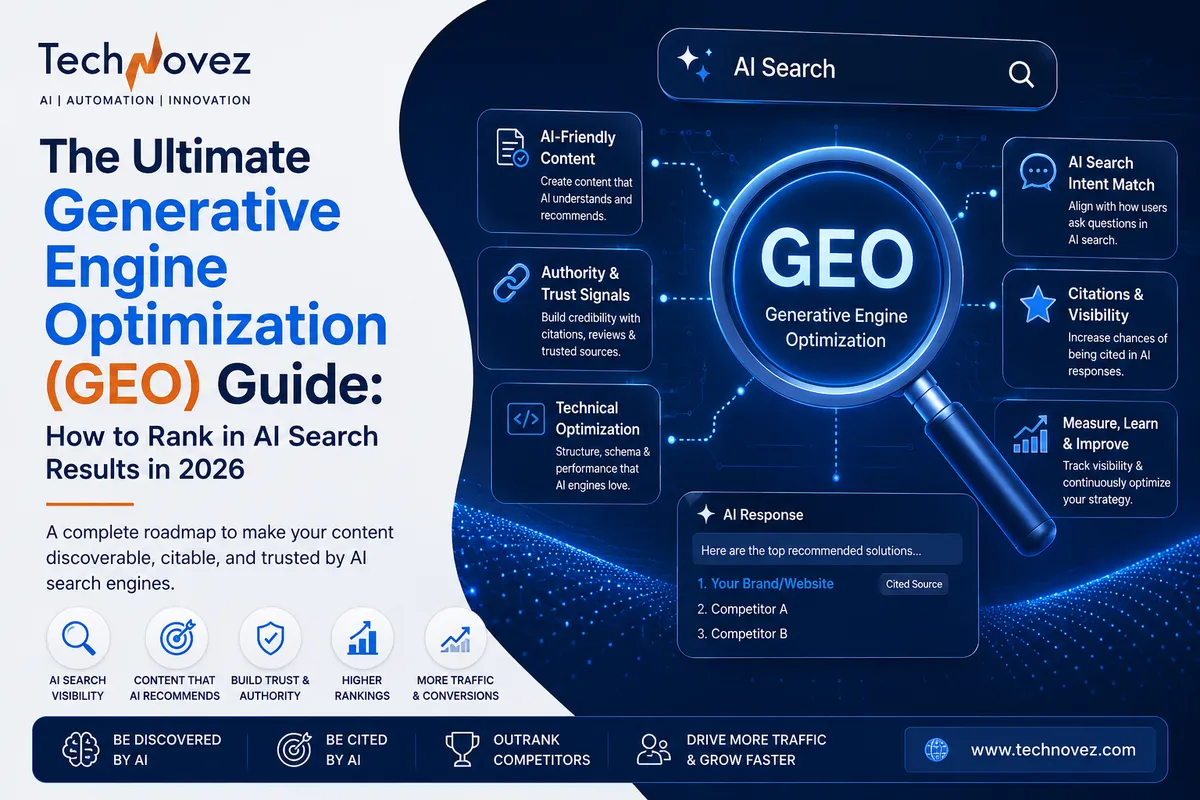
The Complete Enterprise Guide to Winning in AI Search
By the Technovez Editorial Team | AI Search & Enterprise SEO Insights | 2026
| Featured Snippet Answer | Generative Engine Optimization (GEO) is the practice of optimizing content so AI systems like Google AI Overviews, ChatGPT, Microsoft Copilot, Gemini, Claude, and Perplexity can retrieve, understand, and cite it in AI-generated answers. It extends traditional SEO with entity clarity, structured data, and content built for direct answers rather than rankings alone. |
1. Executive Summary
| Quick Answer | GEO has become essential because a growing share of search happens inside AI-generated answers rather than traditional link results, and businesses that aren't optimized for AI retrieval risk losing visibility even when their content ranks well in classic search. |
Search behavior is changing faster than most organizations' content strategies. Google AI Overviews now appear above traditional results for a wide range of queries. ChatGPT, Microsoft Copilot, Gemini, Claude, and Perplexity are increasingly used as first-stop research tools, synthesizing answers from multiple sources instead of returning a list of links to click through.
This shift changes what it means to be found online. Ranking first in traditional search no longer guarantees visibility if an AI system summarizes an answer without citing your page — or cites a competitor instead. Generative Engine Optimization (GEO) is the discipline of making content retrievable, understandable, and citable by these AI systems, alongside continuing to rank well in traditional search.
This guide is a complete, practical reference: what GEO is, how it differs from traditional SEO, how major AI search systems actually retrieve and synthesize information, twelve foundational pillars of GEO practice, a repeatable content framework, technical requirements, and a 90-day implementation roadmap. It's written for marketing leaders, SEO professionals, and technical teams who need to act on this shift, not just understand it conceptually.
Key Takeaways
- GEO extends SEO rather than replacing it — technical SEO fundamentals remain necessary but are no longer sufficient on their own.
- AI search systems prioritize clear entities, direct answers, and structured, well-sourced content over keyword density.
- Structured data and schema markup materially help AI systems understand and trust content, even though implementation details vary by platform.
- Topical authority — comprehensive coverage of a subject area — correlates strongly with AI citation likelihood.
- Measuring GEO success requires new KPIs beyond traditional rankings: AI citations, AI referral traffic, and brand mention frequency.
- A 90-day phased roadmap, starting with a technical and content audit, is a practical way to begin building AI search visibility.
2. What Is Generative Engine Optimization (GEO)?
| Quick Answer | Generative Engine Optimization (GEO) is the practice of structuring and optimizing content so AI-powered search systems can retrieve, interpret, and cite it accurately when generating answers to user queries. |
Traditional search engines return a ranked list of links. Generative AI search systems do something different: they retrieve relevant content from multiple sources, synthesize it into a direct answer, and often cite a small number of sources as supporting evidence. GEO is about earning a place in that synthesis — and in those citations.
How GEO Works
- AI-Generated Answers: Large language models (LLMs) generate a direct response to a query, often drawing on retrieved web content rather than training data alone.
- LLMs: The underlying models — including those powering ChatGPT, Copilot, Gemini, Claude, and Google's AI Overviews — interpret query intent and synthesize retrieved information.
- Knowledge Retrieval: Many AI search systems use retrieval mechanisms to pull current, relevant content from the web before generating a response.
- AI Citations: When an AI system references a specific source in its answer, that's an AI citation — the GEO equivalent of a first-page ranking.
- Entity Understanding: AI systems reason about entities — people, organizations, products, concepts — and their relationships, not just keyword matches.
Why GEO Is Different from SEO
SEO optimizes for ranking algorithms that reward relevance, authority, and user experience signals, with success measured primarily by position in a results list. GEO optimizes for retrieval and synthesis systems that reward clarity, structure, and verifiability, with success measured by whether content gets cited or reflected in an AI-generated answer at all. The two disciplines overlap significantly — both value authoritative, well-structured, helpful content — but GEO adds new requirements specific to how AI systems parse and trust information.
3. Why GEO Matters in 2026
| Quick Answer | GEO matters in 2026 because AI-generated answers increasingly satisfy user queries without a click, meaning businesses that aren't optimized for AI retrieval can lose visibility and traffic even while maintaining strong traditional search rankings. |
- Growth of AI Search: AI-powered search interfaces have moved from novelty to default research tools for a growing share of users.
- Zero-Click Searches: A meaningful share of queries are now answered directly within the search or AI interface, without a click to any website.
- AI Assistants: Copilot, Gemini, and similar assistants are increasingly embedded into everyday productivity tools, extending AI search beyond a dedicated search box.
- Enterprise Visibility: B2B buyers increasingly research vendors and solutions through AI assistants before ever visiting a company's website.
- Brand Authority: Being cited by name in AI answers reinforces brand credibility in a way a ranked link alone does not.
- Customer Acquisition: Early GEO adopters have a visibility advantage while AI search citation patterns are still forming around less-optimized competitors.
- Competitive Advantage: Organizations that treat GEO as a core discipline now are better positioned as AI search share continues to grow.
4. GEO vs Traditional SEO
| Dimension | Traditional SEO | GEO |
| Ranking Factors | Relevance, authority, backlinks, UX signals | Retrieval quality, entity clarity, verifiability |
| Keywords | Central — target keyword and variants | Supporting — natural language and semantic coverage matter more |
| Entities | Secondary consideration | Central — clear entity definitions drive understanding |
| Backlinks | Major ranking factor | Indirect — supports authority signals AI systems may weigh |
| Structured Data | Helps eligibility for rich results | Helps AI systems parse and trust content directly |
| Search Intent | Matched to keyword-driven query patterns | Matched to conversational, question-based queries |
| AI Citations | Not applicable | Primary success metric |
| Topical Authority | Contributes to rankings | Strongly correlated with citation likelihood |
| Content Format | Optimized for scanning and ranking | Optimized for direct extraction and synthesis |
| User Experience | Page experience signals (Core Web Vitals, etc.) | Still relevant — poor UX undermines trust signals |
| Measurement | Rankings, organic traffic, CTR | AI citations, AI referral traffic, brand mentions |
Google Search vs AI Search
| Dimension | Google Search | AI Search |
| Result Format | Ranked list of links with snippets | Synthesized answer with select citations |
| User Behavior | Scans multiple results, clicks several | Reads one synthesized answer, clicks fewer sources |
| Ranking Unit | Individual pages compete for position | Content is one of several sources blended into an answer |
Keyword SEO vs Entity SEO
| Dimension | Keyword SEO | Entity SEO |
| Core Unit | Target keyword and variations | Named entities and their relationships |
| Optimization Method | Keyword placement and density | Clear entity definitions and consistent naming |
| Best Suited For | Classic ranking-based search | AI systems reasoning about concepts and relationships |
5. How AI Search Engines Work
| Quick Answer | Most AI search systems follow a retrieve-then-generate pattern: they retrieve relevant, often recent content from the web or an index, then use an LLM to synthesize that content into a direct answer, frequently citing a small number of sources. |
Google AI Overviews
AI Overviews draw on Google's search index and web ranking signals, generating a synthesized summary above traditional results and typically linking to a handful of supporting sources.
ChatGPT
When browsing or search features are active, ChatGPT retrieves current web content to supplement its trained knowledge, citing sources it draws on directly in its response.
Microsoft Copilot
Copilot integrates Bing's search and indexing infrastructure with LLM-based synthesis, presenting answers with inline citations to source pages.
Gemini
Gemini draws on Google's search and knowledge infrastructure, similarly synthesizing retrieved content into direct answers within Google's AI-powered experiences.
Claude
Claude can retrieve current web content when search is enabled, synthesizing it into a response and citing the specific sources it references.
Perplexity
Perplexity is built around a retrieve-and-cite model by design, prominently displaying source citations alongside its synthesized answers.
Across all of these systems, the common thread is retrieval quality and citation-worthiness: content needs to be discoverable, clearly structured, and trustworthy enough for the system to select and reference it.
6. The 12 Pillars of GEO
| Quick Answer | GEO rests on twelve foundational pillars: entity optimization, semantic SEO, topical authority, content clusters, structured data, schema markup, FAQ optimization, internal linking, digital PR, technical SEO, E-E-A-T, and a fresh content strategy. |
Entity Optimization
Clearly define who and what your content is about — organizations, products, concepts — using consistent naming AI systems can reliably match to real-world entities.
Semantic SEO
Write to cover the full meaning and context of a topic, using natural language variations rather than repeating a single keyword.
Topical Authority
Build comprehensive coverage of a subject area across multiple related pieces of content, signaling depth of expertise.
Content Clusters
Organize related content around a pillar page with supporting articles, connected through internal linking.
Structured Data
Use machine-readable markup that helps AI systems and search engines parse page content accurately.
Schema Markup
Apply Schema.org vocabulary — Article, FAQPage, HowTo, Organization — to make content structure explicit.
FAQ Optimization
Answer specific, commonly asked questions directly and concisely, in a format AI systems can extract cleanly.
Internal Linking
Connect related content with descriptive anchor text, helping both users and AI systems understand topical relationships.
Digital PR
Earn mentions and citations from authoritative external sources, reinforcing entity recognition and trust.
Technical SEO
Ensure content is crawlable, indexable, and fast-loading — AI systems can't cite what they can't access.
E-E-A-T
Demonstrate Experience, Expertise, Authoritativeness, and Trustworthiness through author credentials, sourcing, and accuracy.
Fresh Content Strategy
Keep high-value content current; AI systems favor recently verified information for time-sensitive queries.
7. GEO Content Framework
| Quick Answer | A repeatable GEO content framework moves through ten steps: research, intent mapping, entity research, outline creation, content development, schema implementation, optimization, publishing, monitoring, and refreshing. |
| Step | What Happens |
| 1. Research | Identify target topics based on search demand and AI query patterns, not just keyword volume. |
| 2. Intent Mapping | Determine whether the query is informational, navigational, or transactional, and match content format accordingly. |
| 3. Entity Research | Identify the key entities relevant to the topic and how they relate to your brand and content. |
| 4. Outline Creation | Structure content with clear headings that map to direct-answer sections, not just narrative flow. |
| 5. Content Development | Write clear, well-sourced content that answers the core question before expanding into detail. |
| 6. Schema | Apply appropriate Schema.org markup based on content type (Article, FAQ, HowTo, etc.). |
| 7. Optimization | Refine for semantic completeness, entity clarity, and featured-snippet-style direct answers. |
| 8. Publishing | Publish with clean technical implementation — correct canonical tags, sitemap inclusion, and crawlability. |
| 9. Monitoring | Track AI citations, referral traffic, and traditional rankings to assess performance. |
| 10. Refreshing | Update content regularly to maintain accuracy and freshness signals over time. |
8. Technical GEO Checklist
| Quick Answer | Technical GEO fundamentals include strong Core Web Vitals, full indexability and crawlability, comprehensive structured data, correct canonical tags, complete sitemaps, a properly configured robots.txt, HTTPS, accessibility compliance, and fast page speed. |
☐ Core Web Vitals meet recommended thresholds (LCP, INP, CLS)
☐ All key pages are indexable and not blocked by noindex directives
☐ Site is fully crawlable with no broken internal links
☐ Structured data implemented and validated for key content types
☐ Canonical tags correctly implemented across all pages
☐ XML sitemap is complete, current, and submitted to search consoles
☐ Robots.txt correctly allows access to content meant to be indexed
☐ HTTPS enforced sitewide with no mixed content warnings
☐ Accessibility standards (WCAG) followed for content and navigation
☐ Page speed optimized across desktop and mobile
9. GEO for Enterprise Websites
| Quick Answer | Enterprise GEO requirements vary by sector, but multi-service websites, SaaS platforms, and regulated industries like healthcare and finance all benefit from clear entity structure, dedicated topical hubs, and rigorous E-E-A-T signals. |
Multi-Service Websites
Organize distinct service lines into clearly separated topical clusters so AI systems can match queries to the right offering.
SaaS
Maintain clear product and feature entity definitions, supported by comparison and use-case content that AI systems can cite directly.
B2B
Prioritize topical authority and digital PR, since B2B buyers often research extensively through AI assistants before contacting sales.
Healthcare
Apply rigorous E-E-A-T standards, with clear authorship and sourcing given the sensitivity of health-related AI answers.
Finance
Emphasize accuracy, current data, and clear disclosure given the scrutiny AI systems apply to financial information.
Manufacturing
Use structured data and specification-rich content to support technical, comparison-heavy AI queries.
Professional Services
Build topical authority through case-based educational content that demonstrates real expertise without fabricated claims.
10. Common GEO Mistakes
| Quick Answer | The most common GEO mistakes are keyword stuffing, thin content, ignoring entity clarity, missing schema markup, weak internal linking, outdated content, poor source quality, and a lack of authority signals. |
- Keyword Stuffing: Repeating exact-match keywords unnaturally, which AI systems parse as lower-quality, less trustworthy content.
- Thin Content: Pages that don't fully answer a query in depth are less likely to be selected for synthesis or citation.
- Ignoring Entities: Failing to clearly name and define the people, products, or concepts a page is about.
- No Schema: Skipping structured data makes content harder for AI systems to parse accurately.
- Weak Internal Linking: Isolated pages signal weaker topical relationships than a well-linked content cluster.
- Outdated Content: Stale information is less likely to be trusted or cited for time-sensitive queries.
- Poor Source Quality: Citing weak or unverifiable sources undermines the trust signals AI systems evaluate.
- No Authority Signals: Missing author credentials, citations, or external validation weakens E-E-A-T.
11. Measuring GEO Success
| Quick Answer | GEO success is measured through AI citations, AI referral traffic, featured snippet appearances, brand mention frequency, Knowledge Graph presence, engagement, and conversion rate — alongside traditional organic traffic metrics. |
- AI Citations: How often and how accurately your content is referenced in AI-generated answers.
- Organic Traffic: Traditional search traffic remains a relevant baseline metric alongside AI-specific measures.
- AI Referral Traffic: Traffic arriving from AI platforms that link back to source content.
- Featured Snippets: Appearances in Google's featured snippet format, which often overlaps with AI Overview eligibility.
- Brand Mentions: Frequency of brand name appearances in AI-generated answers, even without a direct link.
- Knowledge Graph Presence: Whether your organization or key entities appear in Google's Knowledge Graph.
- Engagement: Time on page, scroll depth, and interaction signals that reflect content quality.
- Conversion Rate: Whether AI-referred visitors take meaningful action once they reach your site.
12. The Future of GEO (2026–2030)
| Quick Answer | Between 2026 and 2030, expect agentic search that completes tasks rather than just answering questions, deeper AI search personalization, growth in voice and multimodal search, dedicated AI browsers, and AI-driven shopping experiences. |
- Agentic Search: AI systems that don't just answer questions but take action — booking, purchasing, or completing tasks on a user's behalf.
- Personalized AI Search: Answers increasingly tailored to individual user context and history.
- Voice AI: Growing use of voice interfaces for AI-powered search and assistance.
- AI Shopping: AI systems increasingly involved in product research and purchase decisions directly.
- AI Browsers: Browser experiences built natively around AI synthesis rather than traditional link navigation.
- Multimodal Search: Search queries and answers increasingly incorporating images, video, and audio alongside text.
- Enterprise AI Discovery: B2B buyers increasingly discovering and evaluating vendors through internal and external AI tools.
13. How Technovez Helps Businesses
Technovez helps organizations build visibility across both traditional and AI-powered search — combining GEO strategy with the technical and content discipline it requires.
- GEO Strategy: Building a roadmap for AI search visibility aligned with business priorities
- AI Search Optimization: Structuring content and technical infrastructure for AI retrieval and citation
- Enterprise SEO: Maintaining strong traditional search performance alongside AI search visibility
- Technical SEO: Auditing and resolving crawlability, indexability, and structured data gaps
- AI Content Strategy: Developing topical content clusters built for both users and AI systems
- Digital Transformation: Aligning content and search strategy with broader digital transformation goals
- AI Automation: Streamlining content production and monitoring workflows with automation
- Microsoft Copilot Studio: Extending AI visibility work into enterprise AI agent experiences
- Enterprise AI Consulting: Providing broader AI strategy guidance connected to search and content visibility
Enterprise GEO Checklist
☐ Entity definitions clear and consistent across the site
☐ Topical content clusters built around core service areas
☐ Schema markup implemented for Article, FAQ, and Organization types
☐ Internal linking connects related content with descriptive anchors
☐ E-E-A-T signals present: author credentials, sourcing, accuracy
☐ Content refresh cadence established for high-value pages
AI Search Optimization Checklist
☐ Direct-answer sections included at the start of major topics
☐ Content written in natural, conversational language matching query patterns
☐ FAQ sections structured for clean extraction
☐ Featured snippet formatting applied where relevant
☐ Source citations included for factual claims
☐ Brand and entity names used consistently sitewide
Technical GEO Audit Checklist
☐ Core Web Vitals audited and within recommended thresholds
☐ Structured data validated with no critical errors
☐ Crawl budget reviewed for large or complex sites
☐ Canonical tags audited for consistency
☐ Mobile usability confirmed across key templates
☐ Sitemap and robots.txt reviewed for accuracy
Decision Framework: Is Your Website Ready for AI Search?
Use this maturity scoring model to assess AI search readiness. Score each area from 0 (not in place) to 3 (fully implemented and monitored), then total the result.
| Readiness Area | Score |
| Entity clarity and consistent naming | 0–3 |
| Structured data and schema markup coverage | 0–3 |
| Topical authority and content cluster depth | 0–3 |
| Technical SEO health (speed, crawlability, indexability) | 0–3 |
| E-E-A-T signals (authorship, sourcing, accuracy) | 0–3 |
| FAQ and direct-answer content coverage | 0–3 |
| Internal linking structure | 0–3 |
| AI citation and referral traffic monitoring in place | 0–3 |
- 0–8: Early Stage — foundational GEO work has not yet started; begin with a technical and entity audit
- 9–16: Developing — some elements are in place but coverage and structure need work
- 17–20: Established — solid GEO foundation; focus on topical depth and citation monitoring
- 21–24: Advanced — strong AI search readiness; focus on continuous refresh and expansion
The 2026 Enterprise GEO Framework
Enterprise GEO maturity rests on four connected layers: technical foundation, entity and content structure, authority signals, and continuous measurement. Each layer depends on the one before it — authority signals carry little weight if the technical foundation prevents AI systems from crawling the content at all.
| Layer | What It Includes |
| Technical Foundation | Crawlability, indexability, speed, structured data, and accessibility. |
| Entity & Content Structure | Clear entity definitions, topical clusters, and direct-answer content formatting. |
| Authority Signals | E-E-A-T, digital PR, and consistent sourcing that builds AI system trust. |
| Continuous Measurement | AI citation tracking, referral traffic analysis, and a regular content refresh cadence. |
90-Day GEO Implementation Roadmap
| Timeframe | Focus |
| Days 1–15 | Conduct a technical SEO and GEO audit; identify entity, schema, and content gaps. |
| Days 16–30 | Fix critical technical issues; implement core schema markup across key page types. |
| Days 31–45 | Build or update topical content clusters around priority service areas. |
| Days 46–60 | Optimize existing high-value content with direct-answer formatting and FAQ sections. |
| Days 61–75 | Pursue digital PR and authority-building activities to strengthen E-E-A-T signals. |
| Days 76–90 | Set up AI citation and referral traffic monitoring; establish ongoing refresh cadence. |
Quarterly GEO Maintenance Checklist
☐ Review AI citation and referral traffic trends
☐ Audit top-performing pages for freshness and accuracy
☐ Validate structured data across new and updated content
☐ Review and update entity definitions as offerings evolve
☐ Assess new digital PR and authority-building opportunities
☐ Re-run technical SEO health checks (Core Web Vitals, crawl errors)
Enterprise AI Search Readiness Scorecard
Use this scorecard alongside the maturity scoring model above to track readiness by category over time.
| Category | Score |
| Technical Foundation | ___ / 12 |
| Entity & Content Structure | ___ / 12 |
| Authority Signals | ___ / 12 |
| Continuous Measurement | ___ / 12 |
| Overall Readiness | ___ / 48 |
GEO Glossary (40+ Terms)
| Term | Definition |
| Generative Engine Optimization (GEO) | The practice of optimizing content so AI search systems can retrieve, understand, and cite it. |
| AI Overviews | Google's AI-generated summary results shown above traditional search listings. |
| LLM (Large Language Model) | A model trained on large text datasets, capable of understanding and generating natural language. |
| AI Citation | An instance where an AI system references a specific source in its generated answer. |
| Entity | A distinct, identifiable person, organization, product, or concept that AI systems reason about. |
| Entity SEO | Optimization focused on clearly defining and connecting entities rather than keywords alone. |
| Semantic SEO | Optimization for meaning and context rather than exact keyword matches. |
| Knowledge Graph | A structured database of entities and their relationships used by search engines. |
| Structured Data | Machine-readable markup that describes page content in a standardized format. |
| Schema Markup | Structured data implemented using the Schema.org vocabulary. |
| Schema.org | A shared vocabulary maintained collaboratively for structured data markup. |
| Topical Authority | The degree to which a site demonstrates comprehensive expertise on a subject. |
| Content Cluster | A group of related content organized around a central pillar page. |
| Pillar Page | A comprehensive, authoritative page covering a broad topic, linked to supporting content. |
| E-E-A-T | Experience, Expertise, Authoritativeness, and Trustworthiness — Google's content quality framework. |
| Helpful Content | Google's standard for content created primarily to help users rather than to rank. |
| Zero-Click Search | A search query answered directly in the search interface without a click to a website. |
| Featured Snippet | A highlighted direct-answer result shown above standard organic results. |
| Core Web Vitals | Google's page experience metrics measuring loading, interactivity, and visual stability. |
| Crawlability | The degree to which search engine and AI crawlers can access and navigate a site. |
| Indexability | Whether a page is eligible to be included in a search engine's index. |
| Canonical Tag | An HTML element indicating the preferred version of duplicate or similar content. |
| XML Sitemap | A file listing a site's pages to help search engines discover and crawl content. |
| Robots.txt | A file that instructs crawlers which parts of a site they may or may not access. |
| Retrieval-Augmented Generation (RAG) | An architecture pattern where relevant data is retrieved before a model generates a response. |
| Digital PR | Earning media coverage and authoritative mentions to build brand and entity authority. |
| Backlink | A link from an external site to your content, historically a major SEO ranking factor. |
| NLP (Natural Language Processing) | The field of AI focused on understanding and generating human language. |
| Content Freshness | How recently content has been published or meaningfully updated. |
| Internal Linking | Links connecting pages within the same site, reinforcing topical relationships. |
| Search Intent | The underlying goal behind a user's search query — informational, navigational, or transactional. |
| AI Referral Traffic | Website traffic originating from links within AI-generated answers. |
| Brand Mention | An instance where a brand name appears in content or an AI-generated answer, with or without a link. |
| Multimodal Search | Search that incorporates multiple content types, such as text, image, and audio. |
| Agentic Search | AI search that can take action on a user's behalf, not just return information. |
| Voice AI Search | Search conducted and answered through voice interfaces rather than text. |
| Content Chunking | Structuring content into discrete, clearly labeled sections that AI systems can extract independently. |
| Direct Answer | A concise response to a query placed prominently, optimized for extraction by AI systems and snippets. |
| Technical SEO | Optimization of the technical aspects of a site that affect crawlability, indexing, and performance. |
| Organic Traffic | Website visits arriving from unpaid search results. |
| AI Browser | A web browser built around AI-native synthesis and navigation rather than traditional link browsing. |
Frequently Asked Questions
What is Generative Engine Optimization?
GEO is the practice of optimizing content so AI-powered search systems can retrieve, understand, and cite it when generating answers to user queries.
How is GEO different from SEO?
SEO optimizes primarily for ranking position in traditional search results, while GEO optimizes for being retrieved, understood, and cited within AI-generated answers.
How do I rank in ChatGPT?
Focus on clear entity definitions, well-sourced and structured content, and comprehensive topical coverage, since ChatGPT's browsing features retrieve and cite current web content.
How do I appear in Google AI Overviews?
Strong traditional SEO fundamentals combined with clear, direct-answer content and structured data improve the likelihood of appearing in AI Overviews, though inclusion isn't guaranteed by any single tactic.
Does structured data help AI search?
Yes. Structured data helps AI systems parse page content accurately, which supports both understanding and citation.
Can small businesses benefit from GEO?
Yes. Clear entity definitions, direct-answer content, and basic technical SEO health benefit sites of any size, not just large enterprises.
How long does GEO take?
Meaningful results typically take several months, as AI citation patterns depend on consistent authority and content signals building over time, similar to traditional SEO.
What metrics measure GEO success?
AI citations, AI referral traffic, featured snippet appearances, brand mentions, and Knowledge Graph presence, alongside traditional organic traffic metrics.
Is keyword research still relevant for GEO?
Yes, but it should expand to cover natural language and question-based queries, not just exact-match keyword targets.
What is an AI citation?
An AI citation is an instance where an AI-generated answer references a specific source, similar in function to a top search ranking.
Do backlinks still matter for GEO?
Backlinks remain relevant as an authority signal, supporting the trust and E-E-A-T factors AI systems weigh when selecting sources.
What is entity optimization?
Entity optimization is the practice of clearly and consistently defining the people, products, and concepts a piece of content is about.
Should I rewrite all my content for GEO?
Not necessarily. Start by auditing high-value, high-traffic content for entity clarity, structure, and schema gaps before expanding further.
What is topical authority and why does it matter for GEO?
Topical authority is comprehensive coverage of a subject area across multiple pieces of content, and it correlates strongly with AI citation likelihood.
Does GEO replace the need for a content strategy?
No. GEO extends content strategy with AI-specific structural and technical requirements; it doesn't replace the need for genuinely useful, well-researched content.
What schema types matter most for GEO?
Article, FAQPage, HowTo, and Organization schema are commonly relevant starting points, depending on content type.
Can GEO and paid search coexist in a strategy?
Yes. GEO addresses organic AI visibility and works alongside, not instead of, paid acquisition channels.
How often should content be refreshed for GEO?
High-value, time-sensitive content benefits from review at least quarterly; evergreen content can be reviewed on a longer cycle.
What is the biggest mistake companies make with GEO?
Treating GEO as a checklist of technical tweaks rather than building genuinely comprehensive, well-sourced content around clear entities.
Do I need a developer to implement GEO?
Some technical elements, like schema markup and Core Web Vitals fixes, often require developer support, while content and structural changes can often be handled by content teams.
People Also Ask
- What is the difference between SEO and AI SEO?
- How does Perplexity choose which sources to cite?
- Can you track how often your brand appears in AI answers?
- What is the role of Schema.org in AI search?
- How does Microsoft Copilot decide which sources to trust?
- Is traditional SEO becoming obsolete because of AI search?
- What industries are most affected by the shift to AI search?
- How do AI search engines handle conflicting information from different sources?
- What is the relationship between E-E-A-T and GEO?
- Do FAQ pages help with AI search visibility?
- How is content freshness measured by AI search systems?
- What is the difference between a knowledge graph and a vector database?
- Can AI search engines misattribute information to the wrong source?
- How do enterprises track AI referral traffic?
- What role does digital PR play in AI search visibility?
- Is GEO relevant for local businesses?
- How does multimodal content affect AI search rankings?
- What is the difference between agentic search and traditional search?
- How do AI browsers change the concept of a website visit?
- Should companies create separate content strategies for each AI platform?
Related Search Queries
- how to optimize for AI Overviews
- GEO vs SEO explained
- how to get cited by ChatGPT
- AI search ranking factors
- Generative Engine Optimization checklist
- schema markup for AI search
- AI search visibility tools
| Ready to Build Visibility in AI Search Results? | Technovez helps organizations build GEO strategy, AI search optimization, enterprise SEO, technical SEO audits, and AI content strategy — alongside broader AI automation, Microsoft Copilot Studio, and digital transformation initiatives. | Contact Technovez to start with a GEO readiness assessment → www.technovez.com/contact |
Publishing & Technical SEO Notes
Recommended Schema Markup
- Article Schema — headline, author, datePublished, dateModified, publisher
- FAQPage Schema — mapped to the 20 FAQ entries above
- HowTo Schema — mapped to the GEO Content Framework steps
- Organization Schema — Technovez entity, logo, sameAs profiles
- BreadcrumbList Schema — Home > Blog > GEO Guide
- WebPage Schema — page-level metadata supporting AI Overview eligibility
Internal Linking Suggestions
- Homepage anchor text: “Technovez’s enterprise AI and digital transformation services” → https://www.technovez.com/
- Blog anchor text: “more Technovez insights on AI search and Agentic AI” → https://www.technovez.com/blog
- Services anchor text: “our GEO and enterprise SEO services” → https://www.technovez.com/services
- Contact anchor text: “talk to a Technovez GEO strategist” → https://www.technovez.com/contact
- Related article anchor text: “our guide to Agentic AI vs traditional automation” → Technovez Agentic AI article
- Related article anchor text: “how multi-agent orchestration works” → Technovez multi-agent orchestration article
- Related article anchor text: “the Model Context Protocol (MCP) explained” → Technovez MCP article
- Related article anchor text: “our enterprise AI governance checklist” → Technovez AI governance article
- Related article anchor text: “building an AI infrastructure blueprint” → Technovez AI infrastructure article
- Related article anchor text: “scaling AI automation across the enterprise” → Technovez AI automation article
- Related article anchor text: “getting started with Microsoft Copilot Studio” → Technovez Copilot Studio article
Authoritative References to Cite
- Google Search Central
- Google AI Overviews Documentation
- Microsoft Learn
- Microsoft Copilot Documentation
- OpenAI Documentation
- Anthropic Documentation
- Schema.org
- W3C Web Standards
- NIST AI Risk Management Framework
- ISO/IEC 42001
- OECD AI Principles
Note: link directly to the current pages on each of these sites at publication time; do not fabricate specific URLs or citations not verified at time of publishing.
Image SEO
| Element | Detail |
| Hero Image Concept | A visual showing a traditional ranked list of links transforming into a synthesized AI answer bubble, connected by flowing data lines in navy and teal tones. |
| Suggested Featured Image Title | From Rankings to Answers: The Generative Engine Optimization Shift |
| AI Image Generation Prompt | Modern enterprise tech illustration, left side shows a stacked list of ranked link cards fading into the right side showing a glowing synthesized answer bubble with connecting nodes, navy and teal tones; flat corporate style, no text, no logos |
| Alt Text | Illustration showing the shift from traditional ranked search results to AI-generated synthesized answers |
| SEO-Friendly Filename | generative-engine-optimization-geo-guide-2026.jpg |
| Caption | Generative Engine Optimization bridges traditional search rankings and AI-generated answer citations. |
AI-Generated Infographic Ideas
- The 12 Pillars of GEO, visualized as a circular wheel diagram
- GEO vs SEO, visualized as a side-by-side comparison graphic
- The GEO Content Framework, visualized as a 10-step horizontal process flow
- The 90-Day GEO Implementation Roadmap, visualized as a timeline graphic
- The Enterprise AI Search Readiness Scorecard, visualized as a radar/spider chart across four categories
NLP Keyword List
Generative Engine Optimization, GEO, AI search optimization, AI SEO, Google AI Overviews, AI search ranking, ChatGPT SEO, Microsoft Copilot SEO, Perplexity SEO, Gemini SEO, Claude AI search, AI visibility, LLM optimization, entity SEO, semantic SEO, technical SEO, structured data, schema markup, topical authority, content clusters, helpful content, Knowledge Graph, digital PR, AI citation optimization, enterprise SEO, AI content strategy, Core Web Vitals, E-E-A-T, featured snippets, zero-click search.
Featured Snippet Optimization Notes
The Featured Snippet Answer at the top of this document is a direct 40–60 word definition matching Google's preferred featured snippet format. Each major H1 section opens with a Quick Answer callout to support AI Overviews and other GEO citation formats, and the FAQ section is structured for FAQPage schema eligibility with concise, extractable answers.
Content Gap Analysis vs. Leading GEO Resources
- Most existing GEO resources focus narrowly on Google AI Overviews; this guide covers ChatGPT, Copilot, Gemini, Claude, and Perplexity with platform-specific retrieval notes.
- Few competing guides include a scored maturity model; this guide provides both a 0–24 readiness score and a category-based scorecard.
- Most articles treat GEO and SEO as fully separate disciplines; this guide explicitly maps overlap and divergence across three comparison tables.
- This guide includes a 40+ term glossary and a 90-day implementation roadmap, both of which are rare in existing published GEO content.
- Opportunity: a companion technical deep-dive on schema implementation patterns by content type could extend topical authority further.
Technical GEO Audit Template
Use this template to structure a technical GEO audit for any enterprise website.
| Audit Item | Notes |
| Site/Page Audited | ___________________________ |
| Core Web Vitals (LCP / INP / CLS) | ___________________________ |
| Indexability Status | ___________________________ |
| Structured Data Present (Y/N, Types) | ___________________________ |
| Canonical Tag Status | ___________________________ |
| Sitemap Inclusion (Y/N) | ___________________________ |
| Robots.txt Access Status | ___________________________ |
| HTTPS Status | ___________________________ |
| Accessibility Issues Identified | ___________________________ |
| Entity Clarity Assessment | ___________________________ |
| Topical Cluster Fit | ___________________________ |
| E-E-A-T Signals Present | ___________________________ |
| Priority Fixes Identified | ___________________________ |
Social Media Assets
LinkedIn Article Summary
Search is shifting from ranked links to AI-generated answers. This guide breaks down Generative Engine Optimization (GEO) — what it is, how it differs from traditional SEO, how major AI search systems retrieve and cite content, and a practical 90-day roadmap for building AI search visibility. Written for marketing leaders, SEO professionals, and technical teams who need to act on this shift now.
LinkedIn Post
Ranking #1 doesn't mean much if an AI system summarizes the answer without ever citing you.
That's the shift GEO — Generative Engine Optimization — is built for: making content retrievable, understandable, and citable by ChatGPT, Google AI Overviews, Copilot, Gemini, Claude, and Perplexity, not just rankable in classic search.
Our most comprehensive guide yet covers the 12 pillars of GEO, a repeatable content framework, technical requirements, and a 90-day implementation roadmap.
Full guide → link in comments.
#GEO #AISearch #SEO #GenerativeEngineOptimization #EnterpriseAI
Facebook Post
Is your website actually visible in AI search — or just ranking in a results page fewer people scroll through anymore? Our most comprehensive guide yet covers Generative Engine Optimization (GEO): what it is, how it works, and a complete 90-day roadmap. Read it here →
Medium Introduction
For twenty years, being found online meant ranking on a results page. That's no longer the whole picture. Google AI Overviews, ChatGPT, Microsoft Copilot, Gemini, Claude, and Perplexity increasingly answer questions directly — synthesizing information from multiple sources and citing only a few of them. Generative Engine Optimization (GEO) is the discipline of making sure your content is one of the sources chosen. This guide covers what GEO actually is, how it differs from and builds on traditional SEO, how the major AI search systems work under the hood, twelve foundational pillars of GEO practice, and a complete implementation framework — including a 90-day roadmap for teams ready to act on it.